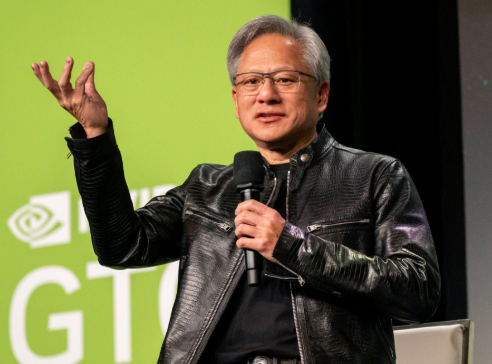
Following a historic tech selloff that erased over $1 trillion in global market value, nervous shareholders finally received a definitive roadmap from the architect of the AI boom. Speaking at an investor conference following the recent market turbulence, Nvidia Corp. Chief Executive Officer Jensen Huang delivered a clear message to the street: look past the panic, because this Nvidia AI stock dip represents a massive, generational buying opportunity.
Consequently, Huang’s reassuring stance helped stabilize global markets, transforming a wave of broader tech anxieties into a calculated moment for accumulation. Rather than signaling a structural end to the artificial intelligence expansion, the billionaire executive argued that the Nvidia AI stock dip is simply a short-term correction before a massive, multihundred-billion-dollar wave of agentic computing deployment takes hold.
The core of investor panic stems from fears that the world’s largest cloud providers including Microsoft, Amazon, and Alphabet might soon scale back their massive data center capital expenditures. However, Huang flatly dismissed these sustainability concerns during his address. He clarified that the market is currently transitioning from an early training phase into an active execution phase.
This technological evolution is driving massive hardware demands:
- The Rise of Agentic AI: Artificial intelligence is moving beyond basic chatbots to deploy local, autonomous software agents capable of executing complex, multi-step actions.
- The Computing Double-Whammy: While standard graphics processing units (GPUs) are required to build and train these data models, managing active agent behaviors requires a secondary, massive wave of central processing units (CPUs).
- The Scale Realities: Over the past twelve months, the total number of partner data centers operating at a high-density capacity exceeding 10 megawatts has almost doubled.
Market Realities: Valuations and the New $200 Billion Target
To back up his optimistic outlook, Huang pointed directly to Nvidia’s structural product roadmap. While the current market correction temporarily lowered Nvidia’s forward price-to-earnings multiple to a highly competitive 24x, the company’s long-term growth vectors remain entirely untouched.
Nvidia Post-Correction Market Indicators (June 2026)
| Financial and Valuation Metric | Current Performance Status | Strategic Long-Term Outlook |
| Forward P/E Multiple | 24x (Significantly de-risked) | Well below historical valuation peaks |
| PEG Multiple (5-Year) | 0.65x (Indicates undervalued asset) | Sits comfortably below the standard 1.0 threshold |
| New Addressable Market | $200 Billion | Unlocked entirely by the new Vera CPU chip platform |
| Full-Year Revenue (FY26) | $215.9 Billion | Represents a massive 65% year-over-year surge |
The primary driver of this future revenue growth is Nvidia’s brand-new Vera CPU platform, which is scheduled to begin shipping in the third quarter of this year. Specifically tailored to act as the primary brain for autonomous software agents, the Vera chip opens up a massive $200 billion total addressable market that Nvidia has never gone after before.
Re-Engineering Corporate Incentives and Executive Conviction
Demonstrating immense internal confidence, Nvidia’s board of directors recently adjusted its corporate incentive programs to align with these aggressive scaling targets. According to recent regulatory filings, the compensation committee finalized a new variable pay structure for fiscal year 2027 that ties executive rewards directly to high revenue milestones, setting a target cash bonus of $4 million for Huang. Ultimately, the takeaway for the broader financial community is a lesson in long-term perspective. While short-term programmatic trading models and macroeconomic interest rate fears can trigger sudden, sharp selloffs, the underlying fundamental demand for high-density computing infrastructure is still early in its journey. By building the specialized silicon needed to power the next generation of digital workers, Nvidia is turning a temporary market panic into its next major launching pad.