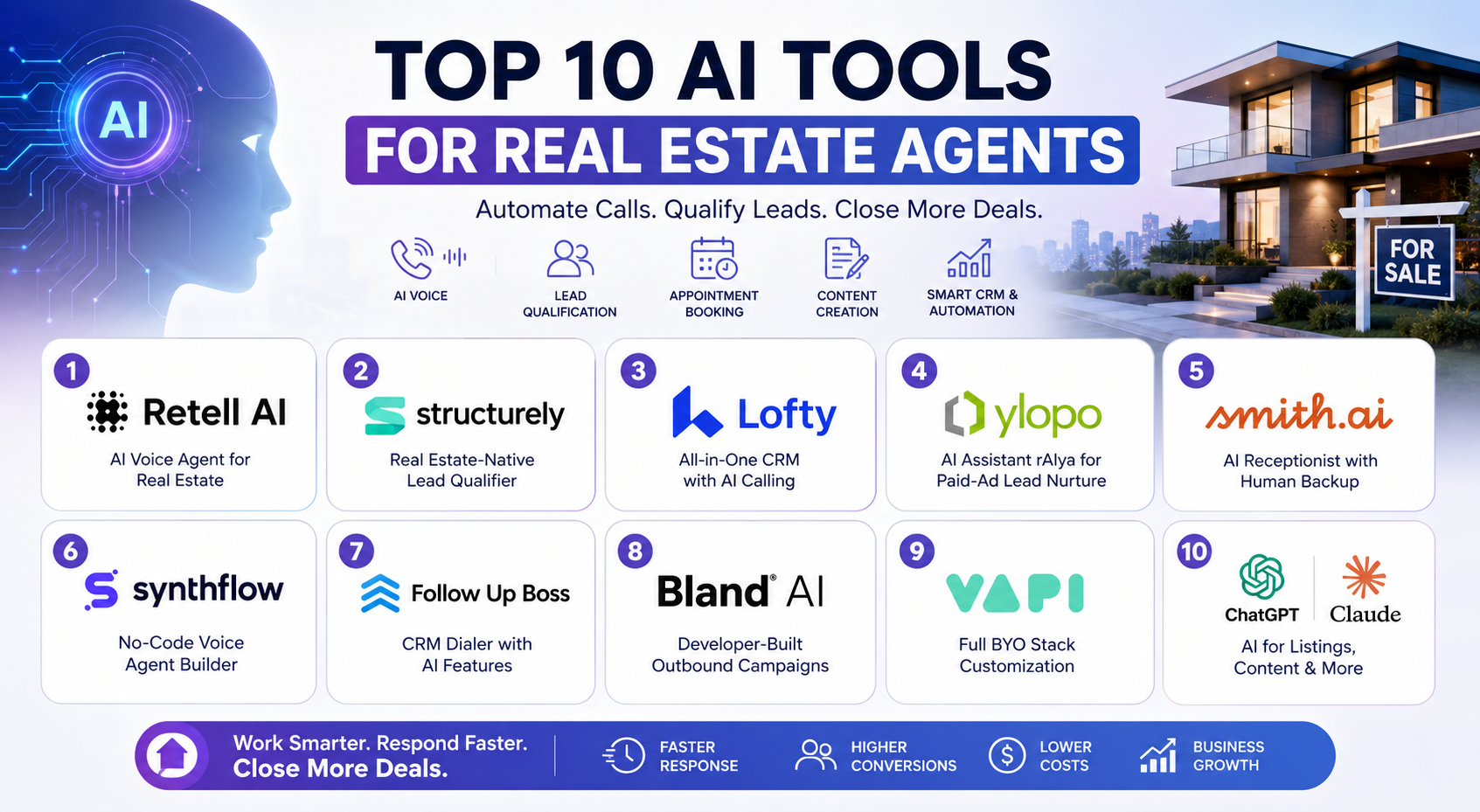
Real estate is undergoing an AI revolution. Voice agents to assist in call center operations, content writing software to draft listings, and other applications of AI have the potential to drastically reduce lead times from days to minutes while allowing firms to expand without employing additional workers. In this guide, we focus on presenting the top 10 AI tools for real estate agents, explain their functionality, and provide tips for purchasing.
Why do agents need AI now?
Prompt response is one of the most straightforward factors that influence conversions within the realm of real estate. The process of engaging with leads in conversation by calling, qualifying, scheduling property viewing appointments, and writing property descriptions becomes automated by means of AI tools.
This saves on manpower, increases promptness, and allows real estate agents to engage more effectively with potential clients. It is no coincidence that the conversational AI industry is developing at an astounding pace.
Top 12 AI Tools for Real Estate Agents
Here is a list of the top 10 AI tools for real estate agents based on their unique features and capabilities. In each case, we have highlighted how the tool performs in a particular area, its target audience, its advantages and disadvantages, and its pricing structure.
1. Retell AI: The best AI voice agent for real estate
What it does: Retell AI runs human-quality voice agents for inbound and outbound calls, with real-time function calls into calendars and CRM systems.
Best for: Solo agents, teams, and brokerages that want pay-as-you-go voice automation without large monthly minimums.
Why choose it: Low-latency conversations (sub-700ms), SIP trunking support, bring-your-own-LLM options, and usage-based pricing. Practical setups can answer calls instantly and book appointments live.
Drawbacks: Requires initial flow design to achieve advanced multi-turn qualification.
Pricing structure: Pay-as-you-go model with no platform fee, a signup credit, and free concurrent calls included. A typical solo agent with moderate call volume lands at a cost well below the fixed monthly tiers of real-estate-native AI tools.
2. Structurely: The best real estate-native lead qualifier
What it does: Structurely’s AI ISA engages leads via SMS, email, web chat, and voice and runs long-term nurture sequences for up to 12+ months.
Best for: Teams generating large volumes of online leads who need a turnkey ISA replacement.
Why choose it: Real-estate-focused scripts, long-term nurture cadence, strong CRM integrations, and pre-tuned buyer/seller/renter flows.
Drawbacks: Higher entry-tier monthly costs, multi-month commitments, and setup fees on some plans; voice latency slightly higher than infrastructure-tier platforms.
Pricing structure: Tiered monthly plans based on lead volume, with a setup fee and minimum commitment on certain plans.
3. Lofty: The Best all-in-one CRM with AI calling
What it does: Lofty bundles CRM, IDX sites, lead gen, and an AI assistant that handles text, email, and voice.
Best for: Teams that want a single vendor for CRM, lead-gen, and AI without stitching tools together.
Why choose it: Predictive analytics that rank likely transactors, integrated web and ad management, and built-in AI features across channels.

Drawbacks: Platform lock-in, steep tier jumps for growing teams, and a learning curve for onboarding.
Pricing structure: Per-user monthly plans with add-ons for dialler and calling; tiered pricing for 10-user and 30-user packages. A free trial is available.
4. Ylopo (rAIya): The best for paid-ad lead nurture
What it does: Ylopo manages paid lead generation, and hands leads to its AI assistant rAIya for long-term text and voice nurture.
Best for: Teams running Facebook/Google lead-gen at scale who want automated engagement without heavy manual follow-up.

Why choose it: High text response rates, long-tail re-engagement behavior, and bundled ad management.
Drawbacks: Tighter coupling to Ylopo’s ad stack and higher monthly costs for full service.
Pricing structure: AI assistant plans start at a mid-range monthly fee; full ad-management packages run higher, excluding ad spend.
5. Smith.ai AI Receptionist: Best AI plus human backup
What it does: Smith.ai combines AI intake with human receptionists for escalation when calls need a live touch.
Best for: Brokerages and agents who want hybrid coverage, AI for volume, humans for complex or sensitive calls.
Why choose it: Escalation to North America-based live agents, strong integrations, flexible coverage models, and no setup fee or contract.
Drawbacks: Costs can inflate when AI hands calls to live agents; per-call and plan limits matter at high volume.
Pricing structure: AI Receptionist plans start at a low monthly rate for a limited number of calls; live receptionist tiers cost more and are call-based.
6. Synthflow: Best no-code voice agent builder
What it does: Synthflow offers a visual, no-code builder with bundled telephony and ElevenLabs voices for quick agent creation.
Best for: Non-technical agents who want a custom voice agent without engineering overhead.
Why choose it: Fast build times, real estate templates, and included TTS voices.
Drawbacks: Add-ons and scaling can increase final per-minute costs; volume pricing reserved for enterprise.
Pricing structure: Monthly base plan with pay-as-you-go voice pricing; all-in production costs typically fall in a higher per-minute range once extras are added.
7. Follow Up Boss: The best CRM dialer with AI features
What it does: Follow Up Boss is a CRM-first tool with a dialler and AI writing assists that adapt to an agent’s voice.
Best for: Teams that need CRM capabilities first and AI drafting as an enhancement.
Why choose it: Deep real-estate adoption, AI-generated replies in your voice, and solid dialler add-ons.

Drawbacks: AI is assistive rather than autonomous; outbound automation is not at the level of specialised voice agents.
Pricing structure: Per-user monthly plans with optional dialer add-ons; higher-tier plans for larger teams. A 14-day free trial is available.
8. Bland AI: The best for developer-built outbound campaigns
What it does: Bland AI is a developer-focused voice platform for batch dialing, structured pathways, and high-volume outbound work.
Best for: Engineering teams running thousands of outbound calls each month who need deterministic scripts.
Why choose it: Predictable flow control, HIPAA and SOC 2 compliance, and scalable batch campaign features.
Drawbacks: Higher latency than infrastructure-tier platforms and a developer lift required to maintain flows.
Pricing structure: Build and scale monthly plans with effective per-minute rates after add-ons; failed outbound calls may incur a minimum charge.
9. Vapi: Best for full BYO stack customization
What it does: Vapi is a toolkit where you bring your own LLM, TTS, STT, and telephony to build fully customisable voice agents.
Best for: Agencies and engineering-heavy teams that need granular control over each component.
Why choose it: Maximum customisation, real-time interruption detection, and choice of AI components.
Drawbacks: Headline costs are misleading—real all-in costs depend on chosen LLM/TTS and telephony providers, and engineering maintenance is required.
Pricing structure: Base platform rate plus component costs; real production costs typically land in a higher per-minute range. A healthcare add-on for HIPAA is available as a separate monthly fee.
10. ChatGPT and Claude: Best general AI for listings and content
What they do: ChatGPT (OpenAI) and Claude (Anthropic) create listing descriptions, social posts, email sequences, market reports, and contract summaries.
Best for: Every agent who needs fast, polished content for marketing and operations.
Why choose them: Easy setup, powerful content generation, and features tuned for bulk tasks like listing copy.
Drawbacks: Not a substitute for autonomous voice agents or CRM-driven qualification; still requires prompt design and review.
Pricing structure: Free tiers are available with paid upgrades for higher usage and specialised features.
11. Magic Hour: Best for professional real estate marketing video customization
What it does: Magic Hour is an all-in-one browser-based AI video platform featuring a powerful Magic Hour AI face swap tool, talking photos, lip-syncing, and image-to-video generators.
Best for: Agents and real estate content creators who want to quickly personalize property walkthrough videos, create high-quality professional headshots, or insert themselves into trending video formats without reshooting.
Why choose it: Exceptional blending on real video footage with zero edge artifacts, built-in lip sync for localized video ads, an AI headshot generator for team branding, and a completely watermark-free free tier.
Drawbacks: Not a standalone CRM or voice-dialing solution; primarily focused on creative marketing media rather than lead follow-ups.
Pricing structure: Free tier available with 400 credits; Creator plans start at $10/month (billed annually) for commercial use and higher resolution outputs, along with scalable API options for development teams.
12. JustCall: Best AI calling and follow-up platform for real estate agents
What it does: JustCall combines business calling, SMS, WhatsApp, AI voice agents, and CRM integrations in one platform. Its AI can answer inquiries, qualify callers, book appointments, and transfer conversations to a human when needed.
Best for: Agents and teams that want to respond to inbound leads quickly while keeping outbound follow-up and conversation history in one workflow.
Why choose it: The platform supports inbound and outbound calls, appointment booking, automated follow-up texts, call summaries, and CRM syncing. AI voice agents can be launched with no-code setup and handle multiple calls at once.
Drawbacks: Teams looking only for content generation or a standalone CRM may find its broader communications focus unnecessary.
Pricing structure: JustCall offers a 14-day AI trial without requiring a credit card; see the vendor for current plan details.
How to choose among the Top 10 AI Tools for Real Estate Agents
- Use case first: If your pain point is missed calls and lead qualification, prioritise voice agents (Retell, Structurely, and Synthflow). If content and admin are the bottleneck, choose ChatGPT or Claude.
- Volume and budget: Pay-as-you-go voice platforms (Retell, Synthflow) scale more predictably for low-to-moderate minutes. Heavy outbound campaigns favour developer platforms (Bland, Vapi) if you have engineering resources.
- Integration needs: If you want a single vendor for CRM + AI, consider Lofty. If you already have Follow Up Boss or another CRM, choose voice-first tools that offer CRM webhooks and native sync.
- Hybrid vs. hands-off: Smith.ai’s hybrid model avoids missed escalations by routing difficult calls to humans. Fully autonomous systems cut labour costs but need well-designed flows.
- Long-term nurture: For paid-ad funnels and long-tail re-engagement, Ylopo’s rAIya shows strong results, especially for teams running continuous ad spend.
Final thoughts
The top 10 AI tools for real estate agents is an indication of the number of dedicated solutions that can help you automate the process of voice, lead qualification, CRM integration, and content creation. It depends on several factors what you can use to maximize automation efforts.
The right solution would be one that meets your volume, technology stack, budget, and area needing most automation. Start with small trials to measure speed-to-lead and booking-cost-per-showing.