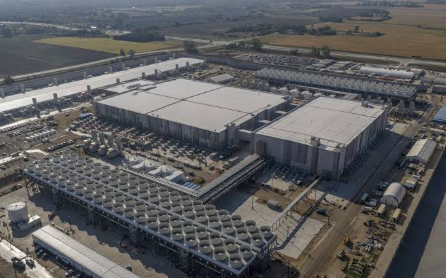
The massive, cross-country expansion of artificial intelligence infrastructure is fast colliding with local community standards and basic residential property rights. Across the United States, tech titans are racing to build massive server compounds, presenting them to state officials as clean investments that bring jobs and digital growth. However, as these facilities go fully operational, local neighborhoods are waking up to a harsh physical reality. In a major federal legal challenge detailed by The Independent, three residents of Racine County, Wisconsin, have filed a proposed class-action lawsuit against Microsoft. The legal filing alleges that the tech giant’s newly opened “Fairwater” facility emits an unreasonable, constant acoustic intrusion, highlighting the heavy hidden toll of data center noise complaints on local communities.
The lawsuit, filed in the U.S. District Court for the Eastern District of Wisconsin, changes the public narrative surrounding Microsoft’s massive $4.7 billion investment in Mount Pleasant. The 315-acre campus includes three massive buildings spanning 1.2 million square feet, marketed by the developer as an “AI superfactory.” Yet, according to nearby residents, the facility functions as a massive, non-stop industrial drone. Legal representatives for the plaintiffs estimate that the ongoing noise disruption impacts over 1,000 households living within a mile and a half of the complex, sparking a significant legal battle over the acoustic limits of the cloud.
1. Anatomy of an Acoustic Intrusion: The Constant Low-Frequency Hum
To understand the core of these data center noise complaints, one must look past simple decibel readings and examine the distinct tonal quality of the sound generated by high-density computing clusters. The primary sources of the persistent drone are the massive industrial cooling fans and emergency backup generators required to keep thousands of AI processing units from overheating. Unlike typical random noises from a highway or airport, the cooling systems emit a constant, low-frequency tonal hum that vibrates continuously through the air.
According to the legal complaint, this persistent drone penetrates directly through standard residential drywall and double-paned glass. The steady hum is especially noticeable during late-night hours when ambient neighborhood noise drops, creating an unavoidable acoustic background that local families cannot escape.
2. Downstream Disturbance: Shifting Shifts and Ruined Backyards
The federal complaint outlines the severe, day-to-day toll this ongoing sound pollution takes on nearby families, proving that the digital expansion of the cloud carries immediate human costs.
Residential Displacement and Impact Metrics
| Plaintiff / Resident Group | Proximity to Campus | Primary Life Disruption | Property Outlook Impact |
| Garret Ostergaard | Within 1.5 miles | Forced to switch from 3rd to 2nd work shift due to severe sleep loss | Reduced resale value and neighborhood appeal |
| David & Joy Wade | Within 1.5 miles | Total loss of backyard use due to persistent, invading drone | Inability to comfortably enjoy outdoor property |
| 1,000 Neighboring Homes | 1.5-mile radius zone | Pervasive sleep disruption and ongoing acoustic fatigue | Collective reduction in regional property value |
The personal accounts in the filing demonstrate how an industrial project can quickly disrupt a community. For instance, plaintiff Garret Ostergaard was forced to completely alter his employment routine, moving from his long-held night shift to an afternoon schedule because the non-stop morning humming made it impossible to get healthy rest. Meanwhile, neighbors David and Joy Wade testified that the constant, heavy drone has effectively ruined their ability to relax in their own backyard, trapping them inside their home to escape the noise.
3. The Corporate Defense: Technical Tinkering vs. Living Room Realities
Microsoft was well aware of the community tension brewing around its Mount Pleasant superfactory months before the class action was filed, and its internal corporate statements highlight a deep gap between technical compliance and real-world conditions. In official community updates published to its local blog, Microsoft acknowledged that bringing equipment online at the facility created a prominent, tonal hum. The company claimed its engineers manually adjusted fan speeds and installed sound-dampening components to fully resolve the issue.
However, the filing of this federal lawsuit proves that these adjustments fell short for the surrounding community. While the facility may technically meet local zoning codes on paper, the unique, traveling quality of low-frequency sound ignores basic property lines, leaving neighbors with an ongoing nuisance that software patches cannot fix.
The New Frontier of Infrastructure Litigation
The unfolding class action in Wisconsin sets a vital legal precedent for the global technology sector. As tech companies invest billions to build processing hubs near residential power grids, the clash in Mount Pleasant proves that communities are no longer willing to accept unlimited noise pollution in the name of digital progress.
Until tech developers design data infrastructure with thick, underground acoustic shielding and advanced silent cooling setups, the physical hum of the cloud will keep running into fierce resistance from the homeowners forced to live in its shadow.