Electric vehicles have earned a reputation for being cheaper to run than conventional cars. They require less maintenance, eliminate oil changes, and deliver impressive performance with instant acceleration. But there is one ownership cost that continues to surprise many first-time EV buyers: tires.
Across Europe, North America, and Asia, tire manufacturers and fleet operators are seeing a growing trend. Electric vehicles are wearing out tires faster than comparable gasoline or diesel models. While some drivers manage to get similar mileage from their tires, many report needing replacements significantly sooner than expected.
This isn’t because EVs are poorly designed. In fact, the very features that make them enjoyable to drive also place greater demands on their tires.
As global EV adoption continues to accelerate, understanding why tire wear happens has become increasingly important for consumers, manufacturers, and tire companies alike.
More Weight Means More Pressure on the Road
The biggest factor behind faster tire wear is simple physics.
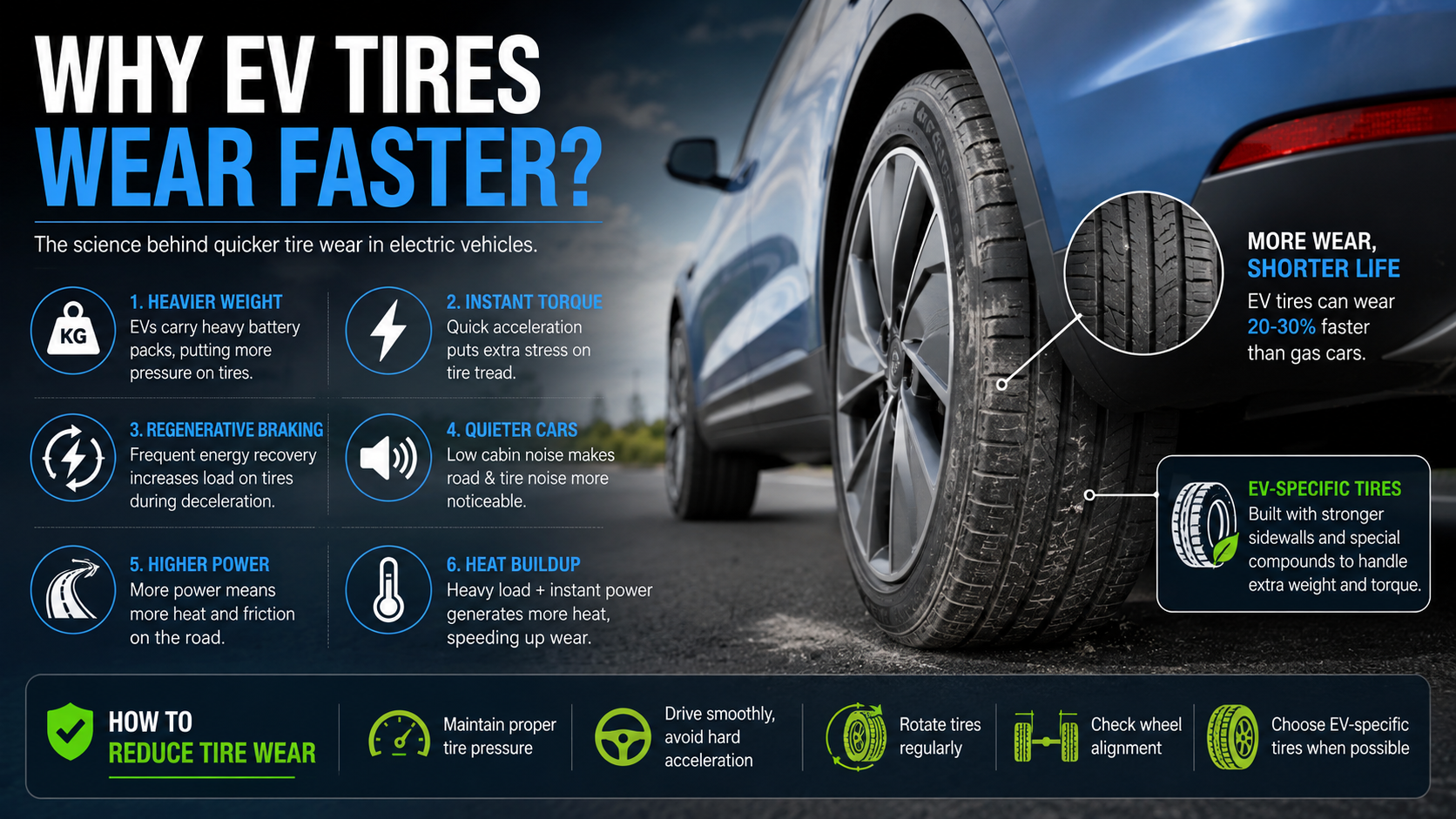
Electric vehicles carry large battery packs beneath the floor. Depending on the model, these batteries can weigh anywhere from 300 to more than 700 kilograms. Even though automakers use lightweight materials elsewhere, many EVs still end up weighing hundreds of kilograms more than similar combustion-engine vehicles.
That extra mass is constantly pressing down on the tires.
Every time the vehicle accelerates, brakes, or corners, the tires absorb greater loads. More pressure means more friction between the rubber and the road surface, causing the tread to wear down more quickly.
For example, an electric SUV weighing over 2.4 tonnes naturally places more stress on its tires than a lighter crossover powered by a conventional engine.
Manufacturers have strengthened suspensions and optimized weight distribution, but the laws of physics remain unchanged. More weight inevitably translates into greater tire stress.
Instant Torque Changes Everything
One of the defining characteristics of electric cars is instant torque.
Unlike internal combustion engines, which gradually build power as engine speed increases, electric motors deliver maximum torque almost immediately. This makes even family-oriented EVs feel remarkably quick off the line.
While drivers love that effortless acceleration, tires experience it very differently.
The sudden transfer of power places immense force on the contact patch where the tire meets the road. Every rapid start, aggressive overtake, or spirited launch removes tiny amounts of rubber.
Performance EVs amplify this effect even further.
Vehicles capable of reaching 100 km/h in under four seconds generate forces that were once limited to sports cars. Even when traction control manages wheelspin effectively, the tires still experience considerably more stress.
This is one reason why enthusiastic driving can noticeably shorten tire life in electric vehicles.
Regenerative Braking Adds a New Dimension
Many people assume regenerative braking reduces tire wear because it decreases the use of conventional brakes.
The reality is more nuanced.
Regenerative braking uses the electric motor to slow the vehicle while recovering energy for the battery. Although this reduces brake pad wear dramatically, it changes how forces are transferred through the tires.
When drivers frequently use one-pedal driving or strong regenerative braking settings, the tires repeatedly handle both acceleration and deceleration forces.
The result is a different wear pattern compared to traditional vehicles.
Tire manufacturers are now studying these patterns closely as EV adoption grows, using real-world driving data to refine future tire designs.
Quiet Cars Make Tire Noise More Noticeable
Electric vehicles are exceptionally quiet.
Without an internal combustion engine producing constant noise, sounds that previously went unnoticed become much more apparent.
One of those sounds comes from the tires.
Drivers often mistake increased road noise as a sign of tire deterioration, even when tread wear remains within normal limits. At the same time, tire makers face the difficult challenge of balancing grip, durability, and acoustic comfort.
Creating quieter tires sometimes requires softer compounds or specialized tread patterns, both of which can influence longevity.
Modern EV-specific tires therefore incorporate foam inserts, optimized grooves, and computer-designed tread blocks to reduce cabin noise without compromising safety.
Tire Manufacturers Are Designing Specifically for EVs
The growing popularity of electric vehicles has led to an entirely new category of tires.
Instead of adapting existing products, manufacturers are developing tires specifically engineered for electric cars.
These tires typically focus on several priorities:
- Higher load capacity for heavier vehicles
- Lower rolling resistance to maximize driving range
- Stronger sidewalls for improved stability
- Reinforced construction to handle instant torque
- Reduced road noise
Major tire brands now offer EV-focused product lines that aim to improve efficiency without sacrificing durability.
Although these tires generally cost more than standard replacements, they are engineered to withstand the unique demands electric vehicles place on them.
Driving Style Has a Bigger Impact Than Many Realize
Not every EV owner experiences rapid tire wear.
In fact, driving habits often make the biggest difference.
Drivers who accelerate gently, maintain steady speeds, and avoid sudden braking typically see significantly longer tire life than those who regularly exploit the instant performance available from electric motors.
Smooth throttle inputs reduce unnecessary stress on the tread.
Similarly, anticipating traffic and avoiding harsh cornering helps preserve rubber over thousands of kilometres.
Fleet operators have observed noticeable differences between vehicles driven conservatively and those used aggressively, even when they are identical models operating under similar conditions.
Tire Pressure Matters More in EVs
Proper tire inflation has always been important, but it becomes even more critical with heavier electric vehicles.
Underinflated tires flex more as they roll, generating additional heat and increasing rolling resistance.
This accelerates tread wear while simultaneously reducing driving range.
Overinflated tires present another problem. They reduce the tire’s contact area with the road, leading to uneven center wear and potentially compromising grip on wet surfaces.
Because EVs place greater loads on each tire, maintaining the recommended pressure can have a significant impact on both efficiency and longevity.
Many modern electric vehicles include advanced tire pressure monitoring systems, but drivers should still perform regular manual checks, particularly during seasonal temperature changes.
Wheel Alignment Is Often Overlooked
Even minor alignment issues can shorten tire life.
If the wheels are slightly out of specification, tires may scrub against the road instead of rolling smoothly.
On heavier EVs, that effect becomes even more pronounced.
Misalignment often develops gradually after hitting potholes, speed bumps, or rough roads.
Uneven wear appearing on the inner or outer edges of the tread is usually one of the first warning signs.
Routine alignment inspections can extend tire life considerably while improving handling and efficiency.
Performance Versus Longevity
Consumers increasingly expect electric cars to deliver impressive acceleration while also offering low operating costs.
Unfortunately, those goals sometimes conflict.
High-performance tires provide exceptional grip but generally wear faster.
Harder compounds last longer but may reduce traction, especially during wet weather.
Automakers must carefully balance these competing priorities when selecting factory-installed tires.
Some premium EVs prioritize sporty handling, while others emphasize maximum driving range and longer tread life.
As battery technology evolves and vehicle weights gradually decrease, manufacturers hope to improve this balance further.
Climate and Road Conditions Also Play a Role
Environmental factors influence tire wear regardless of powertrain.
High temperatures soften rubber compounds, increasing wear rates.
Rough asphalt surfaces generate more friction than smooth pavement.
Frequent stop-and-go urban driving also accelerates tire degradation compared with steady highway cruising.
Regions with poor road maintenance can be especially demanding on EV tires due to potholes and uneven surfaces.
Drivers living in these areas may naturally replace tires more frequently than those operating on well-maintained roads.
New Materials Are Changing the Industry
The tire industry is investing heavily in research to address the unique challenges posed by electric vehicles.
Engineers are experimenting with advanced silica compounds, synthetic rubber blends, recycled materials, and innovative tread designs.
Artificial intelligence and digital simulation now allow manufacturers to predict tire wear before physical prototypes are built.
Some companies are even testing sensors embedded inside tires that continuously monitor temperature, pressure, load, and remaining tread depth.
These smart tire systems could eventually alert drivers before excessive wear becomes a safety concern.
Such innovations may also help reduce waste by ensuring tires are replaced only when necessary rather than according to fixed schedules.
Can Drivers Make Their Tires Last Longer?
While EV owners cannot change the weight of their vehicle, they can significantly influence tire life through everyday habits.
A few practical steps can make a meaningful difference:
- Accelerate progressively instead of using full power at every traffic light.
- Check tire pressure at least once a month.
- Rotate tires according to the manufacturer’s schedule.
- Have wheel alignment inspected regularly.
- Avoid carrying unnecessary cargo that increases vehicle weight.
- Slow down before potholes and rough road surfaces.
- Choose replacement tires specifically designed for electric vehicles when available.
Following these practices not only extends tire life but can also improve efficiency and driving range.
The Cost Question
Replacement tires for electric vehicles are often more expensive than conventional alternatives.
Their reinforced construction, specialized compounds, and low rolling resistance technologies contribute to higher manufacturing costs.
However, analysts note that overall ownership expenses for EVs remain competitive because drivers typically spend less on fuel, routine servicing, engine maintenance, and brake replacements thanks to regenerative braking.
As production volumes increase and competition grows, EV tire prices are expected to become more affordable over the coming years.
Looking Ahead
Electric vehicles are reshaping nearly every part of the automotive industry, and tires are no exception.
What was once considered a simple replacement item has become a highly engineered component designed specifically for heavier, quieter, and more powerful vehicles.
Future battery technologies may reduce vehicle weight, while advances in tire materials promise greater durability without compromising efficiency or grip.
For now, faster tire wear remains one of the few trade-offs associated with electric mobility. Fortunately, it is also one that manufacturers are actively addressing through innovation, and one that drivers can manage through smarter maintenance and driving habits.
As electric vehicles become the new normal on roads around the world, tire technology will continue evolving alongside them. The result is likely to be safer, longer-lasting, and more efficient tires that help maximize the benefits of electric transportation while minimizing one of its most talked-about ownership challenges.