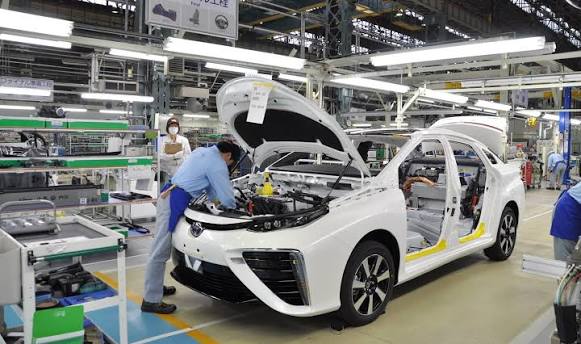
Japan’s biggest automakers are exploring a new way to stay competitive in an industry being reshaped by electrification, software, and connected technologies. Instead of each company independently developing every component, manufacturers are now discussing the possibility of sharing more common parts across brands, allowing them to focus investments on the technologies that matter most to customers.
The proposal comes as Japanese automakers face mounting pressure from global rivals, particularly in the rapidly evolving electric vehicle market.
Industry Leaders Call for Greater Collaboration
The idea is being championed by Toyota CEO Koji Sato in his role as chairman of the Japanese Automobile Manufacturers Association (JAMA). The organization represents several of Japan’s largest carmakers, including Toyota, Honda, Nissan, Mazda, Subaru, Mitsubishi, and Suzuki.
According to Sato, the automotive industry is undergoing one of its biggest transformations in decades. Instead of every company reinventing identical components, manufacturers could standardize non-visible parts while directing engineering talent toward software, battery technology, advanced driver assistance systems, and faster EV charging.
Nissan CEO Ivan Espinosa echoed the sentiment, suggesting that Japanese automakers need to work together more closely if they want to remain competitive against increasingly organized global rivals.
The Focus Is on Hidden Components
The discussions are not about building identical cars.
Instead, manufacturers are considering sharing components that customers rarely notice, such as wiring harnesses, hoses, connectors, and other supporting hardware. These parts play little role in defining a vehicle’s character but require considerable engineering and manufacturing resources.
By reducing duplication in these areas, companies could lower production costs while shortening development cycles for future vehicles.
For consumers, the visible differences between brands—including styling, driving dynamics, interiors, and brand identity—would remain intact.
A Strategy Already Proven in the Industry
Parts sharing is nothing new in the automotive world.
Many manufacturers already rely on common platforms and components across multiple models. Volkswagen Group, for example, uses its MQB architecture across numerous vehicles sold under different brands, helping streamline production while lowering costs.
The industry has also seen successful partnerships between competing automakers. Toyota and BMW jointly developed the current Toyota Supra and BMW Z4, while Mazda and Fiat collaborated on the Fiat 124 Spider, which shared much of its engineering with the Mazda MX-5.
The Japanese proposal, however, would extend collaboration beyond individual partnerships and involve multiple manufacturers across the country’s automotive sector.
Benefits Could Extend Beyond Manufacturing
A broader ecosystem of shared components could create advantages beyond factory floors.
Suppliers may benefit from larger production volumes, helping reduce manufacturing costs and improve supply chain efficiency. Vehicle servicing could also become simpler, as commonly used parts may be easier to source and replace.
Independent repair shops and vehicle owners could see lower maintenance costs if compatible replacement components become more widely available.
Balancing Efficiency with Brand Identity
Despite the potential advantages, the idea raises familiar concerns about excessive standardization.
Automotive enthusiasts have long criticized extensive parts sharing for making vehicles feel too similar across brands. While manufacturers argue that shared engineering reduces costs without sacrificing quality, critics worry that excessive commonality could dilute brand identity.
For now, Japanese automakers appear to be taking a cautious approach. Discussions remain focused on standardizing behind-the-scenes components rather than vehicle platforms or exterior designs.
If the initiative moves forward, it could help Japanese manufacturers redirect billions of dollars toward the technologies shaping the next generation of mobility while preserving the individuality that customers expect from each brand. The challenge will be finding the right balance between efficiency and innovation without making every vehicle feel the same.