The app was created as a simple idea with an age-old problem in view: people wanted to converse, not type. Davison and Seth were experienced in creating social networking apps, hence they knew how online chats took place. In addition, there was a gap that existed between long-form podcasts and short posts on social platforms, live voice. But the rise and fall of clubhouse portrays a different story.
This is how they created Clubhouse through a product called “rooms.” This product consisted of a live audio space in which the host spoke while others listened and raised their hands for their turn to talk. This resembled a conference hallway, a panel discussion, or simply a conference call, except the ease of joining and leaving it.
The application was invite-only and iOS only when it launched at first. This decision was logical in terms of technology and scalability because it allowed keeping the server load low and fixing bugs before the millions joined.
It generated huge curiosity among people who got to see screenshots and tweets about the application but were not able to join yet. In some countries, the invites even appeared for sale on online platforms. This is how Clubhouse started rising its popularity.
The Rise and Fall of Clubhouse During the Pandemic
Clubhouse launched at the same time the world went into lockdown. Offices shut. Conferences stopped. People craved connection. Video calls filled calendars but also made many tired. A light, audio‑only format offered relief.
As more users joined, the rooms became busy. Founders held pitch sessions. Investors hosted office hours. Designers ran live Q&A sessions. Comedians tried new material. Friends ran late‑night chat rooms.
The rise and fall of Clubhouse cannot be told without this moment: people stuck at home, looking for a place where they could listen and speak without turning on a camera.
Growth numbers climbed fast. The app went from thousands of users to hundreds of thousands, then into the millions. Each new wave carried in new communities: tech workers, creatives, students, journalists, and hobby groups.

In some countries, podcasts and Telegram groups acted as feeders, pushing people into Clubhouse rooms and spreading the word.
This growth had a clear pattern. A small group discovered the app. They talked about it in their circles. A few public sessions went viral. Then a larger group rushed to the platform looking for that energy.
The rise and fall of Clubhouse shows how strong network effects can be at the start, when everyone is excited and the content still feels fresh.
Celebrity moments and the peak of hype
The peak of hype came when household names joined. Elon Musk appeared in a room and discussed tech and business. Mark Zuckerberg joined sessions to talk about the metaverse and the future of social apps. Well‑known journalists and TV hosts joined live debates. For many users, this felt like standing in the same room as famous people, but from their couch.
Rooms filled faster than the app could handle. Some hit the platform limit. People restreamed sessions to other platforms so more could listen. Social media caught fire with screenshots and quotes.
The rise and fall of Clubhouse reached its high point here. Suddenly, it was “the place” for live discussion and seemed like a new kind of public square.
This celebrity wave shaped the story in two ways. First, it signaled legitimacy. If top founders, CEOs, and creators were there, the app must be worth joining. Second, it raised expectations.
Users now expected big names and deep conversations. Any dip in quality stood out. These high expectations would later make the fall of Clubhouse sharper when the content did not keep up.
Funding, valuation, and sky‑high expectations
As usage soared, investors took notice. Clubhouse raised multiple funding rounds. A major venture firm backed it early, placing it in the same class as other successful social apps. Its valuation jumped from millions to billions in a short time. Rumors spread that a large social network had considered buying it for around $4 billion.
That number became a symbol. Articles called Clubhouse a “$4 billion audio app.” Commentators on podcasts and YouTube used the figure as proof that social audio was the next big wave.
Inside the company, this kind of valuation added pressure. A product in the early stages now had the weight of a huge outcome on its shoulders.
The rise and fall of Clubhouse is tied to this hype. On the rise, the numbers and funding meant more engineers, more growth teams, and more partnerships. On the fall, those same expectations made every stumble look larger. When growth slowed, it was not just a normal plateau. It looked, from the outside, like the air leaving a bubble.
How the product evolved during the rise and fall of Clubhouse
While growth climbed, the team shipped new features at a fast pace. They expanded beyond their original simple rooms into a richer product.
Key changes included:
- Payments for creators, built through a partnership with a payment processor, so listeners could tip or pay hosts.
- Tools for clubs and recurring rooms, giving communities a way to organize regular sessions.
- Partnerships with brands, conferences, and even major organizations like sports leagues and media groups.
- A shift from invite‑only to open sign‑ups, once the platform felt ready for scale.
- Recording features like replays and clips, so talks could live on after the room closed.
- An Android app, which opened access to large regions where Android use is high.

These steps show real product work. The rise and fall of Clubhouse is not the story of a static app. It is the story of a team running to catch up with demand while trying to lay the groundwork for serious creators.
Yet, each new feature carried trade‑offs. Payments helped some hosts but did not create broad, stable income streams. Replays reduced the “you had to be there” feeling, but did not fully solve the burden of long live talks. Moving from invites to open access opened the floodgates to both great and poor content. These trade‑offs would matter later.
Competition: When Social Audio Turns into a Feature
As soon as Clubhouse looked like the next big thing, large platforms copied its core idea. Twitter launched Spaces. Spaces appeared at the top of the timeline and used the existing follow graph. A user did not need a new app or new account. They clicked a bubble and joined a live room.
Other players tried similar moves. Some built stand‑alone social audio apps. Others folded live audio into their existing products. Spotify, for example, explored live audio in connection with music and podcasts. Meta tried audio experiments on Facebook and Instagram. LinkedIn and Reddit tested live events and talk formats as well.
This changed the game. The rise and fall of Clubhouse shows the harsh reality when your main feature can be cloned and plugged into platforms with billions of users. For a Twitter user, joining Spaces meant using a product they already understood. Notifications came from people they followed. Discovery piggybacked on a feed they checked every day.
To compete, Clubhouse had to offer something more than live rooms. It needed stronger communities, better tools, or richer monetization than incumbents. That was hard, especially with limited resources compared to large companies.
Early Signs that the Rise and Fall of Clubhouse would tilt downward
Even while the numbers looked strong, there were clues that the peak would not last.
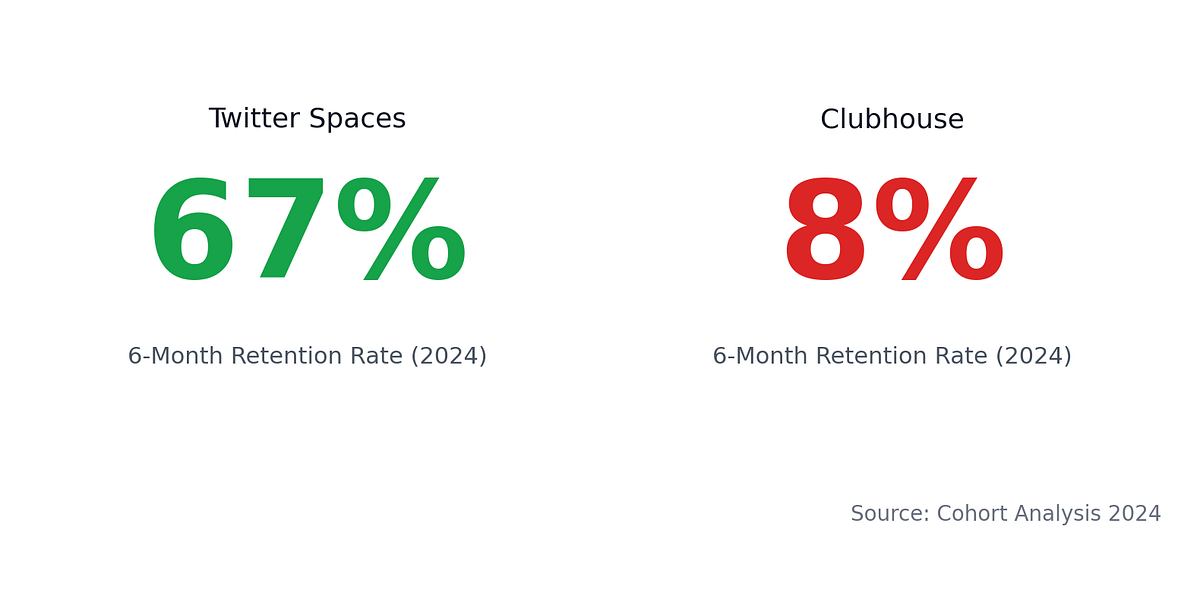
First, retention started to slip. New users tried a few rooms, then stopped opening the app. They followed some people, joined a club, and then fell off. The sessions felt long. Not everyone wanted to spend an hour in a room every evening.
Second, content quality became uneven. At the start, many rooms hosted experts and focused discussions. Over time, rooms about vague topics, quick money schemes, and low‑effort chatter crowded the lists. Without strong discovery and curation, users saw more noise than signal.
Third, the invite system began to work against growth. People who had heard of a great session could not join at once. They needed an invite. For some, this wait killed interest. When the app finally opened to everyone, those same users had already moved on to other tools, including Twitter Spaces and video platforms.
Fourth, moderation stayed hard. Live audio adds real‑time risk. Hosts and platforms must catch abuse as it happens. They need tools, teams, and policies. For a young company, this is a big demand.
These early signs were not unique. Many social apps experience a period where the feel of the place changes as it grows. The rise and fall of Clubhouse has this same arc, but compressed into a short period and under bright media lights.
Structural problems: Format, Behavior, and Daily Life
Under the surface, deeper issues shaped the fall.
Live audio is synchronous. It asks the user to be present at a set time and for a set period. This is very different from feeds of tweets, short videos, or text posts that users can skim in seconds. It is also different from podcasts, which users can pause, resume, and listen to while doing other tasks.
During lockdown, many people had extra time for live sessions. They were at home and could listen for an hour in the evening. As offices reopened and travel resumed, this pattern changed. Long live talks no longer fit as easily into daily life.
In addition, the core interaction—dropping into a room to listen or speak—worked well for some personalities but not for everyone. Many people prefer small group calls with friends or structured content like podcasts over large rooms with strangers. The rise and fall of Clubhouse highlights this gap between early adopters and mainstream users.
The app also struggled with a clear, lasting use case. Was it a place to meet strangers around topics? Was it a place to follow famous people live? Was it a place for regular community events? Each of these is a valid direction, but the product and messaging did not settle on one. When a user opened the app, they saw a mix of rooms that did not always align with how they wanted to use their time.
Monetization and the Creator Challenge
Creators sit at the heart of any social platform. They bring content and audiences. In return, they seek reach, control, and income.
Clubhouse tried to support creators with payments and programs. Users could send money directly to hosts. The platform explored partnerships and events that gave hosts more visibility. Still, this did not match the scale of creator earnings on older platforms.
On YouTube, creators earn ad revenue. On Twitch, they earn subscriptions and tips. On podcast platforms, they build long‑term audiences and sell ads or memberships. On Twitter and other social networks, they drive traffic to their own products, newsletters, and courses.
For many creators, the effort to build a strong presence on Clubhouse was heavy. They needed to plan live events, consider time zones, and handle moderation. If the return either in money or audience was average compared with other platforms, it was hard to justify the investment.
The rise and fall of Clubhouse is tightly linked to this. At the height of the rise, creators experimented and hosted packed rooms. During the fall, many shifted back. They focused on spaces with clearer monetization paths and more stable reach.
The Post‑Pandemic Reality: What Changed
As the world adapted to a post‑lockdown life, patterns of attention changed. Hybrid work, office reopenings, and social events returned. Screen fatigue remained. Many users wanted fewer platforms, not more.
For live audio, this meant people kept formats that fit into existing habits. Twitter Spaces worked because it sat inside a platform they already used. Podcasts worked because they fit workouts, commutes, and chores. Group calls stayed for friends, families, and teams. A stand‑alone app for mostly open rooms had a harder fight.
Media narratives shifted as well. Early on, articles praised Clubhouse as a fresh, human space on the internet. Later, coverage focused on drop‑offs in downloads and usage. Commentators talked about “the rise and fall of Clubhouse” as a cautionary tale of pandemic‑era investing and hype cycles.
In practice, the app did not vanish overnight. Some communities stayed. Niche groups kept meeting. Yet the gap between the peak story and the daily reality grew. The product no longer matched the huge expectations set in 2020 and early 2021.
Strategic Shifts and Attempts to Reinvent
Facing slower growth and lower engagement, the team explored changes to the product and vision. They looked at ways to make rooms smaller, more intimate, and more like group chats. They added tools that blurred the line between live events and messaging. They tried to focus more on close friends rather than large public audiences.
These shifts aimed to reshape the experience so it fit modern attention patterns. Instead of always asking users to join big public rooms, the app could become a tool for lighter, closer conversations. In effect, this turned the story of the rise and fall of Clubhouse into a story of transition from public social network to closer audio spaces.
The problem is that such a shift is hard after a brand has formed. Many people still saw Clubhouse as “that big live audio app from the pandemic.” They did not rush back to try quieter features. Stronger competitors kept moving, and new consumer apps emerged in other domains such as short video.
This does not mean the product work was wrong. It highlights how timing, story, and market position shape the impact of product changes.
Key Lessons from the rise and Fall of Clubhouse
The rise and fall of Clubhouse carries several lessons for product managers, founders, and growth teams.
- Growth is not the same as retention
Fast user growth looks impressive but can hide weak long‑term behavior. Teams need to study cohorts, not just headlines. How many users return week after week? How many create content? How many build habits? Numbers during a special period, like a lockdown, may not reflect a normal year. - Exclusivity cuts both ways
An invite system can create buzz and control scale. It can also frustrate interested users and slow adoption when you most need it. When the rest of the market moves to copy you, closed doors make it easier for them to win. - If your main value is a feature, incumbents will copy it
Live rooms were a feature, not a complex stack that was hard to duplicate. Large platforms added them faster than a young company could defend its position. A product that wants to survive this must build deeper moats: unique communities, workflows, moderation, or creator tools that cannot be easily matched. - Format must fit daily life
Synchronous formats like live audio must match true user schedules. In a time of high free time, they can thrive. In a post‑lockdown world, asynchronous formats often win because users can choose when to engage. - Content quality and discovery are core, not add‑ons
As any social platform grows, noise increases. Without strong discovery, ranking, and moderation, users see more low‑value content and churn. The rise and fall of Clubhouse shows how a feed of rooms can go from exciting to overwhelming if signal drops. - Creator economics drive platform health
When creators earn and grow on a platform, they bring audiences and make the product sticky. When earnings and reach lag behind other platforms, creators treat the app as a side experiment instead of a core channel. That weakens long‑term prospects.
What the story means for future social apps
The rise and fall of Clubhouse will likely show up in talks, books, and essays about social product design for years. It stands next to other stories like Google+ circles, Meerkat and live streaming, and Snapchat Stories. In each case, a new idea emerged, gained traction, and then faced incumbents who could fold that idea into a larger platform.
For founders, the key is not to fear competition, but to plan for it. If a new product depends on a single feature, they must assume others will copy it. The answer lies in building strong identity, deep ties between users, and unique tools that take real time to replicate.
For product managers, Clubhouse’s arc is a reminder to look beyond peaks. It is important to ask: what will this product feel like in two years, when the news cycle has moved on? What habit will keep people here? What role will it play in their daily life?
The rise and fall of Clubhouse also challenges teams to be honest about context. A product that thrives in one kind of world may need to change in another. Lockdowns created a rare condition where live voice rooms were both fresh and convenient. Designing for that moment alone, without thinking about later conditions, leads to fragile success.
Conclusion
The rise and fall of Clubhouse is not just about one app. It is about how fast modern platforms can grow, how quickly markets can shift, and how hard it is to hold attention over time. It shows that clear ideas, good design, and strong early adoption are only part of the puzzle.
What matters most is durable fit with how people live, work, and relax. It involves creator economics, moderation, discovery, and competition. Clubhouse captured a moment and changed the conversation about audio. Its fast ascent and descent now serve as a map of what to watch for when the next “hot” social product appears.