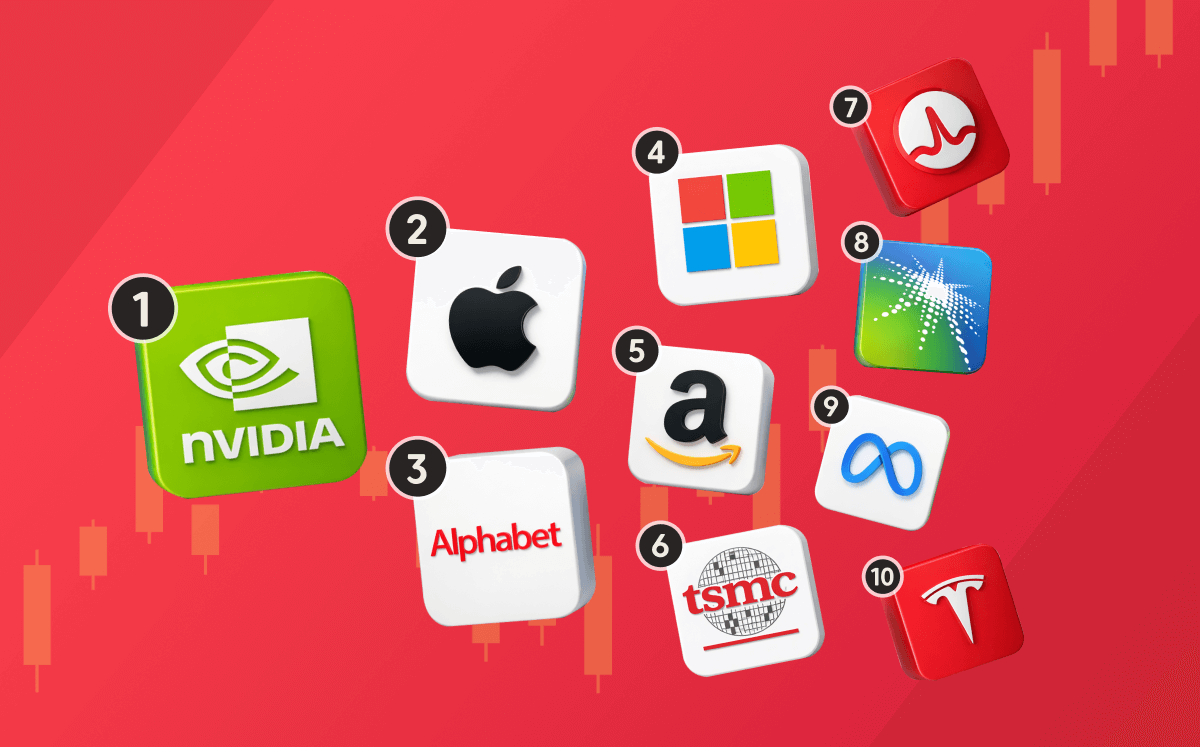
Not long ago, Apple seemed untouchable. It became the first company to cross the $1 trillion, $2 trillion, and eventually $3 trillion market capitalization milestones, setting records that looked impossible to beat. But 2025 has marked a dramatic shift in the corporate world. Microsoft has reclaimed the top spot, Nvidia has become one of the fastest-growing companies in history, and artificial intelligence has transformed the race for the world’s most valuable businesses.
For the first time ever, every company in the global top 10 is worth more than $1 trillion. While these businesses operate across different industries—from oil and finance to semiconductors and e-commerce—they all share one thing in common: they are investing heavily in the technologies that will define the next decade.
Here’s how the world’s corporate giants reached the top and why AI has become the biggest driver of market value.

Credits: The Indian Express
AI Has Become the New Corporate Gold Rush
Every major technological revolution creates winners. Personal computers made Microsoft a giant. Smartphones turned Apple into the world’s most valuable company. Cloud computing fueled Amazon’s rise.
Artificial intelligence is now creating the next generation of corporate leaders.
Unlike previous technology trends that mainly affected one industry, AI is influencing almost every business sector simultaneously. Companies are investing billions of dollars into data centers, custom chips, cloud infrastructure, enterprise software, robotics, and automation.
Investors have rewarded businesses that are leading this transformation. Those that appear to be falling behind—even if they remain enormously profitable—have seen slower growth in their valuations.
This explains why Microsoft and Nvidia have overtaken Apple despite Apple’s continued financial strength.
Microsoft Has Quietly Become the World’s Most Valuable Company
Microsoft’s return to the number one position is no accident.
Under CEO Satya Nadella, the company has transformed itself from a traditional software company into one of the world’s most diversified technology businesses.
Its Windows operating system still powers millions of computers worldwide, while Microsoft Office remains essential for businesses. Beyond that, Azure has become one of the largest cloud computing platforms globally, GitHub has become the home of modern software development, and LinkedIn dominates professional networking.
The company’s biggest advantage today is its AI strategy.
Instead of treating AI as a separate product, Microsoft has integrated it across nearly every service it offers. AI assistants now appear inside Office applications, Azure powers enterprise AI deployments, and businesses increasingly depend on Microsoft’s cloud infrastructure to build their own AI systems.
Because much of Microsoft’s revenue comes from subscriptions and enterprise contracts, investors see its earnings as both stable and capable of long-term growth.
Nvidia Became the Backbone of the AI Revolution
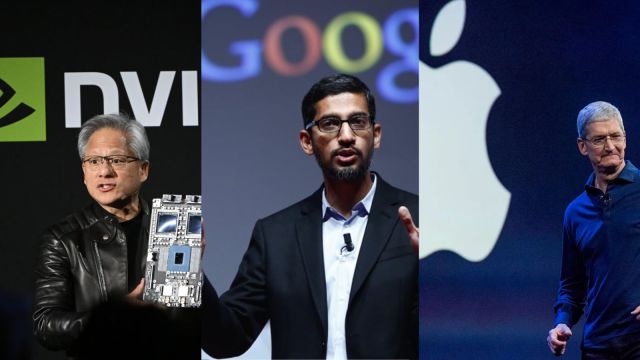
If Microsoft is building AI software, Nvidia is supplying the machinery that makes it possible.
Originally famous for gaming graphics cards, Nvidia discovered years ago that its graphics processors were perfectly suited for artificial intelligence workloads.
Training large language models requires enormous computational power, and Nvidia’s GPUs have become the industry’s preferred solution.
Nearly every major AI company—including Microsoft, Amazon, Meta, Google, and OpenAI—relies heavily on Nvidia hardware.
The company has expanded beyond chips by developing networking equipment, AI software platforms, developer tools, and specialized computing systems.
This ecosystem has made Nvidia much more than a semiconductor manufacturer. It has become the infrastructure provider for the entire AI industry.
Its extraordinary growth reflects the belief that AI investment is only beginning.
Credits: The Indian Express
Apple Is Still a Giant—but Faces New Challenges
Apple remains one of the world’s most profitable businesses, yet its position has changed.
For nearly two decades, the iPhone drove extraordinary revenue growth. Combined with products like the Mac, iPad, Apple Watch, and AirPods, Apple built one of the strongest consumer technology ecosystems ever created.
However, smartphone innovation has slowed considerably.
Most consumers no longer replace their phones every year, and newer models often offer incremental improvements rather than revolutionary features.
Apple also faces increasing pressure from geopolitical tensions. A significant portion of its manufacturing remains concentrated in China, exposing the company to tariffs, trade disputes, and supply chain risks.
Meanwhile, competitors have captured investor attention by leading AI development. Although Apple continues working on artificial intelligence features, the market has yet to view it as a dominant AI player.
Rather than declining as a business, Apple is experiencing what many mature companies eventually face: slower growth expectations.
Cloud Computing Continues to Power Amazon and Alphabet
Artificial intelligence depends on cloud infrastructure.
Companies building AI applications need enormous computing resources, and that demand has strengthened both Amazon and Alphabet.
Amazon Web Services remains one of the world’s largest cloud providers and continues expanding its AI offerings. The company has integrated AI into logistics, advertising, customer support, and cloud services while maintaining dominance in global e-commerce.
Alphabet has followed a similar path.
Google Search remains incredibly profitable, YouTube continues attracting billions of users, and Google Cloud has become one of the company’s fastest-growing divisions.
Although Google initially appeared to trail competitors in generative AI, it has invested aggressively in Gemini and enterprise AI tools.
Both companies demonstrate an important lesson: AI isn’t replacing existing businesses—it is strengthening those with the infrastructure to support it.
Meta’s AI Bet Is Paying Off
Only a few years ago, Meta faced criticism for spending billions on the metaverse.
Today, investor attention has shifted toward its artificial intelligence investments.
Meta has integrated AI into Facebook, Instagram, Messenger, and WhatsApp while using advanced recommendation systems to improve advertising performance.
Since advertising generates almost all of Meta’s revenue, even small improvements in targeting produce billions of dollars in additional income.
The company is also investing heavily in AI infrastructure, building massive data centers capable of training increasingly sophisticated language models.
Its open-source Llama models have become influential across the AI community, strengthening Meta’s position despite fierce competition.

Credits: Dexerto
Chip Companies Are Becoming the World’s Most Valuable Manufacturers
One of the biggest surprises in this year’s rankings is the dominance of semiconductor companies.
Beyond Nvidia, Taiwan Semiconductor Manufacturing Company (TSMC) and Broadcom have both entered the world’s most valuable companies.
TSMC manufactures the world’s most advanced chips for companies including Apple, Nvidia, AMD, and Qualcomm.
Without TSMC’s manufacturing capabilities, many of today’s AI systems simply could not exist.
Broadcom has taken a different approach by focusing on networking hardware, specialized AI chips, and enterprise software through acquisitions like VMware.
As AI models become larger and data centers expand, demand for both companies’ products continues growing rapidly.
The semiconductor industry has effectively become the foundation of the digital economy.
Traditional Industries Still Matter
Technology dominates the rankings, but not every trillion-dollar company comes from Silicon Valley.
Saudi Aramco remains one of the world’s largest companies thanks to its enormous oil reserves and consistent profitability.
Despite global investments in renewable energy, oil continues to power transportation, manufacturing, aviation, and industrial production.
Meanwhile, Berkshire Hathaway represents a completely different investment philosophy.
Built by Warren Buffett over six decades, Berkshire owns businesses spanning insurance, railroads, utilities, manufacturing, retail, and consumer brands.
Even as Buffett prepares to hand leadership to Greg Abel, Berkshire’s enormous cash reserves and diversified portfolio continue giving investors confidence.
These companies remind us that while AI dominates headlines, traditional industries remain essential to the global economy.
What the Rankings Reveal About the Future
The top 10 most valuable companies illustrate how dramatically the business landscape has evolved.
A decade ago, smartphones and social media largely determined corporate success. Today, investors care just as much about cloud computing capacity, AI infrastructure, semiconductor manufacturing, and enterprise software.
The rankings also reveal another trend: scale matters more than ever.
Building modern AI systems requires enormous investments in data centers, advanced chips, research talent, and electricity. Only the world’s largest companies possess the financial resources needed to compete at this level.
This creates a powerful cycle. Larger companies generate more cash, invest more heavily in AI, improve their products faster, attract more customers, and become even larger.
That doesn’t mean innovation has stopped. Instead, competition has shifted toward who can build the most capable AI ecosystem rather than simply creating the next popular consumer gadget.

Credits: The Indian Express
The Race to $4 Trillion Has Already Begun
The world’s most valuable companies are no longer competing solely on products—they are competing to build the infrastructure of the AI era.
Microsoft is integrating AI across enterprise software. Nvidia supplies the processors powering nearly every advanced AI model. Amazon and Alphabet are expanding cloud platforms that host these applications. Meta is reinventing digital advertising with intelligent systems, while semiconductor leaders like TSMC and Broadcom provide the hardware that makes everything possible.
Apple, despite its unmatched brand loyalty and massive ecosystem, now faces the challenge of convincing investors that it can lead the next technological revolution rather than simply dominate the previous one.
With every company in the top 10 now valued above $1 trillion, the race is entering unprecedented territory. The next milestone isn’t another trillion-dollar company—it’s the world’s first $4 trillion corporation.
If current trends continue, artificial intelligence will almost certainly determine who gets there first.