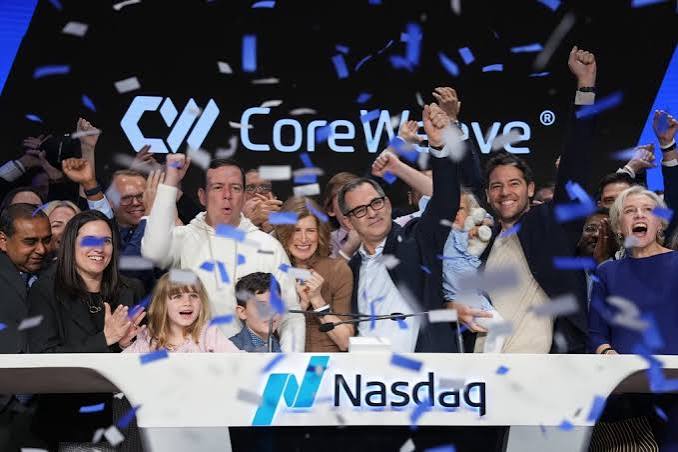
When people talk about the winners of the artificial intelligence boom, names like Nvidia, Microsoft, OpenAI, and Meta usually dominate the conversation. But one of the biggest success stories of the AI era wasn’t born in Silicon Valley. It began as a cryptocurrency mining company in New Jersey.
CoreWeave’s journey is one of the most remarkable pivots in modern technology. The company transformed itself from a struggling crypto miner into one of the world’s most important AI infrastructure providers, signing contracts worth tens of billions of dollars with some of the biggest technology companies on the planet.
Its story proves that sometimes the companies that win the next technological revolution aren’t necessarily those that predict the future perfectly—they’re the ones that adapt fastest when the future changes.
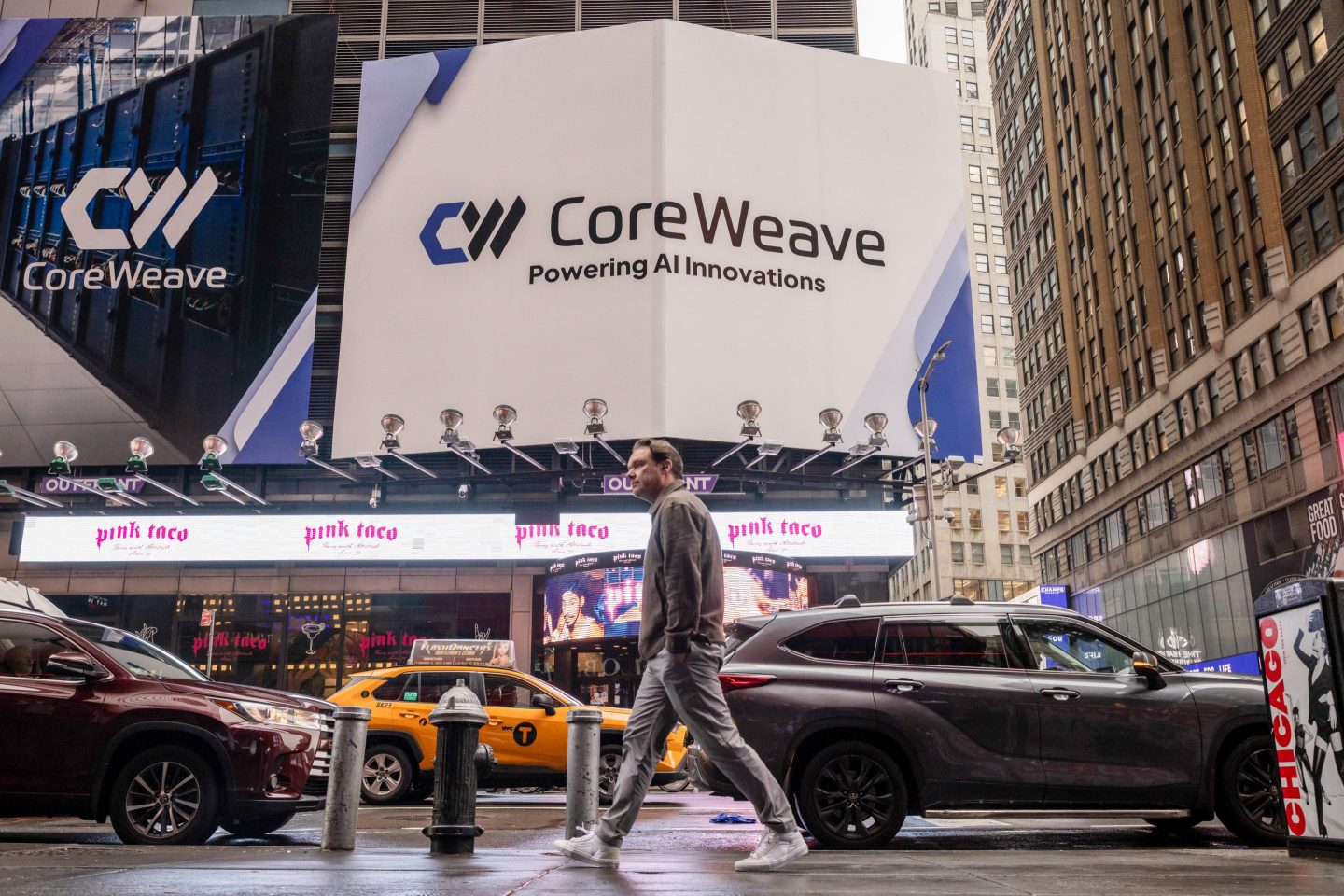
Credits: Fortune
A Company Built During the Crypto Boom
CoreWeave was founded in 2017 by three former commodities traders who initially launched a cryptocurrency mining business under the name Atlantic Crypto.
At the time, the decision made perfect sense.
Bitcoin prices were soaring, Ethereum mining was becoming increasingly profitable, and graphics processing units (GPUs) had become the most valuable hardware in crypto. Mining operations required thousands of high-performance Nvidia GPUs running around the clock, and Atlantic Crypto quickly invested heavily in building GPU-powered infrastructure.
Business was booming.
Cryptocurrencies were attracting mainstream attention, institutional investors were entering the market, and mining operations generated attractive returns. Like hundreds of other companies, Atlantic Crypto believed crypto mining represented the future.
But that future changed almost overnight.
The Crypto Crash That Changed Everything
In 2018, cryptocurrency markets suffered one of the biggest crashes in their history.
Bitcoin lost roughly 80% of its value from its peak. Mining profitability collapsed, GPU demand weakened, and many crypto-focused companies either shut down or drastically reduced operations.
For most mining firms, this was a disaster.
For Atlantic Crypto, however, it became an unexpected opportunity.
Instead of waiting for crypto prices to recover, the founders began asking a different question:
“What else can these GPUs do?”
That simple question would redefine the company’s future.
Seeing AI Before Everyone Else
Even before ChatGPT made artificial intelligence a household term, researchers were training increasingly sophisticated machine learning models.
Those models needed enormous computing power.
Interestingly, they required exactly the same hardware used in crypto mining—high-performance GPUs.
The CoreWeave team recognized that while cryptocurrency demand fluctuated dramatically, demand for AI computing would likely grow for years.
In 2019, the company officially rebranded itself as CoreWeave and shifted its focus from mining digital currencies to renting GPU computing power through the cloud.
It wasn’t simply changing industries.
It was repositioning itself to become part of the foundation of the AI economy.
Why GPUs Became More Valuable Than Gold
Artificial intelligence models are incredibly computationally intensive.
Training a large language model requires processing trillions of parameters across massive datasets. Traditional CPUs simply cannot perform these calculations efficiently.
GPUs, originally designed for gaming graphics, excel at performing thousands of calculations simultaneously.
This made Nvidia’s GPUs the preferred hardware for AI development.
As companies raced to build increasingly capable AI models, demand for GPUs exploded.
Suddenly, the hardware once used to mine cryptocurrencies became the world’s most sought-after AI resource.
CoreWeave already owned thousands of GPUs and understood how to manage them efficiently.
That experience gave it an enormous head start.

Credits: CNBC
Building an AI Cloud Instead of a General Cloud
Unlike Amazon Web Services, Microsoft Azure, or Google Cloud, CoreWeave didn’t try to build a cloud platform for every possible computing workload.
Instead, it focused almost exclusively on AI.
This specialization became one of its biggest competitive advantages.
Its infrastructure was optimized specifically for machine learning workloads, offering customers faster performance, better GPU utilization, and lower costs than many traditional cloud providers.
Rather than spreading resources across databases, web hosting, enterprise software, and storage, CoreWeave concentrated on one thing:
Delivering massive GPU clusters for AI developers.
As generative AI exploded after ChatGPT’s launch, that strategy looked increasingly brilliant.
Nvidia Became Its Biggest Advantage
One of CoreWeave’s greatest strengths has been its close relationship with Nvidia.
Because GPU demand consistently exceeded supply, obtaining Nvidia’s newest AI chips became one of the biggest challenges in the industry.
Companies with access to the latest H100 and later Blackwell GPUs gained a significant competitive advantage.
CoreWeave secured access to these chips earlier than many competitors.
Instead of waiting years for new hardware, it rapidly expanded its GPU fleet, allowing customers to scale AI training much faster.
Its relationship with Nvidia became even stronger as both companies recognized their mutual dependence in powering the AI ecosystem.
AI’s Infrastructure Boom
The launch of ChatGPT in late 2022 fundamentally changed the technology industry.
Every major tech company suddenly wanted to build AI models.
OpenAI, Microsoft, Meta, Anthropic, Mistral, enterprise startups, research labs, pharmaceutical companies, financial institutions, and governments all needed one thing:
More computing power.
Building AI models wasn’t limited by ideas.
It was limited by available GPUs.
This created an enormous opportunity for companies capable of providing AI infrastructure at scale.
CoreWeave was perfectly positioned.
It already had GPU expertise, established data centers, cloud infrastructure, and operational experience managing thousands of graphics processors.
What had once been a crypto mining asset became one of the world’s most valuable AI businesses.

Credits: MarketWatch
Billions of Dollars in Long-Term Contracts
CoreWeave’s transformation became impossible to ignore as it secured massive long-term agreements with leading AI companies.
Among its most significant deals are:
- A multi-billion-dollar cloud infrastructure expansion agreement with OpenAI.
- A long-term arrangement with Nvidia that guarantees purchases of unused cloud capacity through 2032, reducing business risk while ensuring high infrastructure utilization.
- A massive agreement with Meta to provide access to Nvidia’s latest GB300 server racks powered by Blackwell GPUs.
Combined, these contracts represent tens of billions of dollars in future revenue.
For a company that started as a crypto mining operation less than a decade ago, the scale of these agreements is extraordinary.
These partnerships also demonstrate the growing importance of specialized AI infrastructure providers.
Why Big Tech Doesn’t Build Everything Itself
One obvious question is why companies like Meta or OpenAI simply don’t build all their own infrastructure.
The answer comes down to speed and flexibility.
Constructing AI data centers requires billions of dollars, access to GPUs, power infrastructure, cooling systems, networking equipment, and highly specialized engineering talent.
Even the largest technology companies cannot build new AI capacity instantly.
Renting GPU infrastructure from providers like CoreWeave allows them to deploy AI projects much faster while avoiding delays caused by hardware shortages.
In many cases, time-to-market is worth more than ownership.
That dynamic has created enormous demand for AI cloud providers.
Competition Is Intensifying
CoreWeave isn’t alone in recognizing this opportunity.
Traditional cloud giants including Amazon Web Services, Microsoft Azure, Google Cloud, Oracle Cloud Infrastructure, and specialized providers are investing heavily in AI infrastructure.
New GPU cloud startups are also entering the market.
Competition is increasing rapidly.
To stay ahead, CoreWeave must continue expanding capacity, securing access to Nvidia’s latest hardware, improving software efficiency, and maintaining high service reliability.
Its advantage today comes from specialization, but maintaining that edge will require constant innovation.
Risks Investors Should Watch
Although CoreWeave has experienced extraordinary growth, the company still faces meaningful risks.
Its business depends heavily on continued AI spending by large technology companies.
Any slowdown in AI investment could reduce demand for cloud infrastructure.
The company is also capital-intensive.
Building AI data centers requires enormous investments in hardware, networking, electricity, cooling systems, and real estate.
Rapid technological change presents another challenge.
Each new generation of GPUs offers significant performance improvements, meaning infrastructure must be continuously upgraded to remain competitive.
Finally, customer concentration remains an important consideration. Large contracts with a relatively small number of major technology companies can create dependency if customer priorities change.

Credits: The New York Times
The Bigger Lesson Behind CoreWeave’s Success
CoreWeave’s story isn’t simply about artificial intelligence.
It’s about recognizing when an existing asset becomes valuable in an entirely different market.
The GPUs originally purchased for cryptocurrency mining turned out to be exactly what the AI revolution needed.
Instead of clinging to a declining business model, the company reinvented itself before the rest of the world realized where computing demand was headed.
That combination of adaptability, timing, and execution allowed CoreWeave to evolve from a niche crypto miner into one of the most strategically important companies powering today’s AI boom.
As artificial intelligence continues reshaping industries—from healthcare and finance to manufacturing and scientific research—the need for massive computing infrastructure will only increase.
Whether CoreWeave ultimately becomes one of the defining technology companies of this generation remains to be seen. But its remarkable transformation has already secured its place as one of the greatest business pivots of the AI era.