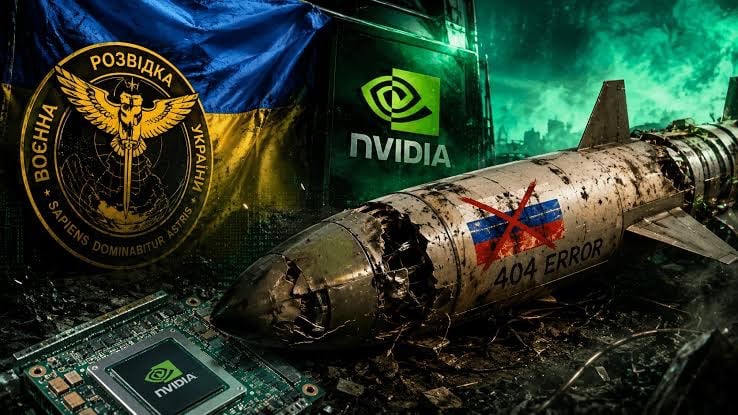
Ukraine’s military intelligence has reported finding an Nvidia Jetson Orin computer module inside Russia’s newly identified S-71 Monochrome cruise missile, offering another glimpse into the foreign technology being incorporated into Moscow’s modern weapons systems.
The discovery was reported by Ukraine’s Main Directorate of Intelligence, known as HUR, which said its specialists examined components from the Russian missile and identified 35 foreign electronic components. Among them was an Nvidia Jetson Orin module, a compact computing platform developed for applications involving artificial intelligence, robotics and autonomous systems.
The presence of the Nvidia hardware is significant because Russia has faced extensive international restrictions on access to advanced Western technology since the invasion of Ukraine. Western governments have imposed export controls on semiconductors, processors and other components that could contribute to Russia’s military capabilities.
Despite those restrictions, Ukrainian authorities have repeatedly reported finding foreign-made electronics in Russian missiles, drones and other military equipment. The latest discovery suggests that Russia continues to find ways to acquire sophisticated computing hardware through international supply chains.

The Jetson Orin platform was originally developed as a general-purpose computing solution rather than specifically as a military component. Nvidia’s Jetson products are widely associated with robotics, artificial intelligence, autonomous machines and edge computing. Their relatively compact size and substantial processing capabilities can make them useful in systems where computing power must be combined with limited space.
The discovery does not necessarily mean that the S-71 Monochrome is an entirely AI-controlled missile. Instead, a computing module such as the Jetson Orin could potentially support a range of functions, including navigation, sensor processing, image analysis, autonomous decision-making or other computational tasks. The exact role of the component inside the missile remains unclear.
Nevertheless, the use of such technology illustrates the increasingly important role of computing in modern warfare. Missiles and drones are no longer dependent solely on conventional mechanical and electronic systems. Advanced processors, sensors, software and communication technologies can play an important role in helping weapons operate with greater precision and autonomy.
The S-71 Monochrome has emerged as part of Russia’s continuing development of long-range strike capabilities. Although publicly available information about the weapon remains limited, the identification of foreign electronics could provide Ukrainian specialists with valuable information about how Russia is designing and manufacturing newer weapons.
For Ukraine, identifying the components inside Russian weapons is also important from a sanctions perspective. Each foreign-made component can potentially reveal weaknesses in international export-control systems. If restricted technology is reaching Russian manufacturers, investigators can attempt to determine how it was obtained and which supply chains were involved.
The global semiconductor industry makes this particularly difficult. A component manufactured in one country can be sold to a distributor in another, eventually passing through several intermediaries before reaching its final destination. Companies and governments therefore face significant challenges in tracking the ultimate users of individual electronic components.
Russia has increasingly sought to reduce its dependence on Western technology by developing domestic alternatives and strengthening relationships with countries that continue to trade with it. At the same time, reports of foreign components in Russian weapons indicate that international technology remains an important part of its military-industrial ecosystem.
The reported presence of 35 foreign electronic components in the S-71 Monochrome is therefore potentially more significant than the discovery of one Nvidia module alone. It suggests that Russia’s weapons industry may continue to rely on a broader collection of foreign technologies, ranging from processors and memory components to specialized electronic systems.
The situation also highlights the dual-use nature of modern technology. Many of the components used in military systems were not originally designed for weapons. Artificial intelligence processors, cameras, sensors, communications equipment and computing platforms can have legitimate civilian applications while also being adaptable for military purposes.
This creates a difficult balance for technology companies and governments. Tightening export restrictions can reduce the availability of sensitive technology to military organizations, but overly broad restrictions can also affect legitimate commercial activities. Effective enforcement therefore requires not only regulations but also close monitoring of international supply chains.
For Nvidia, the reported discovery underscores the broader challenge facing semiconductor manufacturers whose products can be used for both civilian and military purposes. Advanced computing platforms are becoming increasingly valuable across industries, making them attractive not only to technology companies and researchers but also to defense organizations.
The findings could also increase pressure on countries involved in international trade with Russia to strengthen controls over the re-export of sensitive electronics. Preventing direct sales is only one part of the challenge. Authorities must also address indirect routes through intermediaries and third-party markets.
For Ukraine, the examination of captured and recovered Russian weapons has become an important source of information about Moscow’s military capabilities. By identifying individual components, Ukrainian specialists can better understand the technology behind Russian weapons and potentially provide information to international partners seeking to restrict future supplies.
The reported Nvidia module ultimately illustrates how difficult it has become to separate civilian technology from military applications. A compact AI computing platform designed for robotics and autonomous machines can potentially find a new purpose inside a sophisticated weapon system.
As Russia continues developing new missiles and drones, the technology embedded inside those weapons is likely to remain an important area of investigation. The discovery of the Jetson Orin module and dozens of other foreign components provides another indication that advanced international electronics continue to play a role in Russia’s weapons production, despite efforts to restrict Moscow’s access to such technology.