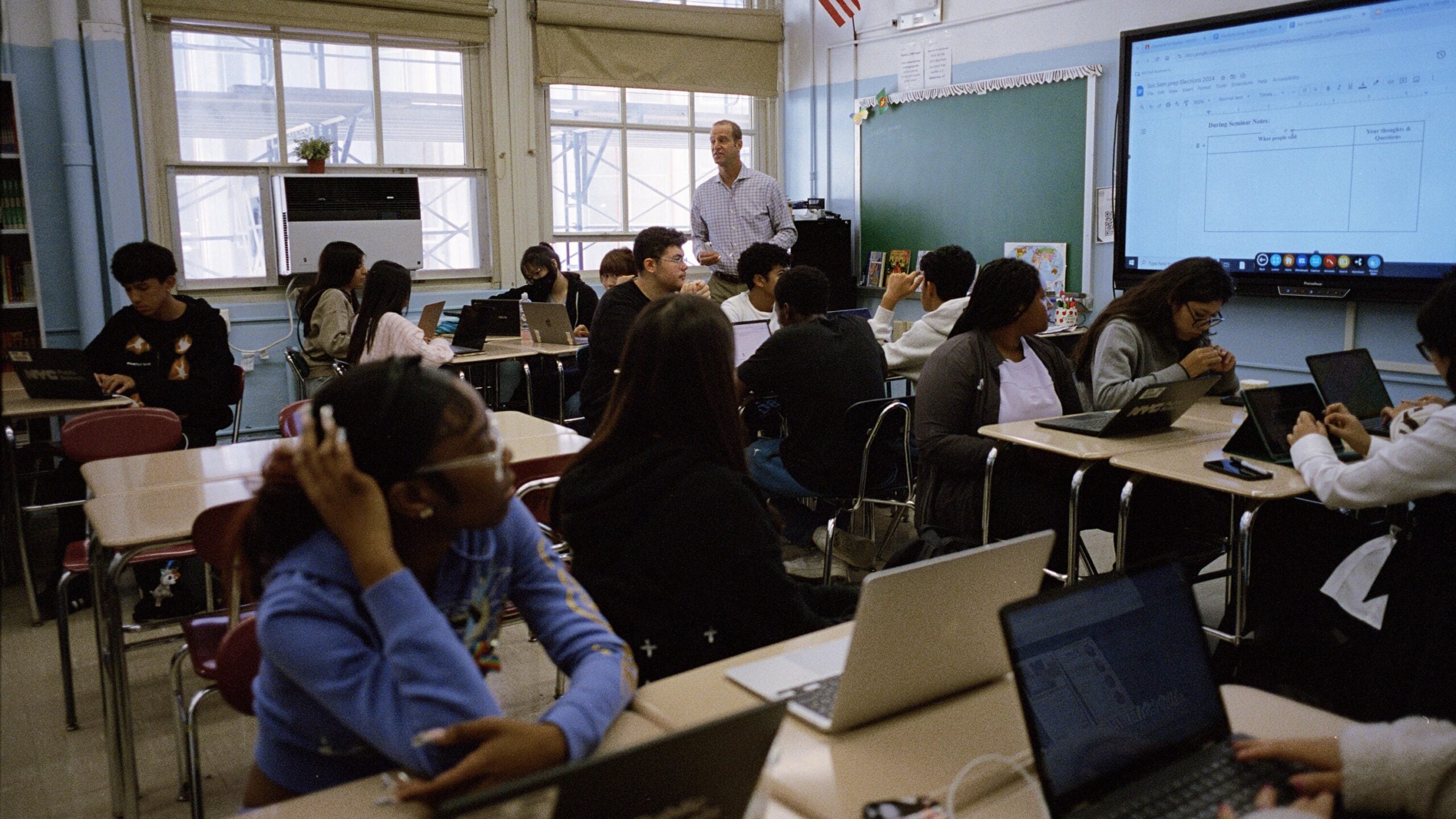
New York City is taking a major step back from artificial intelligence in its public schools, introducing a sweeping overhaul of classroom technology that will restrict student access to AI until high school and significantly reduce screen use among younger students.
The policy, which begins with the 2026–27 school year, will affect hundreds of thousands of students across New York City Public Schools. Under the new rules, students from 2-K through eighth grade will generally not be allowed to use generative AI tools for schoolwork. AI use will instead be introduced in high school through controlled, educational settings.
The decision represents a significant change in the way one of the largest school systems in the United States approaches rapidly developing technology. Rather than making AI a routine part of childhood education, city officials are placing greater emphasis on foundational academic skills, human interaction and independent thinking.
AI restricted for younger students
Students from preschool through eighth grade will face a broad restriction on generative AI tools. The policy is designed to prevent children from relying on chatbots and other automated systems to complete assignments, generate written work or perform tasks that are intended to develop their own skills.
The reasoning behind the change is rooted in concerns that excessive dependence on AI could interfere with the development of critical thinking, creativity and problem-solving abilities.

New York City officials have emphasized that technology should support education rather than replace the relationship between students and teachers. The new approach seeks to ensure that students first develop the ability to read, write, reason and solve problems independently before being introduced to increasingly sophisticated AI systems.
The policy does not represent a complete rejection of artificial intelligence. Instead, it establishes a much later and more structured entry point.
Beginning in high school, students will be allowed to use AI in selected educational circumstances. They will also receive dedicated AI literacy instruction, helping them understand how the technology works, its limitations and the ethical questions surrounding its use.
A wider crackdown on classroom screens
The technology overhaul extends beyond AI.
New York City is also introducing stricter limits on students’ access to digital devices. Children in the earliest grades will have substantially less exposure to individual laptops and tablets during classroom instruction.
Students will generally not receive individual screens until third grade. For older elementary students, screen use will be capped at around 30 minutes per day, while middle school students will face a daily limit of approximately 45 minutes.
The change reflects growing concerns about excessive screen exposure and the possibility that digital technology can become a distraction rather than an educational advantage.
Instead of assuming that every lesson needs a device, schools will be encouraged to use technology selectively, when it provides a clear educational benefit.
The approach also represents a broader reconsideration of the technology-heavy model that became increasingly common in schools during and after the pandemic.
Teachers face new AI rules
The restrictions will not apply only to students.
Teachers will be permitted to use certain AI tools for administrative and preparatory activities, such as developing lesson plans and translating materials. However, they will not be permitted to use AI to grade student work or make sensitive educational decisions.
The distinction is intended to keep important judgments in human hands.
Teachers, counselors and school administrators will continue to be responsible for understanding students and making decisions based on their individual circumstances. AI will not be allowed to replace professional judgment in areas where mistakes could significantly affect a child’s education.
The city is also banning AI-powered psychological or emotional-support chatbots in schools. Officials appear particularly concerned about students forming relationships with automated systems or turning to chatbots for sensitive personal guidance.
Exceptions remain in place
The policy does not create an absolute prohibition on every form of AI or digital technology.
Students with disabilities and multilingual learners may receive access to approved technology when it provides necessary educational support. Certain specialized programs, including computer science courses, may also have exceptions where AI is directly relevant to the curriculum.
This distinction is important because the city does not want restrictions on AI to prevent students from receiving tools that improve accessibility or help address specific educational needs.
The broader objective is to prevent unnecessary dependence on AI while preserving technology that has a legitimate and measurable educational purpose.
Why New York is making the change
The decision comes as schools across the United States struggle to determine how to respond to generative AI.
Since the emergence of tools capable of producing essays, answering questions, creating images and solving complex problems, educators have faced a new challenge: determining whether students are using technology to learn or simply allowing technology to do the learning for them.
AI has also made traditional methods of evaluating student work more complicated. A polished essay may no longer demonstrate that a student can independently research, organize ideas and write.
For supporters of the New York policy, delaying AI use gives younger students an opportunity to develop these basic abilities before introducing tools that can automate parts of the process.
Critics, however, could argue that students need early exposure to AI because the technology is rapidly becoming part of everyday life and the future workplace. Keeping children away from AI entirely could potentially leave them less prepared to navigate a world where understanding the technology will be increasingly important.
New York’s policy attempts to address this concern by separating AI exposure from AI dependence.

A test for the future of education
The new approach could become an important experiment for school systems around the country.
New York City is not simply banning one category of software. It is reconsidering the broader assumption that classrooms should become increasingly digital as technology improves.
The policy instead places human learning at the center and treats technology as something that should be introduced carefully and purposefully.
The city plans to monitor how the new rules work and develop further guidance on AI in education. High school pilot programs will also allow officials and educators to examine how carefully selected AI tools can be used without compromising student learning or privacy.
The debate surrounding the policy is unlikely to end with its implementation. As AI becomes more capable, schools will continue to face difficult questions about when students should use it, how they should use it and where the boundaries should be.
For now, New York City is sending a clear message: children do not need more technology simply because more technology is available.
The city’s new classroom model puts foundational learning first, screens on a tighter leash and artificial intelligence behind a high-school gate—at least for now.