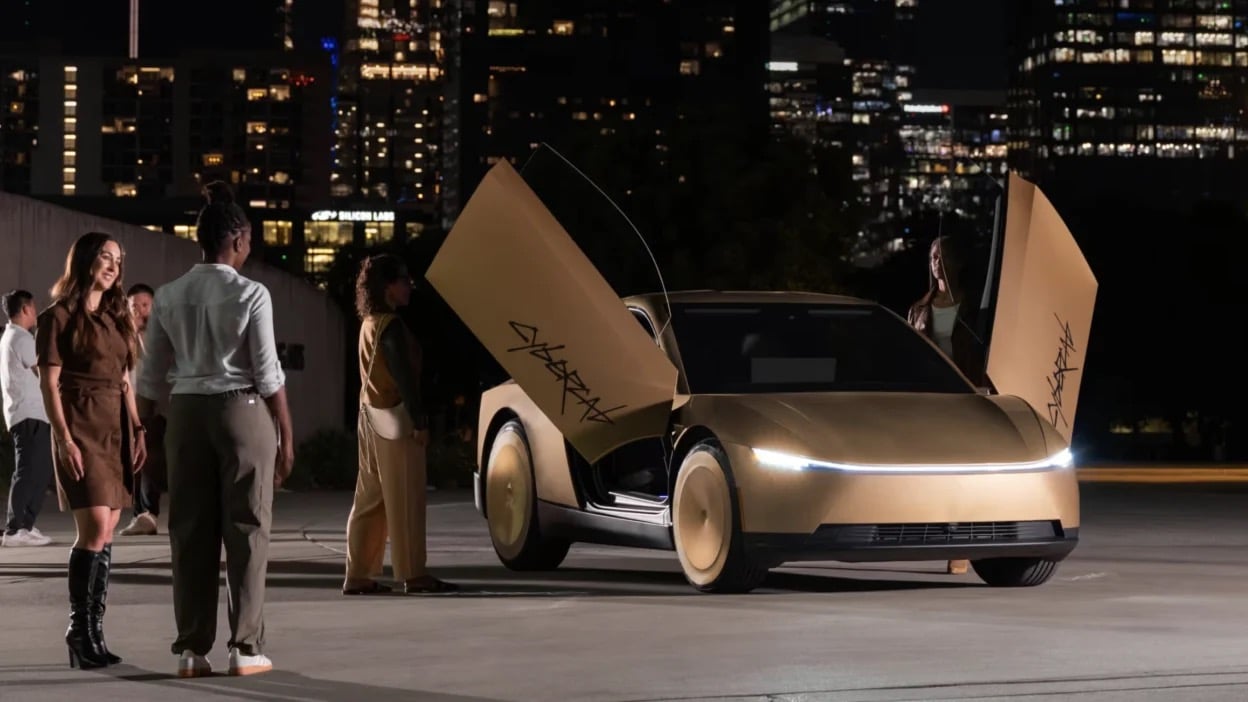
Tesla’s futuristic Cybercab has come under federal investigation just a day after the company began offering rides in the steering-wheel-free autonomous vehicle in Austin, Texas. The National Highway Traffic Safety Administration (NHTSA) is examining whether Tesla complied with federal vehicle safety requirements when it deployed the new robotaxi on public roads.
The investigation puts Tesla’s ambitious autonomous-driving strategy under renewed regulatory scrutiny at a crucial moment. The company has positioned the Cybercab as a purpose-built robotaxi that could eventually operate without human drivers across the United States. But its unusual design, which eliminates the steering wheel, accelerator and brake pedals, has raised questions about how it fits into existing federal safety rules.
Investigation follows Austin launch
Tesla officially began deploying its production Cybercabs in Austin on September 3, marking an important milestone in the company’s long-running effort to build a commercial autonomous transportation network.
The two-seat electric vehicle is designed specifically for autonomous operation. Unlike conventional cars, passengers do not have access to a steering wheel or traditional pedals. The vehicle is expected to handle steering, acceleration and braking on its own.
Federal regulators moved quickly after the launch. NHTSA said it was evaluating Tesla’s rollout and whether the vehicle complies with applicable Federal Motor Vehicle Safety Standards.
The agency’s investigation is focused on Tesla’s certification process rather than being described as a finding that the Cybercab is unsafe. Automakers generally certify that their vehicles comply with federal safety standards, while NHTSA can investigate when questions arise over those certifications.
The missing steering wheel and pedals are central
The Cybercab’s most distinctive feature is also the reason it faces a regulatory challenge.
Traditional passenger vehicles are designed around the assumption that a human being can take control. Steering wheels allow drivers to change direction, while brake and accelerator pedals allow them to control the vehicle’s speed.
The Cybercab removes those controls because Tesla does not intend passengers to drive it.
That creates a complicated question for regulators: how should safety standards designed for human-operated vehicles apply to a car that is designed to operate entirely through autonomous systems?
The NHTSA is examining how Tesla interpreted those requirements when certifying the Cybercab.
The vehicle also lacks conventional exterior mirrors, another feature traditionally associated with federal vehicle requirements. Tesla instead relies on cameras, sensors and its autonomous-driving technology to understand the surrounding environment.
Existing rules remain in place
The investigation comes as U.S. regulators are already considering changes to federal vehicle standards to make it easier for autonomous vehicles without conventional driver controls to reach the road.
The federal government has proposed changes that could eventually remove or modify some requirements for autonomous vehicles, including rules concerning manual controls.
But those changes have not yet replaced the existing regulatory framework.
That distinction is important for Tesla. Even as regulators consider adapting the rules for autonomous vehicles, current requirements remain applicable unless a vehicle receives an exemption or another regulatory pathway allows it to operate differently.
The NHTSA investigation will therefore examine whether Tesla’s certification of the Cybercab properly accounted for those requirements.
Tesla’s robotaxi ambitions
The Cybercab is much more than another electric vehicle for Tesla. It is a central part of CEO Elon Musk’s vision for transforming the company into an autonomous transportation and artificial intelligence business.
Tesla has argued that a fleet of autonomous vehicles could operate as robotaxis, transporting passengers without requiring a human driver. Such a system could potentially allow vehicles to spend much more time generating revenue than privately owned cars.
The Cybercab is designed specifically for this purpose.
Its compact two-seat configuration, absence of conventional driving controls and focus on autonomous operation are intended to make it different from Tesla’s existing vehicles.
The company has also indicated that it wants the Cybercab to eventually become a relatively inexpensive mass-market autonomous vehicle, allowing Tesla to build a large robotaxi fleet.
Austin is only the beginning
The initial Cybercab deployment in Austin is limited, but Tesla has much larger ambitions.
The company wants to gradually increase the number of autonomous vehicles operating on its network and expand into additional markets. A successful Austin deployment would provide Tesla with valuable real-world experience and data while demonstrating that its autonomous technology can support commercial passenger service.
However, federal scrutiny could complicate that expansion.
If regulators determine that additional approvals, exemptions or modifications are necessary, Tesla could face delays before deploying the Cybercab at a much larger scale.
For a company that has repeatedly emphasized the importance of autonomous vehicles to its future, regulatory delays could become a significant obstacle.
Not necessarily a safety finding
The federal investigation should not automatically be interpreted as a conclusion that the Cybercab is dangerous.
Regulatory investigations can examine whether a vehicle complies with technical requirements without establishing that the vehicle has caused accidents or poses an immediate safety threat.
In this case, the unusual design itself appears to have prompted questions about certification.
The Cybercab’s operation also represents a major shift from Tesla’s earlier robotaxi strategy. Previous Tesla robotaxi services have relied on modified versions of existing vehicles. The Cybercab, by contrast, was designed from the beginning around the assumption that there would be no human driver.
That makes its certification especially significant.

Tesla faces a changing regulatory landscape
The Cybercab investigation highlights the challenge facing regulators as autonomous technology develops faster than traditional vehicle standards.
Rules written around human drivers naturally assume that vehicles will contain steering wheels, pedals and other controls. Autonomous vehicles challenge those assumptions.
The regulatory system must now determine which safety requirements remain necessary when a computer is responsible for driving.
Tesla is not alone in facing this issue. Other autonomous vehicle companies have also had to navigate federal requirements and exemptions for vehicles that differ significantly from conventional cars.
The Cybercab could nevertheless become an important test case because Tesla intends to manufacture and deploy the vehicle on a much larger scale.
A critical test for Tesla’s future
The NHTSA investigation arrives at an awkward time for Tesla. The company has finally moved the Cybercab from an experimental concept toward commercial passenger service, only to face federal scrutiny almost immediately.
For now, the investigation does not mean that the Austin service will necessarily be halted. But it does create another regulatory hurdle for Tesla as it attempts to expand its autonomous transportation ambitions.
The outcome could help determine how quickly steering-wheel-free vehicles can become a normal part of America’s transportation system.
The Cybercab represents Tesla’s vision of a future in which passengers simply enter a vehicle, select their destination and let the car handle everything else. But before that vision can become widespread, Tesla must demonstrate that a vehicle designed without a driver can also fit within a regulatory system created for vehicles built around one.
For Tesla, the Cybercab’s Austin launch may therefore prove to be more than the beginning of a new robotaxi service. It could become a defining test of whether the company’s vision for fully autonomous transportation is ready to meet the realities of federal vehicle safety regulation.