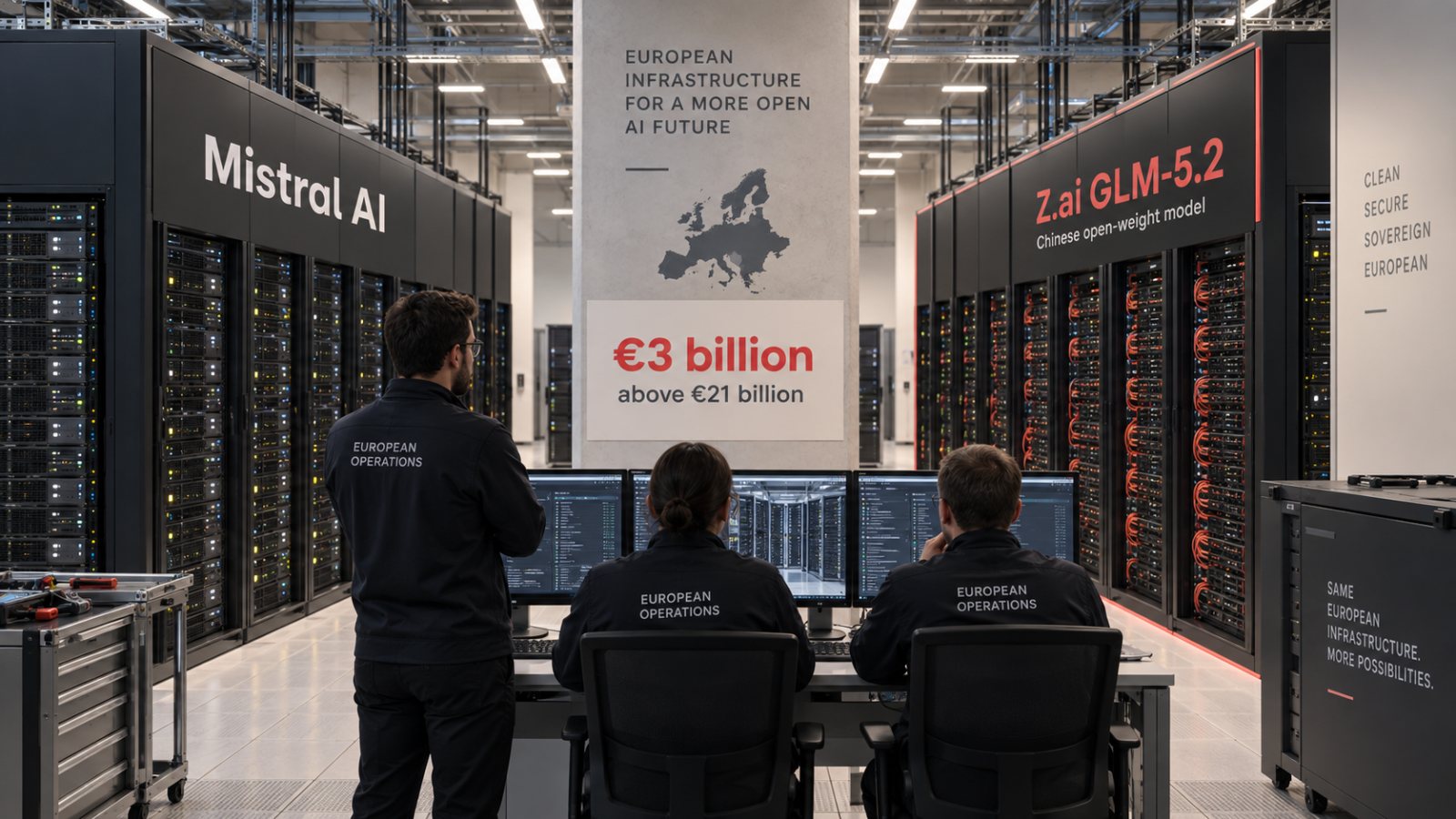
Europe’s artificial intelligence ambitions have received a major boost as French AI startup Mistral has raised €3 billion in fresh equity funding, taking its valuation to around €21 billion. The massive funding round makes the three-year-old company the largest privately owned European technology firm to raise capital in a single equity round.
The fundraising highlights the growing race to build powerful AI companies outside the United States, while also reflecting Europe’s increasing focus on technological independence.

Credits: daily.dev
Mistral Lands One of Europe’s Biggest Tech Funding Rounds
Mistral said the €3 billion round was jointly led by existing investor PSG Equity, Samsung Electronics and the EU-backed Scaleup Europe Fund. For Samsung and the Scaleup Europe Fund, the investment marks their first participation in Mistral.
The new valuation places Mistral among Europe’s most valuable private technology companies. According to the company’s chief financial officer Johan Bergqvist, Mistral is now Europe’s second-highest-valued private technology group and one of the fastest-growing companies on the continent.
The fresh capital will be used primarily to strengthen Mistral’s AI models and fund frontier research. The company is attempting to develop increasingly sophisticated AI systems while competing against significantly larger American rivals.
The scale of the funding demonstrates how investors are increasingly willing to place enormous bets on AI companies that could become foundational players in the global technology industry.
Europe’s Answer to OpenAI and Anthropic
Mistral occupies a unique position in the global AI race. While companies such as OpenAI and Anthropic have achieved valuations hundreds of billions of dollars higher, Mistral is widely viewed as Europe’s strongest candidate for building a globally competitive AI company.
The valuation gap remains enormous. Anthropic is valued at around $965 billion, while OpenAI has been valued at approximately $852 billion. Both American AI giants are also preparing for potential public listings.
Mistral, meanwhile, is taking a different path. Bergqvist said an IPO remains an option for the company, but there are currently no ongoing discussions about a listing and the timing remains uncertain.
That gives Mistral additional time to focus on expanding its technology and customer base before deciding whether public markets are the right destination.
AI Sovereignty Becomes a European Priority
Mistral’s rise comes at a time when Europe is becoming increasingly concerned about its dependence on foreign technology.
Artificial intelligence has become strategically important for governments and businesses, with access to advanced models increasingly viewed as part of national and economic security. Recent restrictions affecting access to advanced AI models have further highlighted the risks of relying entirely on companies based outside Europe.
For Mistral, this creates an opportunity that extends beyond simply selling AI products.
Bergqvist argued that Europe needs its own major AI provider to ensure continued access to critical technology and avoid vulnerabilities in its supply chain. Mistral’s European roots therefore have strategic significance, particularly as governments across the continent push for greater technological sovereignty.
Open Models Could Give Mistral an Edge
One of Mistral’s biggest differentiators is its focus on so-called “open” AI models.
Unlike some competitors that primarily provide AI through controlled cloud platforms, Mistral allows customers to download and customise its models and run them on their own servers. This can be particularly attractive to businesses and governments that want greater control over sensitive data and AI infrastructure.
Mistral already has more than 125 customers, and its geographical footprint is expanding. Bergqvist said the company is seeing particularly strong growth in Asia and North America, suggesting that Mistral’s ambitions extend well beyond the European market.
Credits: Quasa.io
Targeting $1 Billion in Annual Revenue
The company’s growth is also beginning to show up in its financial performance. Mistral is on track to reach $1 billion in annual recurring revenue by the end of 2026, according to Bergqvist.
Reaching that milestone would mark a significant achievement for a company that was founded only three years ago.
The latest funding gives Mistral the financial firepower to accelerate that growth. However, competing with companies such as OpenAI and Anthropic will require enormous investments in computing infrastructure, talent and research.
For Europe, the stakes are even higher. Mistral is no longer simply another promising startup. Its success could determine whether Europe can build a globally influential AI industry of its own—or remain dependent on American technology for the most advanced AI systems.