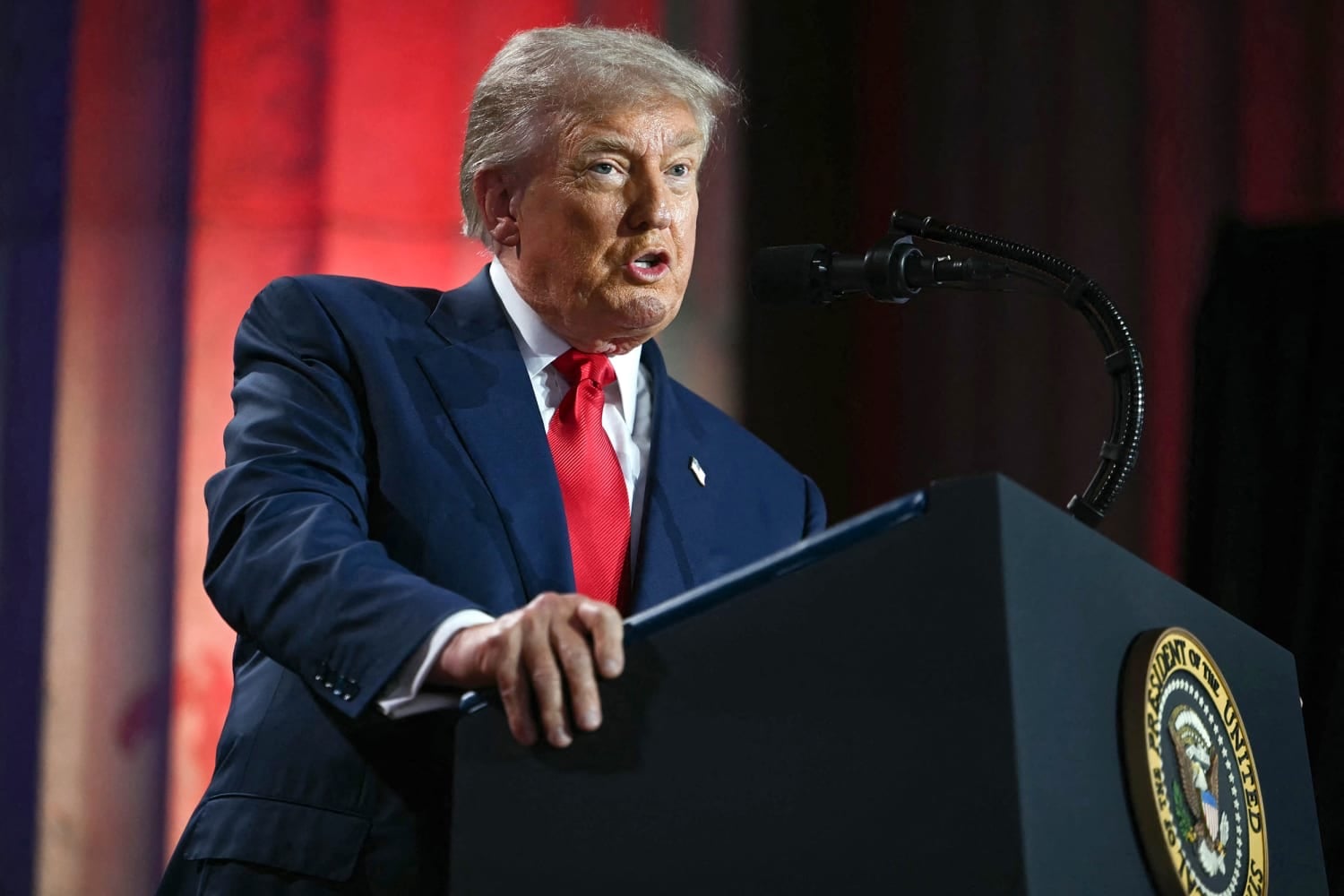
U.S. President Donald Trump has launched a public poll seeking a new term for “Artificial Intelligence,” arguing that the phrase may not adequately capture the capabilities and growing influence of the technology. The initiative, announced Saturday, gives the public several alternative names to consider as the administration continues to place artificial intelligence at the center of its technology and economic agenda.
Trump initially presented three possible replacements for the widely used term “Artificial Intelligence.” The options were Superior Intelligence, Extreme Intelligence and Supreme Intelligence. The president invited people to vote on which name they believed would be a better description of the technology.
The proposal comes at a time when artificial intelligence has become one of the most closely watched areas of technological development. AI systems are increasingly being used in industries ranging from software and finance to healthcare, education, manufacturing and media. Governments around the world are also examining how the technology could affect national security, employment, economic competitiveness and public services.
Trump’s decision to question the name itself adds a new dimension to the broader debate surrounding AI. While “Artificial Intelligence” has been the standard term used by researchers, technology companies and policymakers for decades, Trump has argued that the phrase is not an ideal description of increasingly advanced AI systems.
The three names included in the first poll were designed to emphasize the growing capabilities of machine-based intelligence. “Superior Intelligence” suggests systems capable of performing tasks at a level beyond traditional human capabilities in specific areas. “Extreme Intelligence” places greater emphasis on the rapidly increasing sophistication of AI technologies. “Supreme Intelligence” conveys an even stronger idea of advanced computational and problem-solving abilities.
The poll also attracted attention because of the unusual nature of the proposal. Discussions surrounding AI typically focus on subjects such as regulation, investment, computing infrastructure, data, safety and innovation. Changing the terminology used to describe the technology is a much less conventional approach.
However, the initiative comes against a backdrop of growing political attention toward AI in the United States. The Trump administration has repeatedly emphasized the importance of maintaining American leadership in advanced technology and competing with other countries in the development of powerful AI systems.

The administration has also been exploring ways to expand the United States’ technological capabilities while reducing barriers to AI development. Supporters of a rapid-development approach argue that maintaining a strong position in AI could provide significant economic and strategic benefits. Critics, meanwhile, have raised concerns about the potential consequences of deploying increasingly powerful systems without adequate safeguards.
Trump’s naming poll does not itself change how artificial intelligence is officially defined or regulated. The term remains deeply established across the technology sector, academic research and government institutions. Universities, technology companies and international organizations use “artificial intelligence” to describe a broad field encompassing machine learning, generative AI, robotics, computer vision, natural-language processing and other technologies.
Changing such an established term would therefore be a significant undertaking. Even if one of Trump’s proposed alternatives receives strong support in the poll, widespread adoption would depend on whether government agencies, businesses, researchers and the public begin using it.
The president’s decision to seek public input through a poll also reflects his preference for communicating directly with the public through social media. Instead of relying solely on traditional government processes, Trump has used online platforms to introduce ideas, gauge public reaction and generate discussion around policy and technology.
The poll also highlights the changing way artificial intelligence is being discussed in political circles. Once primarily a subject for computer scientists and technology companies, AI has increasingly become a major issue for national governments. Its applications in defense, intelligence, cybersecurity and economic infrastructure have made it a matter of strategic importance.
At the same time, AI has become a major commercial sector. Companies are investing billions of dollars in computing infrastructure, data centers, chips and AI models. The rapid expansion of these systems has created new opportunities while also raising questions about electricity consumption, employment, copyright, privacy and the concentration of technological power.
Trump’s proposal to rename AI comes as his administration considers broader initiatives involving the technology. The president has discussed establishing an AI-focused force and strengthening the country’s position in the global AI race. These efforts indicate that artificial intelligence is expected to remain a significant part of the administration’s technology agenda.
The naming debate could also influence how the public thinks about AI. Words such as “superior” and “supreme” place emphasis on the power and capabilities of the technology rather than its artificial nature. That distinction could shape public perceptions of what AI systems are capable of and how they should be used.

Still, replacing “Artificial Intelligence” would not change the underlying technology. Whether it is called AI, Superior Intelligence or Extreme Intelligence, the systems would continue to rely on algorithms, data, computing power and machine-learning techniques.
For now, Trump’s poll represents an effort to explore whether a different phrase could better describe the rapidly changing technology. The initial vote included three choices, but the administration’s next steps could determine whether the proposal develops beyond an online poll.
As artificial intelligence continues to evolve, the terminology surrounding it is likely to evolve as well. Trump’s initiative has added an unexpected question to that discussion: whether the name “Artificial Intelligence” itself still reflects the technology’s growing capabilities.