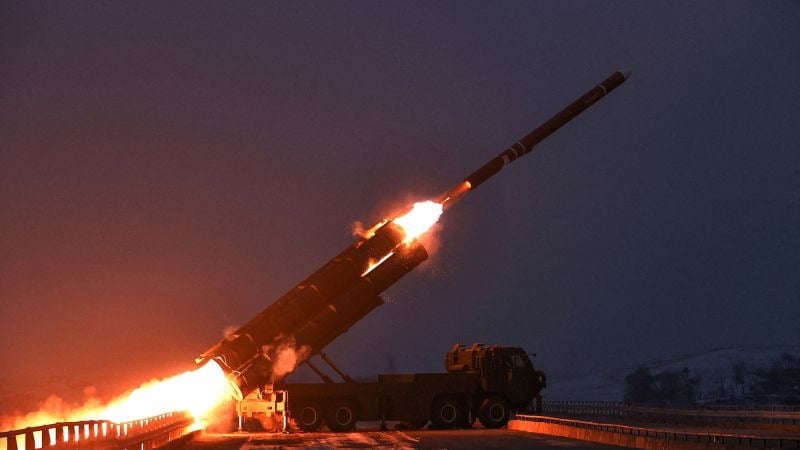
North Korea has reportedly tested a ballistic missile equipped with artificial intelligence capabilities, marking a potentially significant development in the country’s efforts to combine emerging technology with its expanding missile program.
The reported test has drawn attention because North Korea has traditionally focused on improving the range, speed, accuracy and survivability of its ballistic missiles. The addition of artificial intelligence could represent another stage in that development, potentially allowing missile systems to process information more rapidly and perform certain functions with greater autonomy.
However, details about the technology remain limited. It is not yet clear what North Korea means by an “AI-integrated” missile or how much control artificial intelligence would actually have during a flight. AI can refer to several different technologies, including systems that analyze sensor information, assist navigation, recognize objects or calculate flight adjustments.
The reported development therefore does not necessarily mean that North Korea has created a missile capable of independently selecting and attacking targets.
Ballistic missiles already rely on sophisticated computerized guidance systems. Modern weapons can process information from multiple sensors and make calculations while traveling toward a predetermined target. An AI component could potentially improve those functions by allowing a system to process more information and respond to changing conditions during flight.
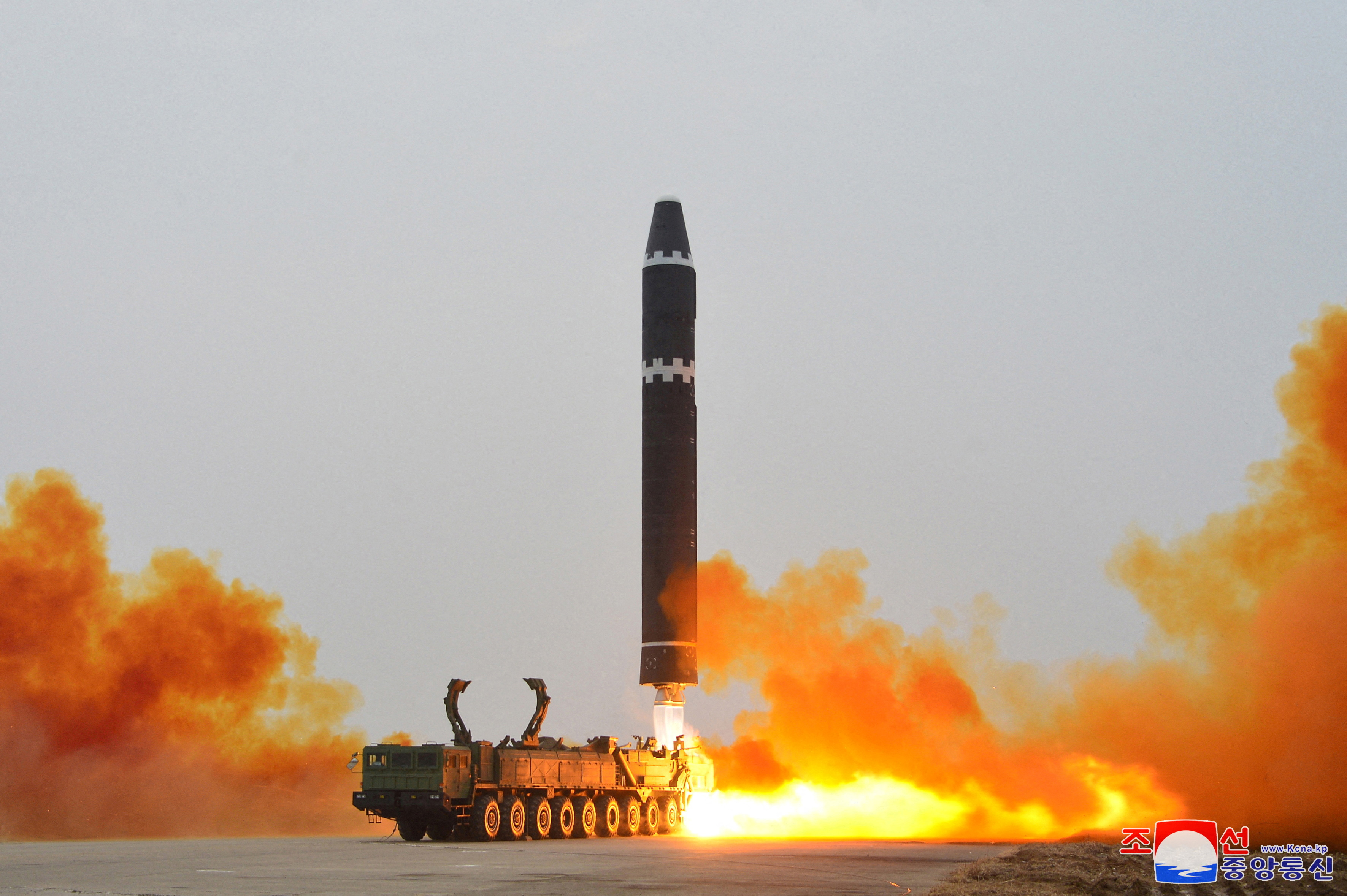
For North Korea, such capabilities could potentially improve the effectiveness of its missile forces.
The country’s military has spent years developing a wide range of ballistic missiles. Its arsenal includes short-range systems designed primarily for targets on the Korean Peninsula as well as longer-range weapons intended to reach targets much farther away.
North Korea has also experimented with maneuverable warheads and other technologies designed to make its missiles more difficult to detect or intercept. Adding sophisticated software and artificial intelligence could complement those efforts.
One possible application would involve navigation. A missile traveling through the atmosphere must constantly account for changes in its flight path. Advanced algorithms could potentially help process data from onboard sensors and calculate adjustments more quickly.
Another possible application involves target recognition. AI systems can be trained to identify patterns in large amounts of sensor data. In a military environment, that could potentially help distinguish objects or determine whether a detected target matches predefined characteristics.
The possibility of AI-assisted targeting is particularly sensitive because of the potential consequences of allowing machines to influence decisions involving lethal force.
Military AI has become an increasingly important issue around the world. Major powers are developing artificial intelligence for surveillance, intelligence analysis, autonomous drones, electronic warfare and battlefield decision-making.
Governments and international organizations have also been debating how much autonomy should be permitted in weapons systems. One of the central questions is whether humans should always remain directly responsible for decisions to use lethal force.
An AI-enabled ballistic missile would make that question even more complicated. Ballistic missiles can travel at extremely high speeds, leaving little time for human intervention once a launch has taken place. If artificial intelligence were given greater control over navigation, target identification or other functions, the distinction between human-controlled and autonomous weapons could become increasingly difficult to define.
For South Korea and Japan, any improvement in North Korea’s missile capabilities is likely to be closely monitored. Both countries have developed extensive missile-warning and defense systems in response to Pyongyang’s weapons programs.
The United States is also likely to pay close attention to the development. Washington maintains military forces in South Korea and works closely with Seoul and Tokyo on regional security.
North Korea, meanwhile, has consistently presented its military programs as necessary for national defense. Pyongyang argues that its weapons are intended to deter what it describes as hostile actions by the United States and its allies.
The United States and its allies have taken the opposite position, arguing that North Korea’s nuclear and missile programs pose a threat to regional and international security.
The introduction of artificial intelligence could add another layer to those existing tensions.
There is also uncertainty over North Korea’s ability to develop advanced AI systems for military applications. Although the country has demonstrated significant progress in missile technology, assessing its software and artificial intelligence capabilities is much more difficult.

North Korean announcements are often accompanied by limited technical information, making independent verification challenging. Analysts therefore have to distinguish between genuine technological breakthroughs, incremental improvements and political messaging.
The word “AI” itself can also create confusion. A weapon can use sophisticated algorithms without being truly autonomous. A missile that automatically adjusts its course using software is not necessarily capable of independently making strategic decisions.
Nevertheless, even relatively limited AI integration could have military significance if it improves accuracy, navigation or resistance to countermeasures.
The reported test also highlights the rapidly changing relationship between artificial intelligence and military technology. AI was once primarily associated with civilian applications such as search engines, recommendation systems and language models. It is now increasingly being incorporated into defense systems.
For countries with advanced weapons programs, AI could become a tool for improving existing capabilities rather than replacing them completely.
North Korea could similarly use AI to strengthen technologies it has already developed. Instead of creating entirely new weapons, integrating more sophisticated software into existing missile platforms could potentially improve their performance.
The reported missile test therefore raises several important questions. How much artificial intelligence is actually integrated into the weapon? Can the system independently interpret sensor information? Does it have any ability to change its mission after launch? And, most importantly, how much human control remains over the weapon?
Those answers will determine the significance of the development.
If North Korea has genuinely succeeded in deploying advanced AI within its ballistic missile program, it could represent an important technological milestone for the country’s military. It could also intensify concerns about the future of autonomous weapons and the growing role of artificial intelligence in warfare.
For now, the reported test demonstrates one clear trend: artificial intelligence is becoming increasingly intertwined with modern military technology. As countries continue to compete in both missile development and AI, the combination of the two could become one of the most consequential areas of future military innovation.