A used smartphone does not have one fixed value.
The same model can be worth significantly different amounts depending on its storage capacity, cosmetic condition, battery health, functional defects, carrier status, market demand, and the cost of preparing it for resale.
That makes device valuation one of the most important decisions in a buyback operation.
Pay too much, and your resale margin disappears.
Offer too little, and customers may take their devices somewhere else.
Modern buyback software helps solve this problem by bringing device identification, diagnostics, grading, pricing rules, and market data into a more structured valuation process.
The result is not simply a faster price.
It is a more consistent way to decide what a device is worth.
What Determines the Value of a Used Smartphone?
A smartphone’s value is usually influenced by several variables rather than one simple formula.
A practical valuation model can look like this:
Device identity + functional condition + cosmetic condition + market demand + resale value + processing costs = potential buyback value
Let’s break that down.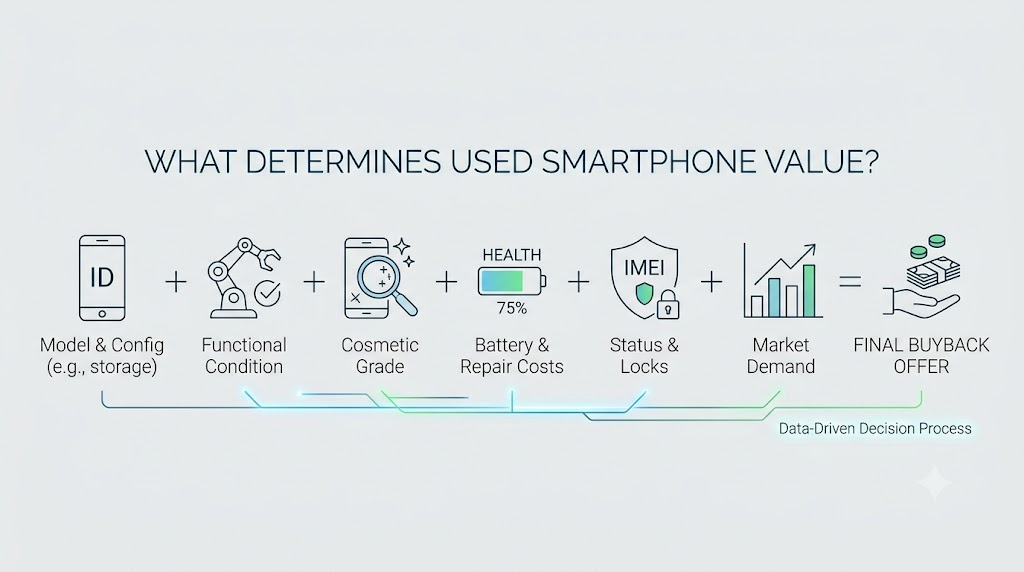
1. Device Model and Configuration
The first question is obvious:
What exactly are you buying?
A valuation system needs to distinguish between models, generations, storage capacities, regional variants, and other configurations.
An iPhone 16 Pro with 256 GB of storage should not automatically receive the same valuation as a 128 GB version.
The same applies to Android devices.
Correct device identification is therefore the foundation of accurate valuation.
2. Functional Condition
Two visually identical smartphones can have very different values if one has a defective camera, damaged charging port, weak battery, or faulty biometric sensor.
This is why professional valuation should not depend entirely on visual inspection.
Modern diagnostic systems can test functions such as:
- Display and touchscreen
- Cameras
- Speakers
- Microphones
- Sensors
- Charging
- Connectivity
- Battery-related functions
- Buttons
- Biometric features
NSYS says its diagnostics platform performs 60+ automated and semi-automated tests and can identify more than 100 hardware defects.
That information can then feed into the grading and valuation process.
3. Cosmetic Condition
A phone can be fully functional and still have a lower resale value because of visible wear.
Consider two identical phones:
Phone A: No visible scratches and minimal signs of use.
Phone B: Deep scratches on the housing and visible screen wear.
Both may pass the same functional tests.
They should not necessarily receive the same offer.
This is where cosmetic grading becomes important.
A standardized grading system translates subjective descriptions such as “excellent” or “good” into defined condition categories.
Industry research has highlighted why standardized grading matters. Without common standards, a Grade A or “Excellent” description can mean different things depending on the seller.
Modern buyback systems increasingly use structured grading or AI-assisted visual inspection to make this assessment more consistent.
4. Battery and Hardware Health
Battery condition can influence the economics of a used phone significantly.
A device with a degraded battery may require replacement before resale.
That introduces an additional cost.
The valuation system therefore needs to distinguish between:
Device value before refurbishment
and
Expected value after refurbishment costs.
The same principle applies to other defects.
If a cracked screen costs $120 to replace, that repair cost needs to be considered before deciding how much to pay for the phone.
5. Device Status and Eligibility
A phone may look perfect but still present a problem for resale.
Examples include:
- Activation locks
- Carrier locks
- Lost or stolen status
- MDM restrictions
- Financing-related restrictions
- Other device-status issues
These checks can prevent a business from paying for inventory that cannot be resold normally.
This is why IMEI and device-status checks should be part of the valuation workflow rather than treated as a separate administrative task.
6. Current Market Demand
Condition isn’t enough.
A device’s value also depends on what buyers are willing to pay for it.
Demand can vary by:
- Model
- Storage
- Region
- Carrier compatibility
- Color
- Age
- Season
- New-device launches
- Availability of competing models
B-Stock’s Mobile Insights product, for example, uses historical and current average selling price and depreciation data to help businesses understand device values and forecast pricing. It also describes using this information to inform trade-in offers.
This illustrates an important point:
Device valuation is partly a condition problem and partly a market problem.
7. Expected Resale Value
A buyback business isn’t purchasing a phone simply because the phone has value.
It is purchasing inventory that needs to generate a return.
Suppose your expected resale price is $400.
You estimate:
- $40 refurbishment cost
- $15 logistics
- $10 processing cost
- $25 expected margin requirement
That does not mean you should offer $310 automatically.
You also need to account for uncertainty, return risk, market movement, and other operational costs.
The important concept is that the buyback price should be connected to the economics of the next stage of the device’s lifecycle.
How Modern Buyback Platforms Calculate Device Value
Older buyback processes often depended heavily on employees.
An employee identifies the device, visually checks it, runs some tests, looks at a pricing list, and manually calculates an offer.
That can work at low volume.
But the process becomes harder to control when you operate multiple stores or process thousands of devices.
Modern systems bring those variables into a structured workflow.
A simplified process looks like this:
Identify → Test → Grade → Check market value → Apply pricing rules → Generate offer
Each step contributes information to the final valuation.
Step 1: Identify
The system establishes the exact device and configuration.
Step 2: Test
Diagnostics identify functional problems that could affect value.
Step 3: Grade
Cosmetic condition is classified using predefined criteria.
Step 4: Check market conditions
Current or historical market data can help establish expected resale value.
Step 5: Apply pricing rules
The business applies its own purchasing strategy, margins, repair assumptions, and other rules.
Step 6: Generate the offer
The customer receives a price based on the combined evaluation.
This approach reduces the amount of subjective decision-making required from the employee.
Manual Valuation vs Modern Automated Valuation
The difference becomes clearer when you compare the two approaches.
| Factor | Manual Valuation | Modern Automated Valuation |
| Device identification | Employee identifies model and configuration | Device information can be captured and verified systematically |
| Functional testing | Depends on technician and checklist | Standardized diagnostic workflow |
| Cosmetic grading | Can vary between employees | Defined grading criteria and, in some systems, AI-assisted assessment |
| Pricing | Employees may reference price lists or calculate manually | Pricing rules can be applied systematically |
| Market data | May require separate research | Can be connected to pricing or market-data systems |
| Processing speed | Slows as inspection volume increases | Designed to handle higher volumes with repeatable workflows |
| Consistency | Can vary by location, experience, and fatigue | Same rules can be applied across locations |
| Documentation | Often spread across forms or systems | Evaluation data can be stored with the device record |
| Scalability | Requires additional trained staff | Easier to deploy across multiple stores or processing centers |
| Auditability | Depends on how well employees document decisions | Digital records can show how the offer was generated |
The key advantage is not simply automation.
It is repeatability.
If the same phone is evaluated at two different stores, you want the business rules to produce comparable outcomes.
Why Consistency Matters in Device Valuation
Imagine you operate 30 retail locations.
At Store A, an employee considers light scratches acceptable.
At Store B, another employee downgrades phones with the same scratches.
At Store C, the employee doesn’t test battery health before making an offer.
You now have three different valuation processes.
That creates problems for both sides.
Customers may receive different offers for similar devices.
The business may overpay at one location and underpay at another.
Inventory grades may become inconsistent.
Managers may struggle to understand why margins vary between stores.
Standardized valuation reduces this variability.
The employee still matters, but the employee is working inside a defined process rather than creating the process from scratch.
Why Device Diagnostics Should Be Part of Valuation
A common mistake is to treat diagnostics as a quality-control step that happens after pricing.
For buyback operations, diagnostics can influence the price itself.
Consider a smartphone with:
- Excellent cosmetic condition
- Working display
- Good cameras
- Weak battery
- Faulty microphone
A purely visual inspection could make the phone look like high-value inventory.
A diagnostic assessment tells you otherwise.
That information can affect:
- Buyback price
- Repair decision
- Final grade
- Expected resale value
- Profit margin
NSYS describes this connection directly: diagnostic results can support grading, pricing, repair decisions, certification, and resale.
This is why diagnostics and valuation work better as connected processes.
How NSYS Buyback Uses Device Condition to Support Valuation
NSYS Buyback is designed around the idea that a buyback offer should be based on more than the device model.
The workflow can incorporate:
- Device identification
- IMEI checks
- Functional diagnostics
- Cosmetic evaluation
- Device grading
- Pricing
- Data erasure
- Certification
- Order tracking
NSYS describes its Buyback platform as an automated system for buyback and trade-in management, while its wider ecosystem connects Buyback with Diagnostics, Autograding, Data Erasure, and Inventory.
That creates a connected valuation workflow.
Functional condition
NSYS Diagnostics can run more than 60 automated and semi-automated tests and identify more than 100 hardware defects, according to NSYS.
Cosmetic condition
NSYS Autograding uses AI-powered visual assessment to help standardize cosmetic grading.
Device identity
IMEI and device-status information can be used as part of the buying decision.
Pricing
The evaluated device condition can then be used within the buyback workflow to determine the offer.
This is particularly valuable when you are processing high volumes.
Instead of asking every employee to remember how each defect should affect an offer, you can build the evaluation logic into the workflow.
What Happens After the Device Is Valued?
Valuation shouldn’t be the end of the process.
It should be the beginning of the device’s next lifecycle stage.
Once a customer accepts an offer, the business still needs to:
- Record the transaction.
- Securely erase previous-owner data.
- Confirm the final condition.
- Assign the device to inventory.
- Decide whether it needs repair.
- Determine its resale channel.
- Price it for the next buyer.
This is another reason integrated platforms can be useful.
The same device record can follow the phone from buyback to diagnostics to grading to erasure to inventory and resale.
NSYS describes this type of connected workflow across its product ecosystem, including Buyback, Diagnostics, Autograding, Data Erasure, and Inventory.
Does Automation Always Produce a Better Valuation?
Not automatically.
Automation is only as good as the data and rules behind it.
A good valuation system still needs:
- Accurate device identification
- Reliable diagnostics
- Clear grading standards
- Current pricing information
- Appropriate business rules
- Regular pricing updates
There will also be unusual cases.
A rare device configuration, unusual cosmetic defect, market shock, or repair issue may require human review.
The goal isn’t to remove humans from valuation.
It is to reduce unnecessary subjectivity while giving employees better information to make decisions.
What Should You Look for in Buyback Software?
If you’re evaluating platforms, don’t focus only on whether the vendor says it offers “automated valuation.”
Ask how the valuation actually works.
Does it identify the exact device?
A pricing engine is only useful if the underlying device information is accurate.
Does it test functional condition?
Find out which components are tested and whether the testing process can be standardized.
Does it assess cosmetic condition?
Ask whether grading is manual, rule-based, AI-assisted, or a combination.
Can you configure pricing rules?
Your business may have different margins, repair costs, or buying strategies from another company.
Can it use market data?
Market values change. A pricing model based on outdated assumptions can quickly become inaccurate.
Can you audit the valuation?
You should be able to understand why a particular device received a particular offer.
Does the workflow scale?
Ask what happens when you move from one store to 20.
The important question is not:
“Can the software value a phone?”
It is:
“Can the software value thousands of phones consistently while preserving the economics of my business?”
The Future of Device Valuation
As the secondary smartphone market grows, valuation is becoming increasingly data-driven.
The combination of diagnostics, AI-assisted grading, market intelligence, and automated pricing can reduce the amount of guesswork involved in acquiring used devices.
At the same time, human oversight remains important.
The strongest model is not necessarily human versus automation.
It is automation for repeatable decisions + human judgment for exceptions.
For buyback businesses, that combination can help create faster customer experiences while protecting purchasing margins.
And that is ultimately what modern valuation is about.
Not finding a theoretical price for a phone.
Finding a price that makes sense for the device, the customer, the current market, and the economics of the business acquiring it.
Frequently Asked Questions
How do buyback platforms determine the value of a smartphone?
They typically combine device identification, functional condition, cosmetic grade, battery health, device status, market value, and business pricing rules to calculate an offer.
Does cosmetic condition affect smartphone buyback value?
Yes. Two devices with identical specifications can have different values because of scratches, dents, cracks, screen wear, or other cosmetic differences.
Why are diagnostics important for device valuation?
Diagnostics identify functional defects that may not be visible during a visual inspection. These defects can affect repair costs, resale value, grading, and the final buyback offer.
Can AI determine the value of a smartphone?
AI can assist with parts of the valuation process, particularly cosmetic grading and pattern recognition. However, the final value also depends on factors such as market pricing, device configuration, repair costs, and business rules.
How does automated valuation help buyback businesses?
It can make valuation faster and more consistent by applying standardized testing, grading, and pricing rules across devices and locations.
Should employees still review automated valuations?
Yes. Automated systems are useful for repeatable assessments, while human review remains valuable for unusual devices, disputed results, and edge cases.