
AI is becoming a core part of CRM platforms rather than just an extra feature. It’s the center of how Salesforce works now. More than 12,000 businesses have used Agentforce since its launch, and its use continues to expand rapidly. It is being used by banks to respond to first-level customer inquiries without any human intervention. Retailers are deploying it to manage their order support workflow process. And the healthcare sector is deploying it for routing patient inquiries without any human intervention. The technology is yielding measurable benefits to businesses, but the people who know how to set up and control such agents are few.
That supply gap is exactly what the Salesforce Certified Agentforce Specialist certification was built to address.
What Is Agentforce and Why Does It Matter Beyond the Hype?
Agentforce is Salesforce’s autonomous AI agent platform. It makes it possible for enterprises to create AI agents that are capable of performing actions within the Salesforce environment. The agent may qualify leads, resolve cases, schedule follow-up, retrieve data from a third party and pass control back to a human being if needed. All that is done while utilizing the current Salesforce infrastructure without creating another AI stack.
Companies are using Agentforce to make their business processes automatic. They need employees who understand how to design and control such agents of artificial intelligence. This is the reason behind the popularity of the Agentforce Specialist certification in the Salesforce community in 2026. Not only in terms of technical skills but in a manner that brings about the desired business result for the client. This is the job of the consultant.
Where Businesses Are Seeing Real Results From Agentforce Deployments
The business cases that drove Agentforce adoption are worth understanding because they’re exactly what exam scenarios are built around. A financial services firm deploying an Agentforce Service agent to handle account inquiries needs the agent configured correctly for the security context it runs in. Getting the security context wrong means the agent either can’t access the data it needs or accesses data it shouldn’t. That’s a real implementation failure, and the exam tests whether you can prevent it.
A retail company deploying an Employee agent to assist internal sales teams with product recommendations needs deterministic behavior configured so the agent stays within defined guardrails. Without proper filter and variable configuration, agents drift outside intended scope and produce outputs that create support overhead rather than reducing it.
This is not a hypothetical situation. The average salary increase for an Agentforce Specialist professional is $15,000 to $30,000 per year in 2026 due to the very same reason. They are willing to pay someone to do this work correctly from the start.
For professionals who want to understand the full certification scope before committing to a study plan, CertBoosters covers the industry insights, global demand overview, and preparation questions in one place.
What Does the Salesforce Agentforce Specialist Certification Actually Test?
The exam has 60 multiple-choice questions, a 105-minute time limit, and a passing score of 72%. It costs $200 to register and aligns with the Spring 26 release. According to the official Salesforce Certified Agentforce Specialist Exam Guide, the exam covers AI Agents at 35% of the total weighting, making it by far the heaviest domain.
The six domains break down across the core competencies a working Agentforce specialist actually needs.
AI Agents at 35% cover the AI agents, hybrid reasoning, deterministic behavior through filters and variables, topic and action settings, channel integrations such as digital experience, email, voice and Slack channels, security context while executing agents, and usage of Employee and Service agents.
Prompt Engineering at 20% involves building and refining prompts for Agentforce, the principles of prompt templates, and how building prompts impacts agent behavior and performance. Prompt engineering is a field that tends to surprise candidates with its practicality in an exam context.
Data 360 Fundamentals at 20% covers how Agentforce connects to Salesforce Data Cloud, unified data models, and how data grounding affects agent responses. This is where the Data Cloud integration becomes critical. Agents that don’t have properly grounded data produce unreliable outputs, and this domain tests whether you understand how to prevent that.
Testing and Deployment at 13% covers how to validate agent behavior before go-live, testing frameworks, monitoring deployed agents, and identifying when an agent is underperforming against its intended function.
Governance and Observability, the most recent domain introduced in the Spring 26 version by 7%, includes Einstein Trust Layer, data masking, audit trails, and governance of AI agent behavior within the enterprise security framework. Any study material created prior to Spring 26 lacks this domain completely.
Multi-Agent Interoperability at 5% covers the Protocol for Modeling Context, Agent-to-Agent Communication, and when to use the Agent API. Lightweight in terms of size but increasingly being used as multi-agent systems become common in enterprise.
Why Salesforce Agentforce Specialist Certification Is Harder to Prepare
The Agentforce Specialist exam is scenario-heavy in a way that differs from traditional Salesforce certifications. The questions do not require that you remember what the topic is about. Instead, they provide you with the description of a situation where a company deploys a Service agent that has certain channel, data access, and security requirements. Four answer choices, two of which look valid. The correct one depends on reading the scenario constraints carefully.
The Governance and Observability domain catches the most candidates off guard because it’s new and most available preparation materials don’t cover it adequately. Einstein Trust Layer, Data Masking Configuration, and Audit Trail Requirement are topics that are explicitly covered in examination papers, and those candidates who omitted this particular domain, considering its weightage, report that this is where they have lost points unexpectedly.
Getting into Salesforce Agentforce Specialist Exam Questions early in your preparation is what separates candidates who pass from those who discover their gaps on exam day. Based on the Spring 26 exam structure that includes the Governance and Observability domain, answering them within a time limit in the first week would give you an idea of how you should improve your preparation.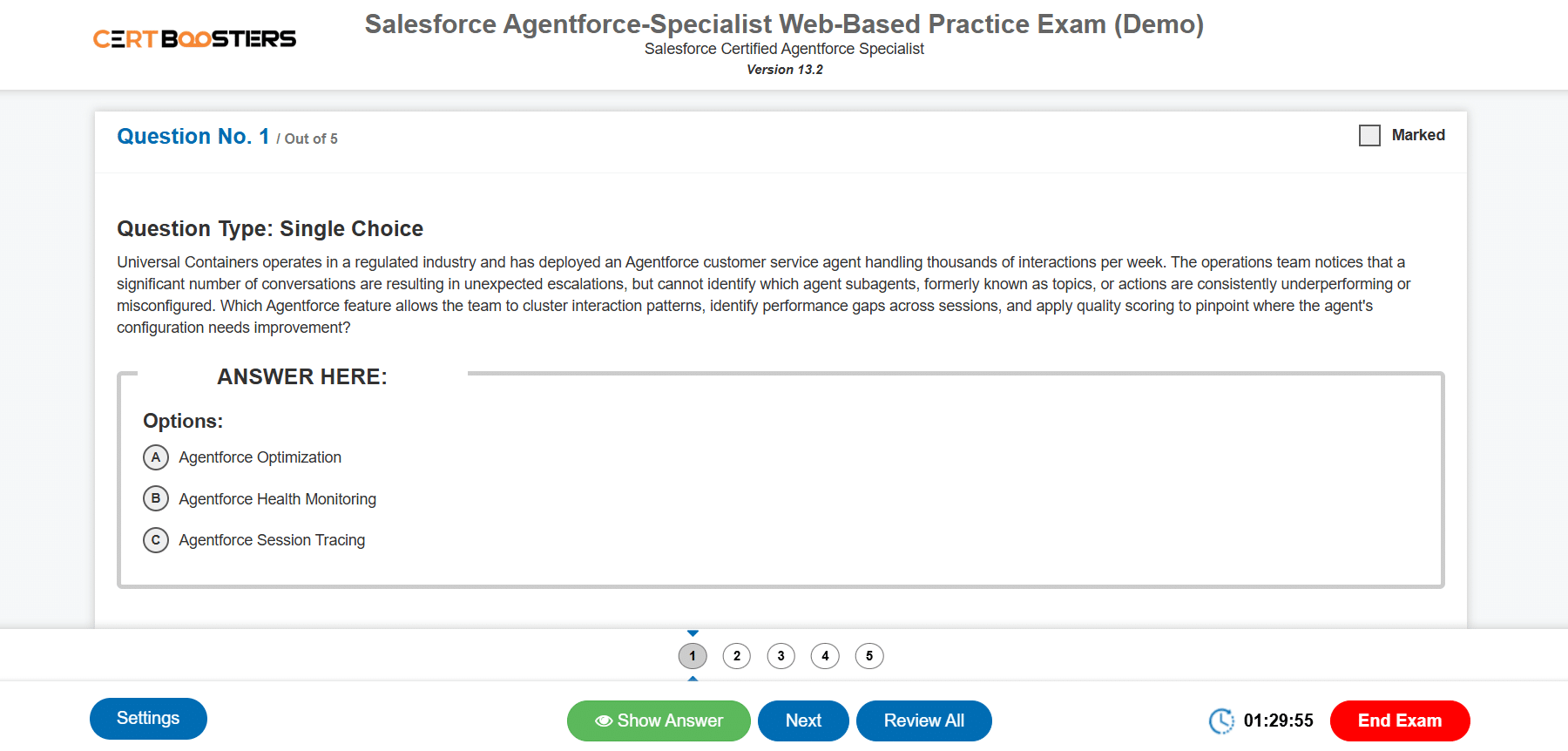
Is the Salesforce Agentforce Specialist Certification Worth It in 2026?
Here’s what the certification data actually shows. The professionals earning Agentforce Specialist in 2026 aren’t just adding a credential to their resume. They’re positioning themselves inside a deployment wave that is still in its early stages. Over 12,000 organizations have deployed Agentforce, but adoption is accelerating, not plateauing. The implementations going live in 2027 and 2028 will be more complex, more multi-agent, and more governance-heavy than what’s being built today.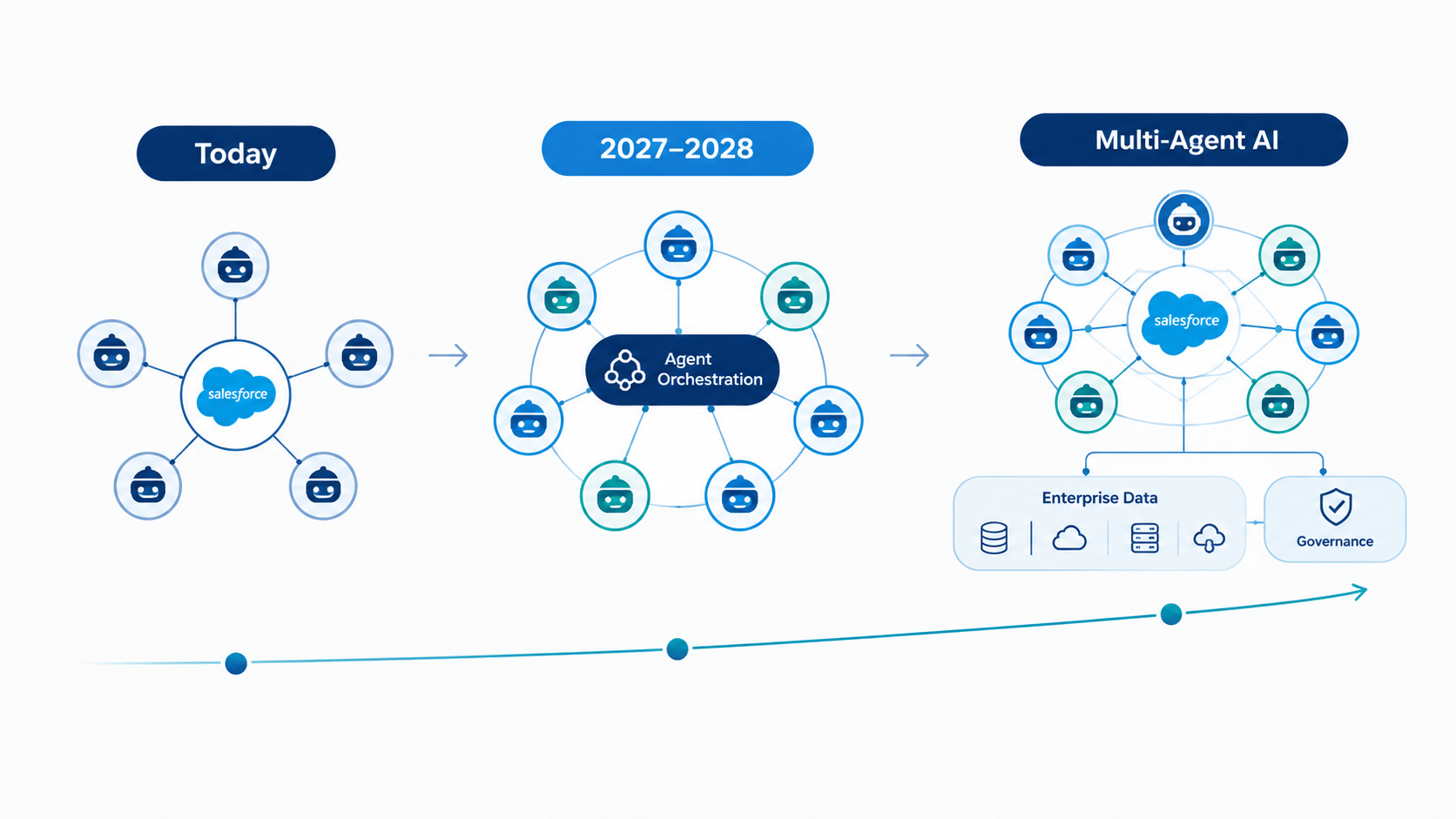
The professionals who fully comprehend Agentforce today – from its governance to multi-agent orchestration to its integration with Data Cloud – will be leading the way in these more complicated implementations. The certification is only the first step in the process. What you do with the knowledge after you pass determines the trajectory.
The real question isn’t whether the Agentforce Specialist certification is worth pursuing. It’s whether you understand enough about where Agentforce is heading to know what preparation you actually need right now.