You upload a long document and ask AI to summarize it. The screen stays quiet for a few seconds, then the answer begins to appear. That brief wait reveals two important parts of AI infrastructure: processing existing information and generating new content.
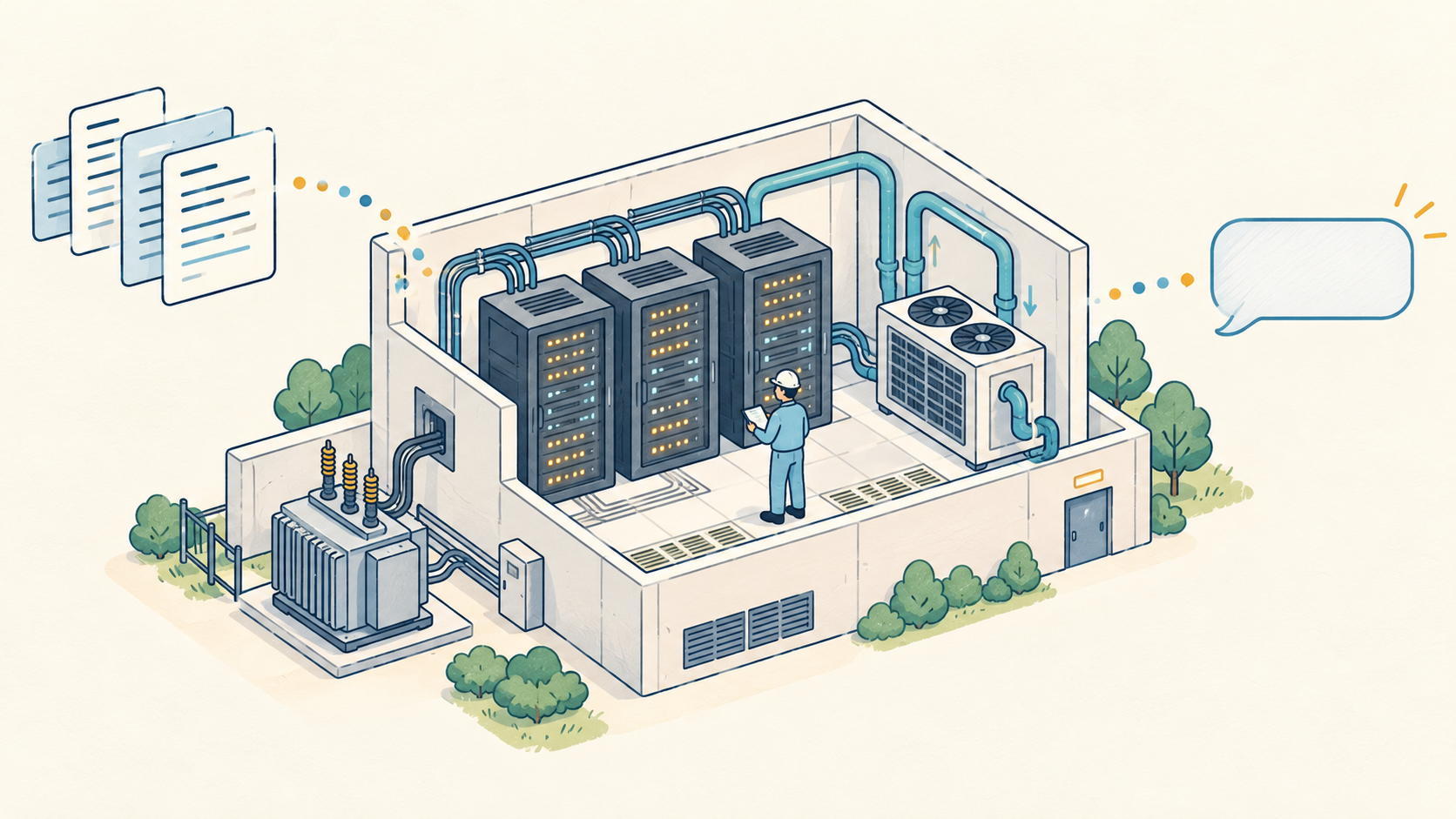
An AI data center provides the computing, storage, networking, power, and cooling needed for AI training and inference. Training develops or adjusts a model’s capabilities. Inference uses those capabilities to perform tasks such as summarizing documents, answering questions, or generating code.
For users, a request begins with clicking “send.” For operators, it requires equipment, data, and electricity to work together. Even with GPUs and a suitable facility, coordination affects response times and operating costs.
51AIpower: Opening Individual Participation in AI Infrastructure Through Power
Electricity supports every stage of this process. GPUs processing documents, models generating responses, and networking and cooling equipment all depend on power. As AI becomes part of everyday life, the infrastructure supplying that power becomes increasingly relevant.
This raises a question for individuals: beyond using AI tools, can they participate in the infrastructure behind them? Purchasing GPUs, arranging electricity, and maintaining equipment require capital and technical expertise. Individual power plans offer another entry point.
51AIpower focuses on supporting the electricity requirements of AI infrastructure, offering Power Plans designed to lower barriers to individual participation. Users support the power and GPU computing required by AI factories without purchasing hardware, deploying equipment, or supplying electricity themselves. Rewards depend on plan terms and actual operating performance.
This approach allows individuals to explore earning opportunities in the infrastructure supporting the AI economy. To understand the resources involved, return to the opening example: what happens inside a data center while AI reads your document?
Why Does AI Pause Before Answering a Long Document?
Suppose you ask AI to read a report and summarize it in several paragraphs. For common autoregressive language models, inference typically involves two main stages.
First comes prefill, which processes the input. After the system converts the input into tokens, the model processes that content to establish context. During decode, it progressively generates output tokens that form the response.
NVIDIA’s March 2026 technical explanation describes different resource requirements for these stages: prefill is generally compute-intensive, while decode is often constrained by memory bandwidth. Some systems deploy them separately so resources can be allocated to each stage.
This helps explain why the time before an answer starts differs from its subsequent generation speed. Input length, queues, model configuration, and system load can all affect the experience. A slow response alone does not establish that more GPUs are needed.
What Do GPUs, Power, Cooling, and Networks Actually Do?
GPUs handle substantial parallel computation, but a complete AI service also depends on resources that keep those processors supplied with data and operating reliably.
| Component | Role in an AI service | Potential constraint |
| GPUs and other processors | Perform model computations | Limited request-processing capacity |
| GPU and system memory | Hold models and working data | Limits on model size, context, or concurrency |
| Networking and storage | Supply data and connect equipment | Processors waiting for data or communication |
| Power systems | Supply reliable electricity | Restrictions on operation or expansion |
| Cooling systems | Remove heat | Difficulty sustaining designed performance |
| Scheduling software | Allocate requests and resources | Busy resources alongside idle capacity |
NVIDIA’s enterprise AI factory architecture guidance, updated in September 2026, treats computing, networking, storage, software, and facility requirements as connected design decisions. It identifies inadequate networking and storage paths as potential obstacles to deployment and operation.
GPU counts are therefore only a starting point. The more useful question is how much productive work the equipment can sustain. Adding processors will not necessarily deliver proportional gains if they spend time waiting for data.
How Do AI Data Centers Differ From Conventional Data Centers?
Conventional data centers host websites, databases, enterprise software, and cloud services. AI data centers use much of the same underlying infrastructure, with configurations adapted to AI workloads.
The distinction is not absolute. Existing facilities can support some AI tasks, and one location may run inference, analytics, and other services together. A configuration suitable for modest inference workloads may be unsuitable for large-scale training.
Cooling also depends on the deployment. NVIDIA’s enterprise guidance discusses both air-cooled and higher-density configurations, emphasizing the need to match infrastructure to workload and facility constraints. An AI data center does not automatically require liquid cooling in every rack.
What matters is whether the facility can support its intended tasks consistently.
The 2026 Question: How Much More Work Can Existing Power Support?
The International Energy Agency’s 2026 report, Key Questions on Energy and AI, estimates global data center electricity consumption at approximately 485 terawatt-hours in 2025, projecting about 950 TWh by 2030. The first figure estimates a past year; the second is a forecast. Both cover data centers overall, not exclusively AI facilities.
Alongside expansion, operators are investigating how to use available electricity more effectively. Increasing supply requires physical infrastructure, while resource allocation can sometimes unlock capacity within an existing installation.
In a September 15, 2026 case study, NVIDIA reported that GPU cloud provider Lambda achieved 24% greater token throughput within the same power budget through power-allocation changes in a specific cluster test. This vendor-reported result should not be generalized to every data center.
The example illustrates why available power and productive output are separate measures. Performance depends partly on how resources are coordinated.
Why Does the Same Number of AI Tokens Not Mean the Same Electricity Use?
Tokens represent units of content processed by a model, such as words, word fragments, or other elements. Input and output tokens measure content entering and leaving language-model services. Here, AI tokens are not cryptocurrency.
Tokens are also not electricity units. Model size, context length, generation methods, hardware, and concurrent requests affect the computation involved. Processing a thousand input tokens is not equivalent to progressively generating a thousand output tokens.
NVIDIA’s 2026 analysis of long-context inference examines how sequence length, attention configuration, and parallelism affect performance. Token-speed comparisons therefore need context about the model, equipment, and workload used.
Commercially, the AI token economy connects usage measurement, service pricing, and resource costs. Increasing token usage indicates activity, but profitability depends on whether revenue covers equipment, electricity, and operations.
How Can Individuals Get Started With 51AIpower?
51AIpower organizes participation through individual Power Plans, allowing users to review plan activity and reward records without becoming hardware operators.
Under the platform’s stated rules, new users receive up to 200 free Starter Plan purchases, limited to one per day. Earnings are real and credited to the account, while withdrawals remain subject to applicable conditions. The free purchase allowance itself is not withdrawable cash.
Users can register, review the Starter Plan instructions, activate a plan using their allowance, and explore account records. Before considering paid Power Plans, they should understand duration, reward calculations, financial restrictions, and withdrawal requirements.
Participation rights depend on the applicable contract. Starter Plan results do not establish future paid-plan performance.
Risk disclosure: Infrastructure participation involves platform, contractual, financial, and operational risks, including potential losses. Industry growth, estimated rewards, and trial results do not guarantee individual returns.
Frequently Asked Questions
Does AI Retrain Its Model Whenever It Answers a Question?
Usually not. Everyday questions generally involve inference using an existing model. Training and model updates are separate processes.
Does Every AI Data Center Need GPUs?
GPUs are important, but other accelerators and CPUs may also serve AI workloads. Requirements depend on the model, task, cost, and performance objectives.
Can AI Tokens Be Converted Directly Into Electricity Costs or Rewards?
There is no universal conversion across models and facilities. Electricity costs depend on operating conditions; platform rewards also depend on contracts, calculation rules, and performance.