Beyond Speed and Scale
Artificial intelligence now sits inside the tools people use every day, from the apps that sort their inboxes to the systems that route their medical records. Most of the public conversation still centers on speed, scale, and computing power. Far less attention goes to the people those systems are meant to serve.
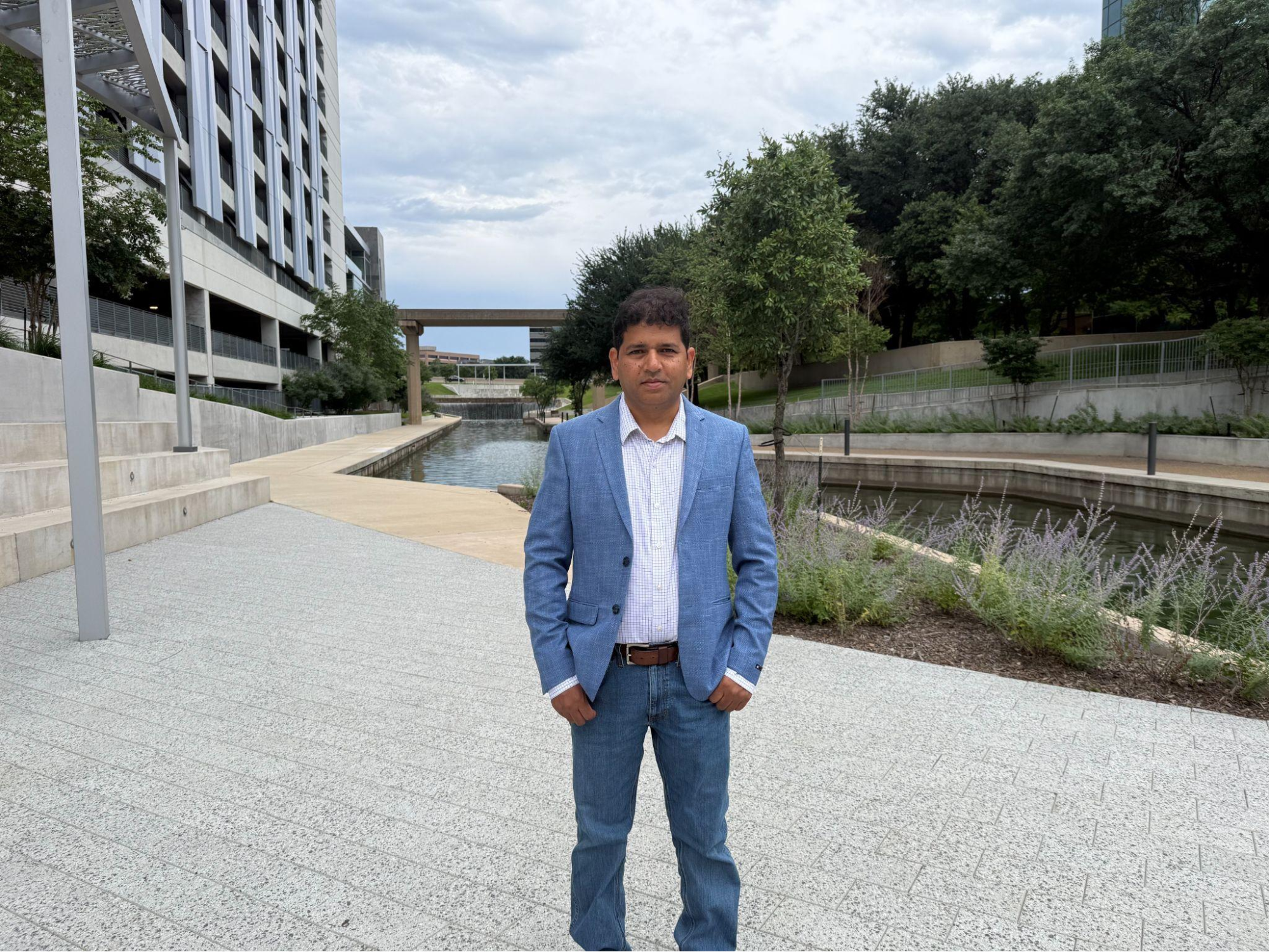
Manas Mohanty has spent his career close to that gap. A Senior Data Architect at Christus Health in Irving, Texas, he has watched what happens when technology is built well and when it is not. His new book, Beyond Algorithms: The Human Side of AI and Machine Learning, is his attempt to widen the conversation. Available in paperback on Amazon, it argues that the real measure of AI is not what machines can compute but how well they support human judgment, values, and potential.
Two Decades Inside Enterprise Systems
Mohanty’s perspective comes from long experience rather than theory. Born in Puri, Odisha, India, he earned a Master of Science in Computer Information Systems at the Regional College of Management in Bhubaneswar. He then built a career of more than nineteen years across industries where mistakes are expensive.
At Satyam Computer Services, working with Citi Group’s lending systems, he helped engineer security applications and led migrations that moved obsolete platforms onto modern Microsoft .NET and Oracle environments. At Tech Mahindra, within General Electric’s Power and Water monitoring and diagnostics group, he developed Optimus, a tool built on TIBCO Spotfire, GE Proficy Historian, and MATLAB that tracked sensor data from hydro, wind, and gas turbines. At Chetu Inc., he spent more than eight years leading development of Electronic Health Record applications for clients across the United States and Africa, working through the integrations and compliance demands that come with patient data.
Each of these roles taught him something the textbooks tend to leave out. Systems do not exist in isolation, and the people who rely on them rarely see the engineering underneath. They only notice when it fails.
What Healthcare Taught Him About Trust
Nowhere has that lesson been clearer than at Christus Health, a non-profit healthcare system whose mission is to extend the healing ministry of Jesus Christ. As Data Analytics and Engineer II, Mohanty works as a Senior Data Architect and as the cross-functional Master Data Management lead across a dense ecosystem of clinical and administrative platforms.
One of his best-known projects began with a very ordinary problem. Referrals, records, and paperwork were arriving by fax and being handled by hand, which meant a processing cycle of roughly twenty-four hours. Rather than patching that workflow, Mohanty redesigned it, building a Generative AI and large language model–based ingestion pipeline to read and route incoming documents. Cycle times dropped from twenty-four hours to under two minutes.
His wider portfolio includes integrations across Epic EHR, MDStaff, Kyruus, Sparkle, Merge, and Pieces, with 99.9 percent uptime for critical registries. He has also built monitoring tools for compliance-sensitive areas such as federal debarment and sanctions, fraudulent TRICARE sanctions, national provider registries, and pharmacy claims and prescription data.
Working in that environment shaped his thinking about AI. A faster pipeline matters only if clinicians and administrators can trust what comes out of it. In his view, trust is not a feature added at the end. It has to be designed from the start.
Inside Beyond Algorithms
The book takes readers through the relationship between people and intelligent machines, combining technical insight with ethics, cognitive science, and real-world application. It follows the arc of the field from early technical experimentation toward systems designed around human needs, and then looks ahead to what collaboration between humans and AI might become.
Its main themes include:
- The evolution of human-centered AI: how the field has shifted from technical experimentation toward systems built around human needs, values, and experiences
- Mind and machine: the similarities and differences between human cognition and machine learning, and how cognitive science informs AI development
- Ethics and responsibility: why fairness, transparency, and accountability must guide how intelligent systems are designed and deployed
- AI’s impact on society: how AI is changing industries, professional skills, communication, and relationships
- The art of machine teaching: the role of human expertise in training systems and choosing meaningful data
- Human-AI partnerships: how explainable AI, intuitive interfaces, and adaptability build trust between people and machines
- An AI-enabled future: how emerging technologies, cultural perspectives, and responsible policy can shape a shared future
The book is written for a broad audience, including students, researchers, educators, technology professionals, and business leaders, along with anyone curious about where the technology is heading. It avoids heavy jargon and keeps its focus on the questions that matter to non-specialists as much as to engineers.
Machine Teaching and the Role of Human Judgment
One of the book’s more distinctive ideas is what Mohanty calls the art of machine teaching. Public discussion tends to treat AI as something that simply learns on its own. His experience suggests otherwise. Behind every capable system are people who decide what data to use, what to leave out, and what “good” should look like.
That is where human responsibility begins. A model trained on poorly chosen data will reflect those choices, and an unexplained system will be hard for anyone to rely on. Mohanty’s argument is that people are not a temporary stage on the way to full automation. They are the reason the technology exists and the standard by which it should be judged.
“The most useful AI is not the one that replaces human judgment,” Mohanty says. “It is the one that gives people a better foundation to exercise it, and that only happens when we design for trust, transparency, and human values from the very beginning.”
A Practitioner Who Also Teaches
Mohanty’s writing is not limited to the book. He is a published technical author on CodeProject, where his work on secure data protocols won the Best Article of May 2023, Second Prize. His credentials include Microsoft Certified: DevOps Engineer Expert, Azure Administrator, and Technology Specialist, along with the ITIL 4 Foundation Certificate. He has also completed Stanford University’s Internet of Things program.
Outside work, he volunteers with local road-cleaning efforts and supports Our Daily Bread, which assists homeless and at-risk individuals. He meditates, gardens, travels, and spends unhurried time with his wife and son, visiting libraries, exploring parks, and biking. The same instinct that shapes his engineering, a concern for the people on the receiving end of a system, shows up in how he spends his time away from it.
Looking Ahead
As AI moves deeper into hospitals, workplaces, schools, and homes, the choices made by the people who build and govern these systems will carry real consequences. Mohanty does not argue for slowing down. He argues for building with more care, for asking who benefits, who might be left out, and how a system can be explained to the people who depend on it.
Beyond Algorithms is his contribution to that effort. It is the work of an engineer who has seen what technology can do when it is built responsibly, and who believes the next chapter of AI will be written as much by human values as by code.