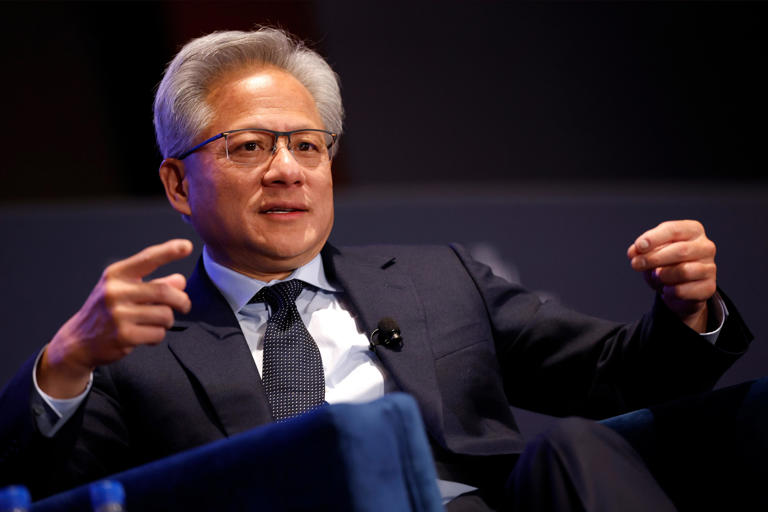
Nvidia CEO Jensen Huang didn’t mince words during his recent appearance at the Hill & Valley Forum in Washington, D.C. For the man leading the world’s most influential AI hardware company, the message was simple but urgent: the United States must act now to stay competitive in the global AI race. That means more than just investing in chips and data centers it means reskilling the American workforce, at scale, and fast.
Huang’s keynote struck a balance between optimism and urgency. “To lead,” he said, “the U.S. must embrace the technology, invest in reskilling, and equip every worker to build with it.” This isn’t a passing trend, he emphasized. AI is becoming as foundational to the global economy as electricity or steel once were and countries that fail to harness it will be left behind.
Drawing a comparison to previous industrial revolutions, Huang reminded his audience how the U.S. surged ahead by being the fastest to adapt to new technologies. The AI revolution, he argued, requires the same level of boldness and coordination, not fear or hesitation.
Huang didn’t shy away from geopolitical realities. One of the more striking data points he shared: half of the world’s AI researchers are Chinese. While he didn’t frame it as a threat, he made clear that such figures should shape how U.S. leaders think about long-term strategy.
“This must play into how we think about the game,” he said, pointing to the intensifying U.S.-China tech rivalry. It’s not just a competition over chips or algorithms it’s a race for global influence, economic power, and technological leadership.
Recent U.S. export restrictions on Nvidia’s H20 chips tailored for the Chinese market could cost the company up to $5.5 billion in revenue. That figure underscores how AI development and geopolitics are now deeply intertwined.
AI won’t be “solved” next year, or even next decade. Huang called it an “infinite game” one that requires constant iteration, innovation, and adaptation. And while he acknowledged concerns about job displacement, he urged policymakers and business leaders to shift their perspective.
“This isn’t about replacement,” he said. “It’s about augmentation, transformation, and growth.” Huang believes AI, like past waves of automation, will create new industries and roles but only if the workforce is ready.
He warned that by 2030, the world could face a shortfall of at least 50 million workers. AI and robotics, he argued, will be essential to filling that gap not just replacing human labor, but stepping in where workers are no longer accessible.
At his recent GTC 2025 keynote, Huang launched Groot N1, a new foundational AI model made to power humanoid robots. This move signals Nvidia’s next frontier: bringing AI off the cloud and into the physical world.
Groot N1 is built to enable robots that can understand, reason, and move through complex environments. In Huang’s vision, these machines could become digital employees operating in warehouses, hospitals, and even homes, wherever human labor is in short supply.
It’s not science fiction anymore. It’s a calculated response to demographic trends and productivity needs, especially in aging societies like Japan, South Korea, and parts of Europe.
Even with all this momentum, Nvidia faces its own challenges. The new Blackwell AI chips set to power the next generation of data centers and AI models are already in short supply. Huang admitted that demand is outpacing production, a problem that could slow deployments in the near term.
Still, he remains confident. “Demand is just incredible,” he told Fox Business. Even with trade restrictions and logistical hurdles, Nvidia’s roadmap is clearly aligned with where the industry and the world is headed.
Huang also made a bold prediction: AI could eventually augment up to 40% of jobs. Not in a dystopian sense, but by handling repetitive tasks, supercharging productivity, and giving workers more creative and strategic bandwidth.
For Huang, this is more than a corporate outlook it’s a call to national action. He believes the U.S. needs a comprehensive AI workforce strategy, one that brings together government, academia, and private industry. That means revamping education, launching large-scale reskilling programs, and making AI literacy a mainstream goal.
His message was clear: AI will reshape the economy whether we’re ready or not. The question is whether the U.S. will lead that change or scramble to catch up.
“We’re not racing against machines,” he said. “We’re racing against stagnation.”