The financial crisis surrounding edtech giant Byju’s has deepened further, as the Qatar Investment Authority (QIA), through its subsidiary Qatar Holding LLC, has filed a fresh enforcement petition in the Karnataka High Court. The petition seeks to recover a massive $235 million arbitral award, plus an additional 4% interest compounded daily since February 2024, pushing the total outstanding obligation to over $249 million.
For Byju’s, already reeling under mounting debt, investor disputes, and regulatory scrutiny, this escalation adds another layer of pressure. For QIA, it marks a decisive move to ensure its multi-million-dollar investment is not lost in the turmoil.

Credits: Business Standard
How It All Began: The 2022 Loan Deal
The roots of the dispute date back to September 2022, when Qatar Holding extended a $150 million loan to Byju’s Investments Private Limited (BIPL). BIPL, an investment vehicle fully owned by Byju’s Global, had Byju Raveendran as its sole shareholder. The loan was personally guaranteed by Raveendran, highlighting QIA’s reliance on his credibility at the time.
The loan proceeds were earmarked for a strategic purpose — acquiring 17.89 million shares in Aakash Educational Services Limited (AESL). AESL, better known as Aakash Institute, had been acquired by Byju’s in 2021 in what was then hailed as a landmark deal for the edtech sector.
However, QIA’s financing agreement reportedly came with a clear restriction: the AESL shares purchased through the loan could not be transferred to another entity or individual.
Breach of Agreement: The Trigger for Dispute
QIA alleges that this restriction was violated when the AESL shares were later moved to another Singapore-based corporate entity controlled by Raveendran. According to Qatar Holding, this transfer not only breached the financing agreement but also created a significant risk of asset diversion, leaving the sovereign wealth fund exposed.
This alleged breach triggered a series of legal proceedings. Qatar Holding initially approached the Karnataka High Court, seeking to restrain Raveendran and BIPL from disposing of assets worth $235 million, including AESL shares.
Indian Court’s Initial Stand
In April 2024, the Karnataka High Court dismissed Qatar Holding’s petitions for asset restraint. The court held that since the dispute arose out of a financing agreement with an arbitration clause, Qatar Holding must take its case to the Arbitral Tribunal under the Singapore International Arbitration Centre (SIAC) rules.
However, the court did grant a temporary status quo, reflecting its acknowledgement of the seriousness of the claims while still directing QIA to pursue arbitration in Singapore.
Arbitration in Singapore: A Big Win for QIA
Qatar Holding wasted no time in commencing arbitration in Singapore in March 2024. In a major development, an Emergency Arbitrator issued a global freezing order on BIPL’s and Raveendran’s assets worth up to $235 million, citing a clear risk of asset dissipation.
The Singapore High Court subsequently confirmed both the emergency award and the freezing order, strengthening QIA’s case.
On July 14, 2025, the arbitral tribunal delivered its final ruling. It directed immediate payment of $235 million to Qatar Holding, along with 4% interest per annum, compounded daily from February 28, 2024. The daily compounding of interest meant that arrears quickly ballooned, crossing $14 million within months. As a result, Byju’s and Raveendran now face a staggering liability of over $249 million.
Why QIA Is Back in Indian Courts
Armed with the favorable arbitral award, Qatar Holding has now returned to the Karnataka High Court, this time with an enforcement petition. The move reflects its intention to leverage Indian legal mechanisms to ensure repayment, especially since BIPL and Raveendran’s significant assets — including AESL shares — lie within Indian jurisdiction.
A statement from QIA’s legal counsel underlined the urgency: “Given the risk of asset dissipation, enforcement in India is critical to secure Qatar Holding’s rights under the final award.”
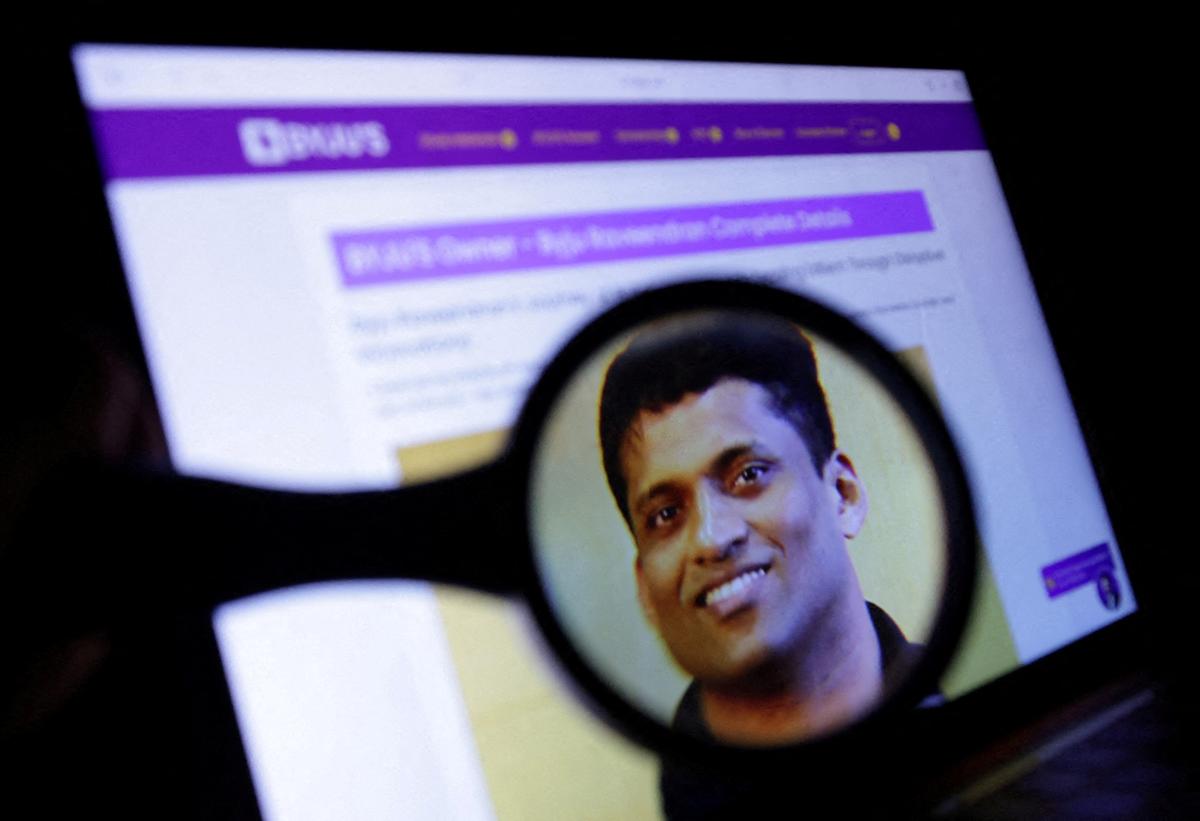
Credits: The Hindu
What This Means for Byju’s Future
The fresh enforcement petition adds to Byju’s already complex legal and financial woes. Once India’s most valued startup, Byju’s is now battling multiple lawsuits from investors, lenders, and regulators. The $249 million enforcement case by QIA could further weaken its position, especially as AESL — considered its crown jewel — lies at the center of the dispute.
For QIA, this legal push is a signal to global markets: it is unwilling to write off its investments, no matter the challenges. For Byju’s, however, the escalating pressure may force hard decisions, from asset sales to restructuring its ownership of Aakash.
As the case unfolds, the Karnataka High Court’s decision on enforcement will not only impact Byju’s immediate financial future but could also set a precedent for how international arbitral awards are enforced against Indian startups in distress.