• Send Us A Tip
  • Calling all Tech Writers
  • Advertise
Friday, July 3, 2026
  • Login
TechStory
  • News
  • Crypto
  • Gadgets
  • Memes
  • Gaming
  • Cars
  • AI
  • Startups
  • Markets
  • How to
No Result
View All Result
  • News
  • Crypto
  • Gadgets
  • Memes
  • Gaming
  • Cars
  • AI
  • Startups
  • Markets
  • How to
No Result
View All Result
TechStory
No Result
View All Result
Home Future Tech Electric Vehicles

Yamaha’s Wild Patent: An EV Motorcycle That Sounds and Feels Like a Gas Bike

by Samir Gautam
September 29, 2025
in Electric Vehicles, Manufacturing
Reading Time: 3 mins read
0
Yamaha’s Wild Patent: An EV Motorcycle That Sounds and Feels Like a Gas Bike

Yamaha’s Wild Patent: An EV Motorcycle That Sounds and Feels Like a Gas Bike

TwitterWhatsappLinkedin

Electric motorcycles are coming, whether riders are ready or not. The question isn’t if, but how to preserve what makes motorcycling so visceral. For many riders, it’s not just the wind in your face but the full sensory hit: the thrum of the engine, the vibrations under the seat, and the bark of the exhaust. Strip those away, and you risk losing the magic. Yamaha thinks it has an answer.

You might also like

Global EV Sales Surge in 2025 as Tesla Holds BEV Crown and China’s Carmakers Tighten Grip

Lamborghini Unveils Urus SE Performante, Bets Big on Hybrid Power Instead of EVs

Automakers Turn to Aluminium Wiring as Rising Copper Costs Reshape EV Production

The Patent That Turns Heads

Filed under the rather plain title “Saddle-Riding Type Electric Vehicle,” Yamaha’s new patent takes a different approach to electrification. Instead of asking riders to give up on engine character, the company has engineered a way to replicate it.
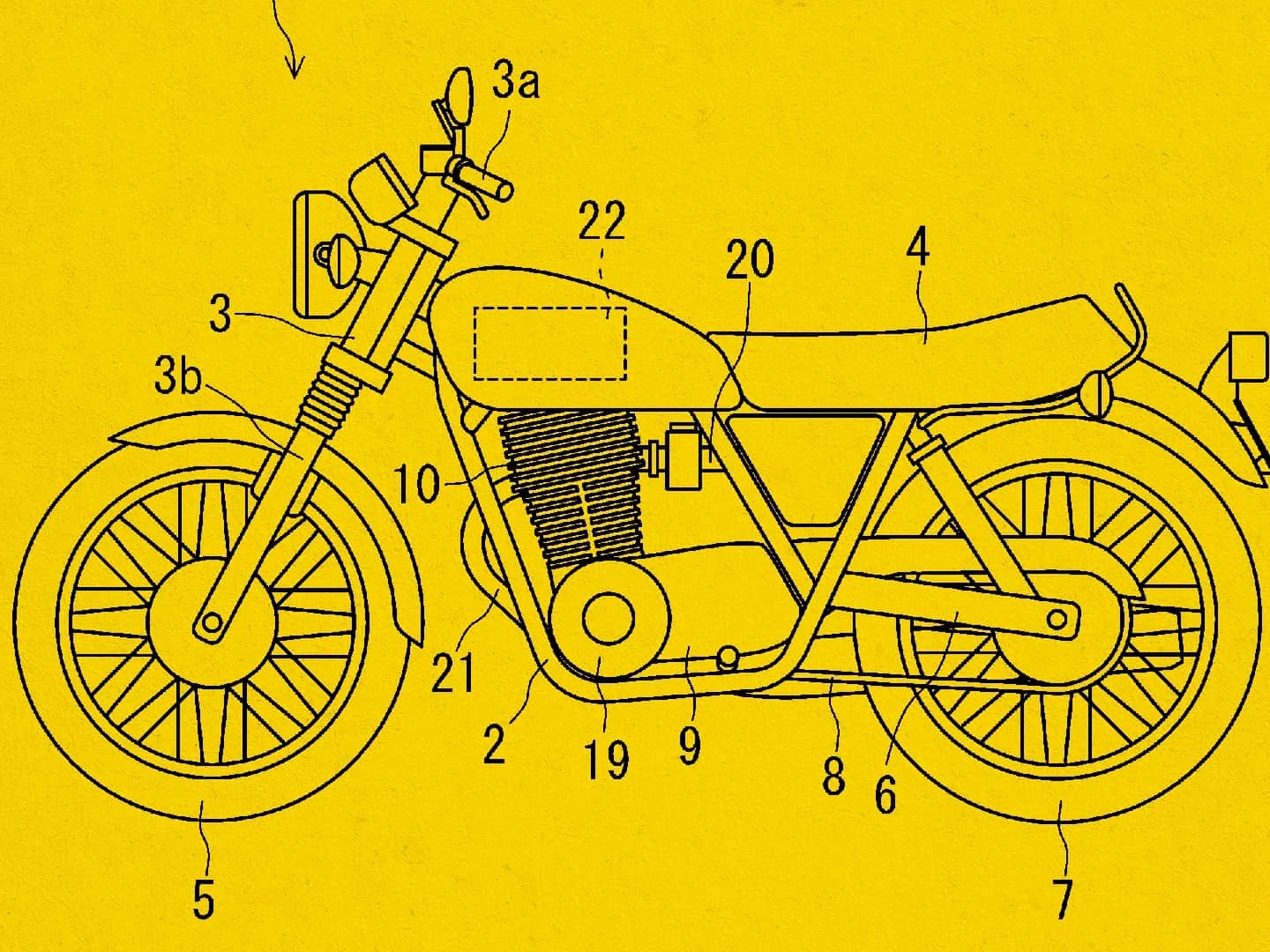
Yamaha Designed a Fake Motor for EV Motorcycles That Makes Noise and  Vibrates
Yamaha’s Wild Patent: An EV Motorcycle That Sounds and Feels Like a Gas Bike (Image Credit: RideApart.com)

The abstract acknowledges the elephant in the garage: internal combustion engines thrill because every piston stroke creates noise, vibration, and movement. Electric motors, on the other hand, are nearly silent and vibration-free. For some, that’s progress. For others, it’s soulless. Yamaha is betting the latter group is big enough to matter.

A Fake Engine That Isn’t Just Fake

Here’s where things get unconventional. Yamaha’s design includes a piston and cylinder setup powered not by fuel but by a linear motor. This “fake” engine actually moves like a traditional one, inhaling air, exhaling through valves, and producing the intake and exhaust sounds riders expect. The moving parts also generate vibrations—real reciprocating mass that simulates the feel of a gas-powered motorcycle.

In short, Yamaha has dreamed up a working mechanical system whose only job is to make electric bikes feel alive. It’s not just a speaker pumping out engine noise or a haptic motor shaking the handlebars. It’s a functional, physical unit.

Why Yamaha Thinks This Matters

Motorcycles aren’t appliances. Riders often talk about being part of the machine, the way throttle inputs directly translate to sound and motion. Yamaha’s patent suggests the company doesn’t want to lose that emotional connection in the switch to battery power.

While range, charging infrastructure, and price remain the biggest obstacles to EV motorcycle adoption, the absence of sensory drama is a quieter deal-breaker for traditionalists. Yamaha’s solution doesn’t fix the first three, but it could make the fourth less of a barrier.

A Clever Gimmick or the Future of EV Riding?

There’s room for skepticism. Adding a mechanical system just to mimic a combustion engine’s feel could increase weight, cost, and complexity. It’s also fair to ask if younger riders, those who never grew up wrenching on carbureted machines, will even care. For them, the silent rush of an electric motor might be the appeal.

But for those who still swear by the smell of gas and the rumble between their knees, Yamaha’s experiment could bridge the emotional gap. A noisy, vibrating EV bike that doesn’t burn a drop of fuel? That’s a compromise some may find compelling.

The Road Ahead

Patents don’t always become products, and Yamaha hasn’t confirmed when, or if, this design will hit the streets. Still, it signals that one of the biggest names in motorcycling is thinking deeply about how to carry the spirit of riding into the electric age.

The revolution may be silent, but Yamaha seems determined to keep at least part of the soundtrack alive.


Tags: electric motorcycleYamahaYamaha ebicycles
Tweet55SendShare15
Previous Post

Microsoft Launches AI Marketplace That Pays Publishers for Their Content

Next Post

AMG Faces Leadership Change Amid Engine Strategy Shake-Up

Samir Gautam

Recommended For You

Global EV Sales Surge in 2025 as Tesla Holds BEV Crown and China’s Carmakers Tighten Grip

by Samir Gautam
July 2, 2026
0
Global EV Sales Surge in 2025 as Tesla Holds BEV Crown and China's Carmakers Tighten Grip

The global electric vehicle (EV) market entered a new phase in 2025 as battery electric vehicles (BEVs) accelerated faster than plug-in hybrid electric vehicles (PHEVs), reflecting shifting consumer...

Read more

Lamborghini Unveils Urus SE Performante, Bets Big on Hybrid Power Instead of EVs

by Samir Gautam
July 2, 2026
0
Lamborghini Unveils Urus SE Performante, Bets Big on Hybrid Power Instead of EVs

Lamborghini has expanded its electrified lineup with the debut of the new Urus SE Performante, a plug-in hybrid SUV that pushes the brand further into high-performance hybrid technology...

Read more

Automakers Turn to Aluminium Wiring as Rising Copper Costs Reshape EV Production

by Samir Gautam
July 1, 2026
0
The automotive industry is quietly undergoing one of its biggest material changes in decades. As copper prices continue to climb and supply constraints intensify, leading automakers are increasingly replacing traditional copper wiring with aluminium in electric and hybrid vehicles. Luxury brands such as Ferrari and BMW are expanding the use of aluminium wiring across their latest models, joining companies like Tesla and several Chinese electric vehicle manufacturers that adopted the technology earlier. The shift signals more than just a cost-saving exercise. It reflects a broader effort to build lighter, more efficient vehicles while preparing for long-term pressure on global copper supplies. Copper's Cost Challenge Is Driving Change Copper has been the preferred material for automotive electrical systems for generations because of its excellent conductivity and durability. However, growing demand from renewable energy projects, artificial intelligence infrastructure, and expanding data centres has significantly increased pressure on global copper supplies. Industry analysts expect this imbalance between demand and supply to persist for years, pushing manufacturers to explore alternative materials that can deliver similar performance at a lower cost. Aluminium has emerged as the strongest candidate. It currently costs roughly one-quarter as much as copper while offering significant weight savings, making it particularly attractive for electric vehicles where every kilogram affects battery efficiency and driving range. Ferrari and BMW Expand Aluminium Use Ferrari introduced aluminium power cables in its 296 hybrid sports car and has since expanded the technology into additional models, including its newly launched fully electric vehicle. According to the company, switching to aluminium reduces the overall weight of wiring systems by as much as 20 percent. BMW has been using aluminium conductors for more than a decade, beginning with its compact models before gradually integrating them into hybrid and electric vehicles. The company's latest eDrive platform now incorporates aluminium extensively across both high-voltage and low-voltage electrical systems. While aluminium's lower price offers a financial advantage, both manufacturers emphasize that performance, efficiency and weight reduction remain the primary reasons behind the transition. Chinese EV Makers Push Adoption Further China's electric vehicle sector is accelerating the industry's move toward aluminium wiring. Manufacturers including XPeng, Xiaomi and AVATR have adopted the material as competition in the domestic EV market continues to squeeze profit margins. The Chinese government has also encouraged manufacturers to increase aluminium substitution across multiple industries, including automotive, power equipment and household appliances. Engineering experts believe aluminium has substantial room to replace copper, particularly in battery busbars and electrical distribution systems where copper still dominates today's vehicles. Industry-Wide Shift Expected to Continue Consultants and investment analysts expect aluminium adoption to grow steadily over the remainder of the decade. Estimates suggest that around two percent of global copper demand could be replaced by aluminium this year, with that figure potentially reaching six percent by 2030 if copper prices remain elevated. The transition is not without challenges. Aluminium requires greater volume than copper to carry the same electrical current and its production is more energy intensive. Manufacturers must also redesign certain components to accommodate its different physical properties. Despite these engineering considerations, the combination of lower material costs, lighter vehicle weight and long-term supply security is making aluminium an increasingly attractive choice for automakers worldwide. As electric vehicle production expands and pressure on critical raw materials continues to grow, aluminium wiring is rapidly moving from an alternative solution to a mainstream automotive technology. The shift highlights how material innovation is becoming just as important as battery development in shaping the next generation of mobility.

The automotive industry is quietly undergoing one of its biggest material changes in decades. As copper prices continue to climb and supply constraints intensify, leading automakers are increasingly...

Read more
Next Post
AMG Faces Leadership Change Amid Engine Strategy Shake-Up

AMG Faces Leadership Change Amid Engine Strategy Shake-Up

Please login to join discussion

Techstory

Tech and Business News from around the world. Follow along for latest in the world of Tech, AI, Crypto, EVs, Business Personalities and more.
reach us at info@techstory.in

Advertise With Us

Reach out at - info@techstory.in

Aviator Game India 2026

BROWSE BY TAG

#Crypto #howto 2024 acquisition AI amazon Apple Artificial Intelligence bitcoin Business China cryptocurrency e-commerce electric vehicles Elon Musk Ethereum facebook funding Gaming Google India Instagram Investment ios iPhone IPO Market Markets Meta Microsoft News OpenAI samsung Social Media SpaceX startup startups tech technology Tesla TikTok trend trending twitter US

© 2025 Techstory.in

No Result
View All Result
  • News
  • Crypto
  • Gadgets
  • Memes
  • Gaming
  • Cars
  • AI
  • Startups
  • Markets
  • How to

© 2025 Techstory.in

Welcome Back!

Login to your account below

Forgotten Password?

Retrieve your password

Please enter your username or email address to reset your password.

Log In
Are you sure want to unlock this post?
Unlock left : 0
Are you sure want to cancel subscription?