India is gearing up to take a giant leap in nuclear technology with the development of small, deployable nuclear power reactors, a move that could redefine the country’s energy future. According to senior government officials, scientists at the Bhabha Atomic Research Centre (BARC) are designing compact reactors that can be installed not just at industrial sites but even on commercial ships.
These next-generation reactors, dubbed Bharat Small Modular Reactors (BSMRs), promise to deliver safe, flexible, and efficient power generation — making nuclear energy more accessible and adaptable than ever before.

Credits: The Economic Times
Power on Demand: The 55 MW and 200 MW Reactors
At the heart of this project are two cutting-edge designs: one with a capacity of 55 MW and another of 200 MW. Unlike conventional nuclear plants that require massive infrastructure and long gestation periods, these small modular reactors can be built faster, transported easily, and deployed wherever energy is needed most.
“The reactors can be placed wherever needed, including on ships,” a senior official explained. “They’re designed with very high safety standards and can even power merchant navy vessels.”
Such portability and scalability could be a game-changer for energy-intensive industries like cement, steel, and chemicals — sectors that currently depend heavily on fossil fuels. The reactors are also being viewed as a reliable solution for remote or island regions, where conventional grid connectivity is challenging.
Nuclear Power Sets Sail
One of the most intriguing aspects of the BSMR project is its potential use in commercial maritime operations. Traditionally, nuclear propulsion has been reserved for military vessels, such as submarines and aircraft carriers. However, India’s new designs open the door for nuclear-powered merchant ships, capable of traversing long distances without refueling — drastically reducing operational costs and emissions.
India already operates two home-built nuclear submarines — INS Arihant and INS Arighaat — each powered by an 83 MW reactor. A third, INS Aridhaman, is undergoing trials. The experience gained from these naval programs has provided crucial technical know-how for the design and miniaturization of BSMRs.
Private Sector May Get a Foot in the Door
In a landmark shift, the Indian government is also considering allowing private participation in the nuclear power sector — a domain historically restricted to public entities under the Atomic Energy Act (AEA).
According to sources, discussions are underway to amend the AEA and the Civil Liability for Nuclear Damage Act (CLND) to open up parts of the nuclear ecosystem to private players. This could allow companies to build, operate, and even source nuclear fuel from abroad, provided safety and waste-handling protocols are strictly followed.
The proposed changes would also cap the liability of suppliers of nuclear equipment, ensuring that contractual terms determine their responsibility in case of any mishap. Moreover, the term “supplier” would be clearly defined as providers of critical nuclear equipment — bringing much-needed clarity to India’s nuclear liability framework.
Towards a 100 GW Nuclear Future
Prime Minister Narendra Modi has set an ambitious target of achieving 100 GW of nuclear power capacity by 2047, a massive jump from the current 8.8 GW. The development of small modular reactors could play a pivotal role in achieving this goal, offering a flexible and scalable approach to power generation as India transitions to cleaner energy sources.
Unlike solar or wind, nuclear power provides constant base-load energy, unaffected by weather or daylight. If successfully commercialized, BSMRs could make nuclear energy more viable across industries and geographies — from ports and islands to factories and data centers.
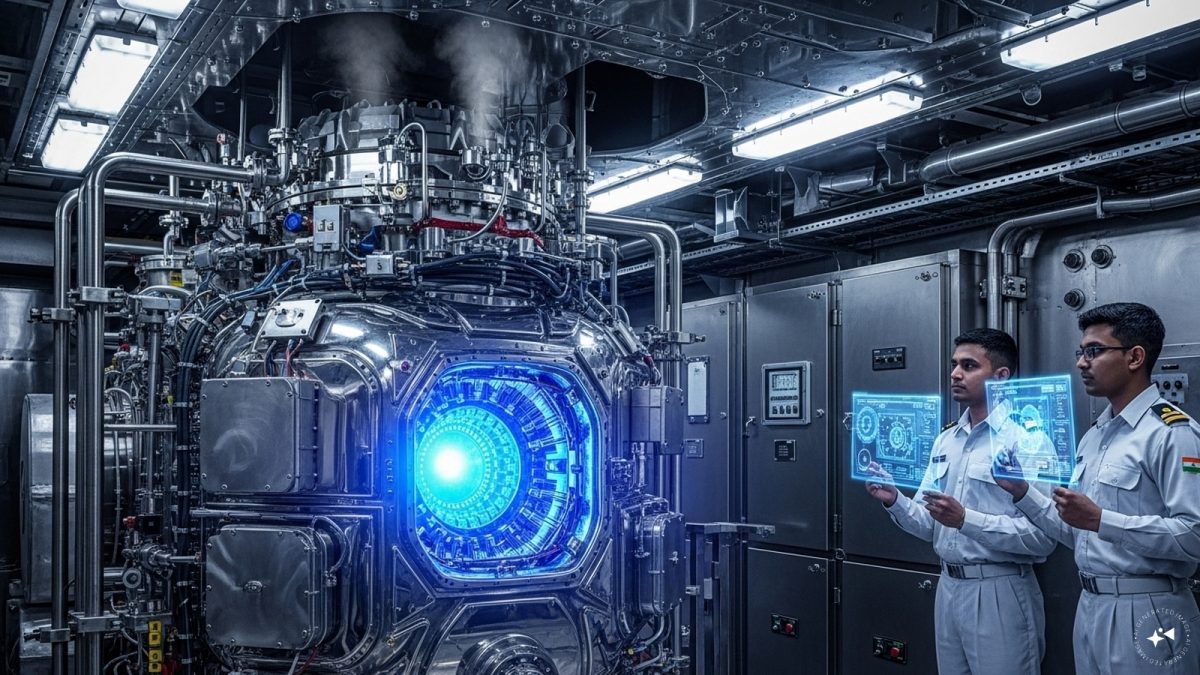)
Credits: Firstpost
A Compact Reactor for a Big Vision
India’s pursuit of small modular reactors marks a strategic convergence of technology, energy, and national ambition. With BARC leading the charge and potential private participation on the horizon, the country is poised to democratize nuclear power — turning it from a state-run behemoth into a versatile, deployable solution for a growing economy.