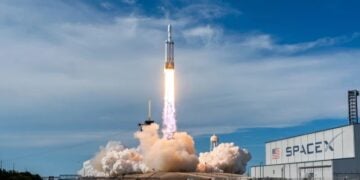
Elon Musk’s SpaceX has revealed plans to launch as many as 1 million satellites into orbit, forming a gargantuan constellation that will be used to tap the power of solar energy and build artificial intelligence data centers in space, according to documents filed with the Federal Communications Commission on Friday.
The move comes just one day after Reuters reported that SpaceX and Musk’s AI firm xAI are in talks to merge in preparation for a public offering later this year.
The merger would represent a major acceleration of SpaceX’s plans to build an orbital data centre, as Musk continues to escalate his rivalry with Google, Meta, and OpenAI in the rapidly shifting landscape of artificial intelligence.
The move is a radical transformation of what data centers, the physical backbone of AI, might look like in the future.
Current data centers are massive power drains that require complex cooling systems, representing both a major expense and a serious environmental concern. SpaceX’s plan would bypass all of these issues by installing the infrastructure in orbit.
“By directly harnessing near-constant solar power with little operating or maintenance costs, these satellites will achieve transformative cost and energy efficiency while significantly reducing the environmental impact associated with terrestrial data centers,” the company stated in its FCC filing.
SpaceX Files for Massive 1-Million Satellite Constellation to House Orbital Data Centers
The project would need to be approved by the Federal Communications Commission before it can proceed.
Although the 1 million satellite number may seem high, especially when taking into consideration that only 15,000 satellites are currently orbiting the Earth, industry insiders point out that satellite companies often apply for permission to launch more satellites than they actually plan to use. This gives them more flexibility during the development and launch process.
This is not the first time that SpaceX has done this. When they first set out to create their internet service satellite constellation, they applied for permission to launch 42,000 satellites. Today, the Starlink satellite constellation, which is now growing in size, uses approximately 9,500 satellites in orbit to provide internet service to customers around the world.
The success of this ambitious satellite data center project depends on SpaceX’s ability to significantly lower the cost of launching satellites into space using their new Starship rocket system. The Starship system is currently under development and is intended to be fully reusable, making it much cheaper to launch large quantities of cargo into space.
“Fortunately, the development of fully reusable launch vehicles like Starship that can deploy millions of tons of mass per year to orbit when launching at rate, means on-orbit processing capacity can reach unprecedented scale and speed compared to terrestrial buildouts, with significantly reduced environmental impact,” SpaceX explained in the filing.
How Starship and AI are Moving the Cloud to the Stars?
Since its initial test launch in 2023, Starship has conducted 11 test launches as SpaceX continues to refine the massive rocket system. Musk has stated that he believes Starship will begin transporting actual payloads into orbit later this year, which would represent a significant step forward for the development of the rocket itself as well as the overall plans of SpaceX.
The timing of this filing is not coincidental and represents the overall AI explosion that is taking place in the tech world. Companies are scrambling to develop the computing infrastructure required to support and execute increasingly complex AI models, which has created an unprecedented demand for data center capacity and the power to support it. By taking data centers to space, SpaceX could potentially address two significant challenges: access to energy and environmental concerns.
Musk’s Vision for a Space-Powered AI Empire
Solar panels in space receive constant sunlight without the interference of weather patterns, clouds, or the day-night cycle that restricts the placement of solar panels on Earth.
The proposed merger between SpaceX and xAI would combine Musk’s rocket company with his AI company, making for a vertically integrated entity that would own all aspects of the satellites and rockets, as well as the AI that they would power. This would potentially give Musk a huge advantage in the AI race.
But there are still many hurdles to overcome. The idea of launching and operating a million satellites is an unprecedented task. There are also questions about space debris, satellite congestion, and the effects of launching so many rockets on the environment. These issues will be carefully considered by the FCC as it reviews the application.
For now, this is just the latest in a series of ambitious plans by Musk to combine his business interests to solve what he sees as the biggest challenges and opportunities facing humanity.