Artificial intelligence has evolved rapidly over the last few years. While much of the discussion has focused on prompt engineering, a newer concept is becoming increasingly important for building reliable AI applications: context engineering.
If you have ever wondered what is context engineering, the answer is simple. Context engineering is the practice of designing systems that determine what information an AI model receives before generating a response. Instead of relying only on a single prompt, context engineering manages all the relevant information that helps an AI system make better decisions.
As AI assistants, chatbots, coding tools, and autonomous agents become more advanced, understanding what is context engineering is essential for developers, businesses, and AI practitioners.
What Is Context Engineering?
Context engineering refers to the process of gathering, organising, filtering, and delivering the most relevant information to an AI model at the right time.
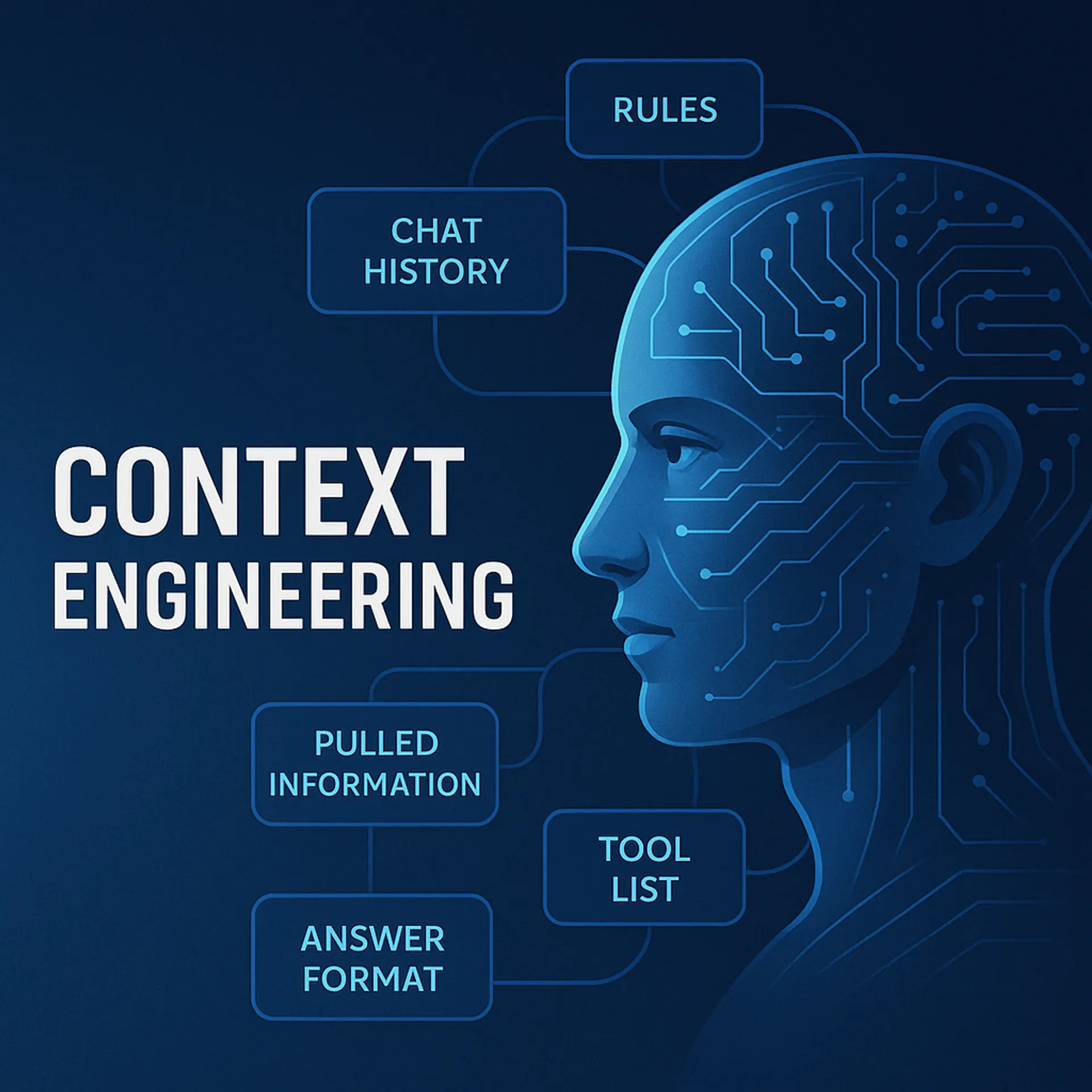
Large language models (LLMs) generate responses based on the information available in their context window. This context can include:
- System instructions
- User preferences
- Conversation history
- External documents
- Database records
- API responses
- Tool descriptions
- Structured output formats
Rather than starting from scratch with every request, context engineering ensures the model has access to the information it needs to provide accurate and relevant answers.
In simple terms, if prompt engineering is about writing better instructions, context engineering is about building the entire information system behind those instructions.
Why Context Engineering Matters?
Modern AI applications rarely operate with a single prompt. Most real-world systems require access to multiple sources of information.
For example, an AI customer support assistant may need to:
- Access previous support tickets
- Check customer account details
- Retrieve product documentation
- Follow company policies
- Maintain conversation history
Without proper context management, the AI would struggle to provide useful responses.
This is why understanding what is context engineering has become critical for organizations building production-ready AI applications.
Components of Context Engineering
Several information layers work together to create effective AI context.
| Context Component | Purpose |
| System Instructions | Define rules, behavior, and objectives |
| Conversation History | Maintain continuity across interactions |
| User Preferences | Personalize responses |
| Retrieved Documents | Provide external knowledge |
| Tools and APIs | Enable actions and data access |
| Output Schemas | Ensure structured responses |
| Real-Time Data | Supply current information |
The challenge is fitting all of this information within the model’s available context window while keeping the most relevant details accessible.
What Is Context Engineering vs Prompt Engineering?
One of the most common questions is the difference between prompt engineering and context engineering.
Prompt engineering focuses on creating effective instructions for a specific task. Context engineering focuses on managing all the information surrounding that task.
Prompt Engineering
Prompt engineering works well for:
- Content creation
- Summaries
- Email writing
- One-time requests
- Structured outputs
The AI must combine all this information before generating a response.
Comparison Table
| Feature | Prompt Engineering | Context Engineering |
| Focus | Writing instructions | Managing information |
| Scope | Single task | Ongoing system |
| Best For | One-off requests | Complex AI applications |
| Information Sources | Prompt only | Multiple sources |
| Personalization | Limited | Extensive |
| Memory Support | Minimal | Long-term |
Most advanced AI applications use both approaches together.
What Is Context Engineering in Real-World Applications?
The concept becomes clearer when examining real-world implementations.
RAG Systems
Retrieval-Augmented Generation (RAG) was one of the earliest forms of context engineering.
Before RAG, companies often needed to retrain AI models on proprietary information. RAG changed this process.
Instead of retraining the model, a RAG system:
- Searches relevant documents
- Retrieves useful information
- Places that information into the context window
- Generates a response using the retrieved content
This allows AI systems to answer questions about information that was never included in their original training data.
RAG is now widely used in:
- Enterprise search
- Knowledge management
- Customer support
- Research assistants
AI Agents
AI agents take context engineering a step further.
Unlike traditional chatbots, agents can actively interact with external systems.
An AI agent may:
- Search the web
- Query databases
- Access APIs
- Update records
- Perform calculations
The system continuously updates the context based on new information collected during the task.
As a result, AI agents can solve more complex problems than systems relying solely on static prompts.
AI Coding Assistants
Coding assistants such as Cursor and Windsurf showcase some of the most advanced examples of context engineering.
When developers request code changes, the assistant needs to understand:
- Project structure
- File dependencies
- Existing code patterns
- Framework usage
- Recent edits
The assistant gathers this information and creates a context-rich environment before generating suggestions.
This is why coding assistants often become more useful over time as they learn more about a project’s structure and development patterns.
Common Context Engineering Challenges
Many people assume larger context windows will eliminate the need for context engineering. However, several challenges still remain.
Even models supporting millions of tokens can encounter problems when too much information is included.
Let’s examine four major context failures.
1. Context Poisoning
Context poisoning occurs when incorrect information enters the context and continues influencing future responses.
For example, if an AI agent generates a false assumption and stores it as memory, future decisions may rely on that incorrect information.
Over time, the system can become trapped in a cycle of repeating errors.
Solution
To reduce context poisoning:
- Validate information before storage
- Separate short-term and long-term memory
- Use memory verification systems
- Create isolated context threads
These measures help prevent false information from spreading through the system.
2. Context Distraction
Context distraction occurs when the context becomes too large.
Instead of focusing on the current task, the AI may spend excessive attention on historical information.
As context grows, performance often declines even before reaching the maximum context limit.
Solution
Context summarisation is one of the most effective techniques.
Instead of storing every interaction, the system creates concise summaries that preserve key information while removing unnecessary details.
Benefits include:
- Lower token usage
- Improved reasoning
- Faster responses
- Better focus
3. Context Confusion
Context confusion happens when too much irrelevant information is included.
One common example involves tool selection.
If dozens of tools are available, the model may choose the wrong one even when the correct option is obvious.
More information does not always improve performance.
Solution
Tool loadout management helps solve this problem.
The system retrieves only the tools relevant to the current task rather than exposing every available tool.
This keeps the context cleaner and easier for the model to process.
4. Context Clash
Context clash occurs when conflicting information exists inside the context window.
For example:
- Earlier assumptions may contradict later facts.
- Preliminary answers may remain visible after new information arrives.
- Multiple sources may provide inconsistent details.
These conflicts can significantly reduce model accuracy.
Solution
Two effective techniques include:
Context Pruning- Remove outdated or conflicting information as new information becomes available.
Context Offloading- Store intermediate reasoning in separate workspaces instead of keeping everything in the primary context.
This approach reduces contradictions and improves overall reasoning quality.
Best Practices for Effective Context Engineering
- Organizations implementing context engineering should follow several proven strategies.
- Prioritize Relevant Information
- Only include information directly related to the user’s request.
- Use Retrieval Systems
- Vector databases and semantic search help retrieve the most relevant content quickly.
- Maintain Memory Layers
Separate:
- Short-term memory
- Long-term memory
- User preferences
- Session-specific information
This creates cleaner context structures.
- Regularly Summarise Context – Summaries help prevent context windows from becoming overloaded.
- Validate Stored Information- Memory systems should verify important information before saving it for future use.
- Limit Tool Exposure- Present only the tools required for the current task to reduce confusion.
- The Future of Context Engineering- As AI systems continue to evolve, context engineering will become even more important.
Future AI applications will need to manage:
- Long-term memory
- Multi-agent communication
- Personalized experiences
- Real-time knowledge updates
- Cross-platform interactions
Rather than focusing solely on larger context windows, developers are increasingly investing in smarter context management systems.
The goal is not simply providing more information to AI models. The goal is providing the right information at the right moment.
Conclusion
So, what is context engineering? It is the practice of designing systems that decide what information an AI model sees before generating a response. It goes far beyond prompt writing and focuses on managing the flow of information across conversations, tools, documents, APIs, and memory systems.
As AI applications become more sophisticated, context engineering is emerging as one of the most important disciplines in artificial intelligence development. Whether through RAG systems, AI agents, or coding assistants, effective context management allows AI systems to deliver more accurate, personalized, and reliable responses.
For businesses and developers building modern AI applications, understanding what is context engineering is no longer optional—it is becoming a core requirement for creating AI experiences that feel intelligent, useful, and truly context-aware.