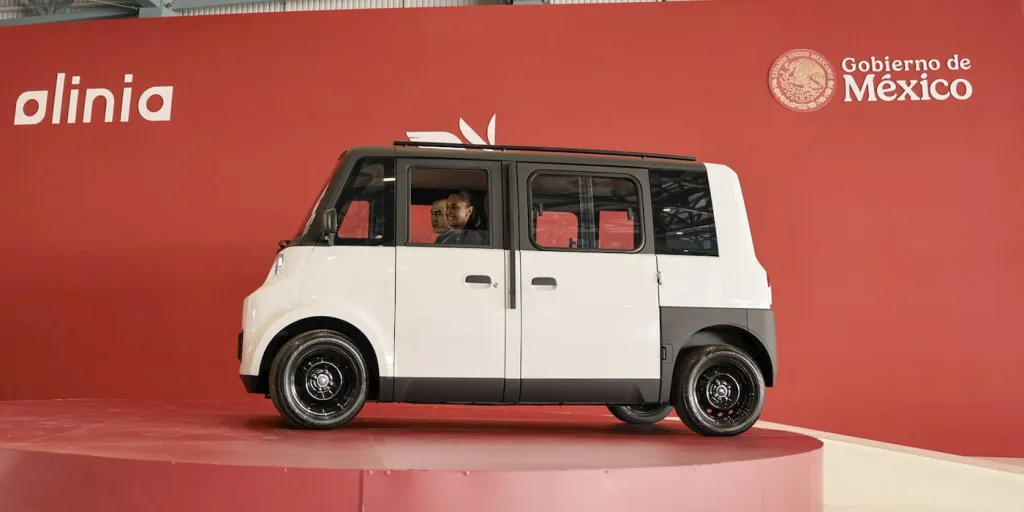
At first glance, the Uno doesn’t look like a typical car. Its boxy shape, compact size, and practical layout make it feel more like a modern urban shuttle than a traditional passenger vehicle. That’s exactly the point.
The government isn’t positioning the Uno as a competitor to family sedans or SUVs. Instead, it is being pitched as a safer, cleaner alternative to motorcycles and mototaxis, which are widely used across the country for short-distance travel.
Built for Everyday City Travel
The biggest talking point is the price. The Olinia Uno is expected to start at around 150,000 pesos (roughly US$8,600) when production begins in 2027, making it one of the most affordable electric vehicles planned for the Mexican market.
The vehicle can carry six passengers and even accommodate a wheelchair, an unusual feature in a vehicle of this size. Under the hood, it is powered by a 14.7 kWh lithium iron phosphate battery paired with a 13 kW electric motor.
Its performance figures are modest. The Uno has a top speed of 50 km/h and an estimated range of just over 100 kilometers on urban routes. For daily city commutes, that may be enough. For anyone expecting highway capability, it probably won’t be.
Charging is designed to be simple. Owners can plug the vehicle into a regular household outlet, with a full charge taking around four hours on a 220V connection or roughly eight hours on a standard 110V outlet.
Inside, the Uno keeps things basic with a 7-inch touchscreen, Bluetooth connectivity, a reverse camera, LED headlights, and front disc brakes.
More Than a Car Project
The Olinia project is about more than just launching an electric vehicle.
It represents Mexico’s ambition to develop its own EV technology and manufacturing capabilities. The initiative is being led by the Ministry of Science, Humanities, Technology and Innovation in collaboration with several universities and research institutions, including UNAM, IPN, TecNM, and UPAEP.
Production is expected to take place in Puebla starting in the summer of 2027.
For President Sheinbaum, the vehicle is part of a broader effort to make cleaner transportation accessible to more people while reducing dependence on imported technologies.
Not Everyone Is Convinced
The unveiling has also attracted criticism.
Some industry observers argue that the Uno’s specifications are too limited for the asking price. Others have questioned whether consumers will be willing to pay car-level money for a vehicle with a relatively low top speed and short driving range.
Businessman Ricardo Salinas Pliego, whose company owns motorcycle manufacturer Italika, was among the most vocal critics. He described the project as an expensive government initiative that offers little value compared to products developed by private industry.
Safety has become another discussion point. While Olinia has highlighted the vehicle’s practicality and affordability, questions remain about the safety systems that will be included in the final production version.
A New Category or a Tough Sell?
The challenge for Olinia is clear. The Uno doesn’t fit neatly into any existing category. It is not a motorcycle, not a conventional car, and not quite a microcar in the traditional sense.
Yet that could also be its biggest advantage.
For urban families, delivery operators, and communities looking for an affordable enclosed electric vehicle, the Uno may offer something currently missing from the market. While its specifications won’t impress EV enthusiasts, its focus on practicality could resonate with everyday users.
Whether that is enough to turn the Olinia Uno into a success remains to be seen. But for now, Mexico has made one thing clear: it wants a place in the future of electric mobility, and it intends to build that future at home.