The multi-billion-dollar mobile phone and wearable display industry operates on a relentless battle for efficiency. As consumer demand shifts toward massive, pixel-dense screens that boast vibrant color spaces, extreme peak brightness levels, and continuous always-on functionality, engineers face a punishing energy bottleneck. Historically, the display panel stood as the single largest drain on a smartphone’s battery, continuously pulling massive currents just to keep its pixels illuminated and refreshed. When the industry adopted high refresh rates like 120Hz to make user interfaces feel incredibly smooth, battery life plummeted across the board.
To break this direct conflict between smooth visuals and long battery life, hardware manufacturers had to redesign the display backplane at a molecular level. Getting an LTPO display explained reveals a brilliant, hybrid semiconductor architecture that fundamentally rewrites how display panels handle power management. By combining two completely different thin-film transistor technologies onto a single substrate, this innovation allows screens to dynamically shift their refresh rates from a smooth 120Hz down to a static 1Hz in real time. This advanced material science revolution allows devices to run beautiful, high-refresh always-on interfaces while slashing overall screen power consumption by up to 20%, permanently changing our expectations for mobile battery endurance.
1. The Backplane Battlefield: The Transistor Physics of LTPS vs. IGZO
To get a premium LTPO display explained, you must look past the glowing organic light-emitting diodes (OLEDs) and examine the backplane. The backplane is the underlying matrix of thin-film transistors (TFTs) that controls exactly when each individual pixel turns on, turns off, or changes color. For years, display engineers were forced to choose between two competing, imperfect transistor materials.
Low-Temperature Poly-Silicon (LTPS)
LTPS has functioned as the standard backbone of premium mobile screens for over a decade. Its primary advantage is exceptional electron mobility. Because electrons can move through poly-silicon rapidly, LTPS transistors can switch states fast enough to drive high-resolution panels at ultra-smooth speeds like 120Hz or 144Hz. However, LTPS has a massive, built-in weakness: a very high off-state leakage current. Even when a pixel is supposed to show a completely static image, the underlying LTPS transistor continuously bleeds electrical charge. To prevent the image from visibly flickering or fading, the system is forced to refresh the entire screen at least 60 times per second, wasting massive amounts of battery power on static text.
Indium Gallium Zinc Oxide (IGZO)
IGZO stands as a completely alternative semiconductor material pioneered for larger television panels. The defining superpower of IGZO is its incredibly low off-state leakage current. Once an IGZO transistor charges a pixel to a specific color state, it holds onto that electrical charge like a sealed vault, leaking virtually zero current. Consequently, an IGZO screen can stop refreshing entirely for long periods without losing image quality. However, IGZO has significantly lower electron mobility than LTPS, making it highly difficult and expensive to scale down into ultra-fast, high-density smartphone screens.
The LTPO Breakthrough
LTPO (Low-Temperature Polycrystalline Oxide) completely solves this dilemma by creating a hybrid backplane. Rather than choosing one material over the other, an LTPO panel places both LTPS and IGZO transistors right next to each other on a single glass substrate. In this setup, the fast LTPS transistors handle the rapid, complex switching work needed for user interface animations, while the ultra-stable IGZO transistors drive the pixels during static conditions. This material marriage gives devices the best of both worlds: blistering speed when you are gaming, and absolute power efficiency when the screen is still.
2. Variable Refresh Rates: The 1Hz Variable Engine
The primary reason why an LTPO display is a game-changer for modern hardware is its ability to execute Variable Refresh Rate (VRR) adjustments on the fly, without requiring any manual user input or triggering noticeable screen glitches. When you scroll through a fast social media feed or play an intense mobile game, the device operating system registers the rapid movement and instantly instructs the LTPO backplane to run at its maximum 120Hz speed. The fast LTPS elements handle this workload beautifully, delivering fluid, lag-free animations.
However, the moment you stop scrolling to read a long article, look at a photo, or lock your phone into its always-on clock mode, the display engine drops the refresh rate down to 10Hz, 5Hz, or even a single, solitary 1Hz (one refresh per second). Because the IGZO driving transistors leak virtually no current, the screen can sit at 1Hz for extended periods without dropping its brightness or shifting its colors. This variable engine prevents the device from wasting power rendering 119 identical, unnecessary frames every single second.
3. Comparative Deep-Dive: LTPO vs. Standard LTPS
To understand how rapidly this technology has taken over the premium electronics market, it helps to examine how the mechanical attributes of LTPO contrast against standard, legacy display backplanes.
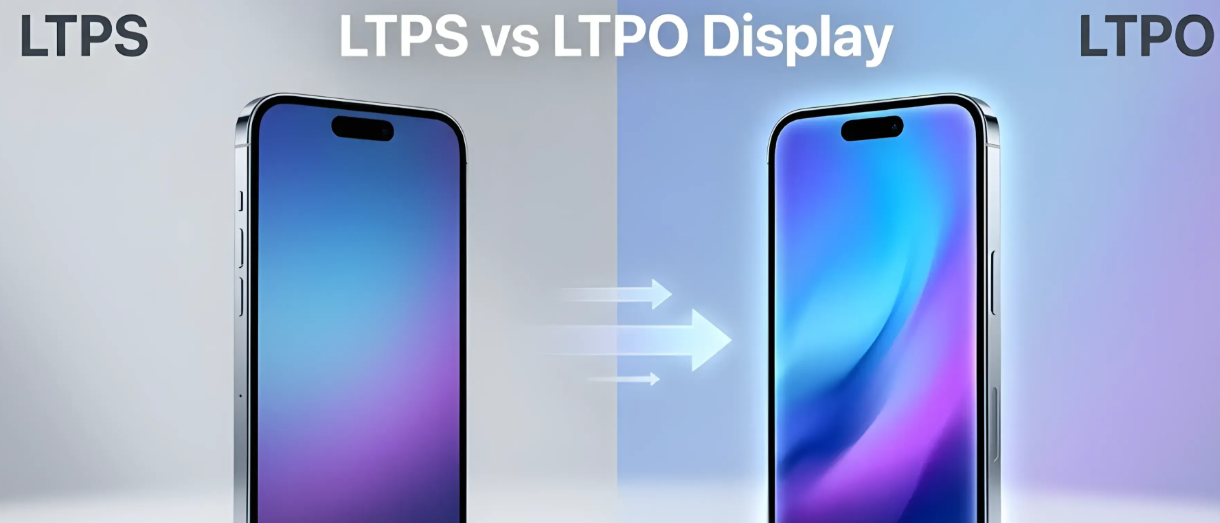
Backplane Material Performance Metrics
| Physical Performance Domain | Legacy LTPS Display Backplane | Modern LTPO Display Backplane | Engineering Impact on Design |
| Electron Mobility Speed | Exceptionally High (100 cm2Vs) | Combined Hybrid Architecture Base | Enables fast, crisp pixel response times for gaming |
| Off-State Current Leakage | High (Continuous electrical drain) | Ultra-Low Leakage Matrix | Determines minimum refresh rate without flicker |
| Minimum Stable Refresh Rate | 60Hz (Some panels down to 48Hz) | True 1Hz Operating Frequency | Allows for high-efficiency always-on clocks |
| Manufacturing Complexity | Standard (6 to 9 photomask steps) | High (12 to 15 complex mask layers) | Directly increases the retail price of premium panels |
| Average Backplane Energy Saving | 0% Baseline Reference | 15% to 20% Total Power Reduction | Extends device battery life during everyday tasks |
The core takeaway from this data is the dramatic reduction in minimum stable refresh rates. On an older LTPS panel, trying to drop the refresh rate below 48Hz causes the electrical charge in each pixel to decay so fast that the human eye can spot a distinct, distracting rhythmic flash across the screen. LTPO eliminates this artifact completely, allowing for completely stable, low-frequency performance.
4. Multi-Industry Adoption and the Boutique Sourcing Maze
As display buyers realize the massive battery benefits of hybrid backplanes, LTPO technology has quickly become a mandatory requirement for high-end consumer hardware. However, because manufacturing these panels requires a massive number of complex mask layers and specialized cleanroom environments, production remains heavily concentrated within a select group of global display giants.
Samsung Display leads the market with its proprietary HOP (Hybrid Oxide Polycrystalline) technology, which supplies the ultra-premium screens found on flagship devices like the Galaxy Ultra series and Apple’s iPhone Pro models. Simultaneously, rival manufacturers like LG Display and BOE have scaled up their own proprietary LTPO lines to secure massive component contracts.
The value of this technology has extended well past standard mobile phones. Smartwatches which depend heavily on compact batteries rely on these hybrid backplanes to run ambient, full-color always-on faces that last for days. As production efficiencies improve, this material framework is making its way into premium laptops and tablets, promising massive battery enhancements across all mobile computing platforms.
5. Technology Comparison: LTPO vs. MicroLED vs. Standard OLED
To choose the right hardware architecture for your next enterprise deployment, you must understand exactly how an LTPO panel compares to alternative next-generation display technologies.
Standard LTPS OLED
Standard OLED screens deliver exceptional color contrast and infinite black levels because each individual pixel generates its own light. However, because they are bound to an LTPS backplane, they suffer from high power drain whenever the user interface runs a high-refresh or always-on mode. This forces device makers to limit screen brightness or cut out always-on features entirely to save battery.
MicroLED
MicroLED is a revolutionary, non-organic display technology that replaces organic molecules with microscopic, long-lasting gallium nitride LEDs. MicroLED promises incredible peak brightness, zero risk of permanent screen burn-in, and exceptional power efficiency. However, because placing millions of microscopic LEDs onto a mobile backplane requires an incredibly complex manufacturing process, MicroLED remains too expensive and difficult to produce for small consumer devices, keeping it locked away as an experimental option for luxury television displays.
LTPO OLED
LTPO OLED strikes the ultimate balance for contemporary hardware. It retains all the classic benefits of standard OLED, including rich color spaces and deep contrast, while using its hybrid backplane to completely eliminate energy waste during slow tasks. This balanced design makes LTPO the absolute baseline standard for modern mobile display design.
The Definitive Standard for Next-Generation Mobility
The rapid rise of hybrid polycrystalline oxide backplanes proves that the performance of a display panel can no longer be judged solely by its resolution or maximum speed. In an era where users demand large screens, smooth interfaces, and multi-day battery life, raw material efficiency has become the true measure of innovation.
By blending the rapid speed of LTPS with the ultra-stable, power-saving properties of IGZO, an LTPO display provides an elegant solution to mobile power consumption challenges. As manufacturing yields improve across major global foundries and contract costs drop, this hybrid backplane framework will continue to expand throughout the consumer tech market. This material science breakthrough ensures our portable devices can run beautiful, high-refresh interfaces without demanding any compromises on battery life, locking down its position as the foundational architecture for the premium screens of tomorrow.