The global consumer wireless market has operated for over two decades on a foundational blueprint known as Bluetooth Classic. When consumers pull true wireless earbuds from a charging case, join a hands-free voice call, or stream high-fidelity stereo files, they step directly onto an old network structure developed in the early 2000s. That architecture relies heavily on the Advanced Audio Distribution Profile (A2DP) and its mandatory Sub-Band Codec (SBC). While highly functional, this legacy system was built for simple point-to-point data transfers. It has reached a dead end, characterized by notable latency bottlenecks, high energy drain, and a lack of scalable multi-device distribution options.
To overcome these structural limitations, the Bluetooth Special Interest Group (SIG) completed the single largest specification project in its operational history. Investigating bluetooth le audio explained reveals a ground-up redesign that moves wireless sound transmission from the heavy, battery-draining channels of Bluetooth Classic onto the highly efficient framework of Bluetooth Low Energy (LE).
By implementing synchronized transport channels, advanced compression mathematics, and pairing-free public broadcasting infrastructure, this tech ecosystem changes the physics of wireless acoustics. For hardware developers, enterprise deployment managers, and everyday consumers, understanding bluetooth le audio explained provides a direct window into a new landscape of energy-efficient, low-latency, and shared audio networks.
1. The Architectural Pivot: Isochronous Channels and ISOAL
The core reason why traditional Bluetooth Low Energy could not support streaming media prior to the release of Bluetooth Core Specification 5.2 was its structural focus on asynchronous, low-bandwidth data transfers. Early LE profiles were built for low-power IoT equipment, like heart-rate monitors and fitness trackers, which send tiny data packets at unpredictable intervals. Audio data requires a strict, predictable stream where data packets arrive at exact intervals to prevent audible gaps, pops, or stutters.
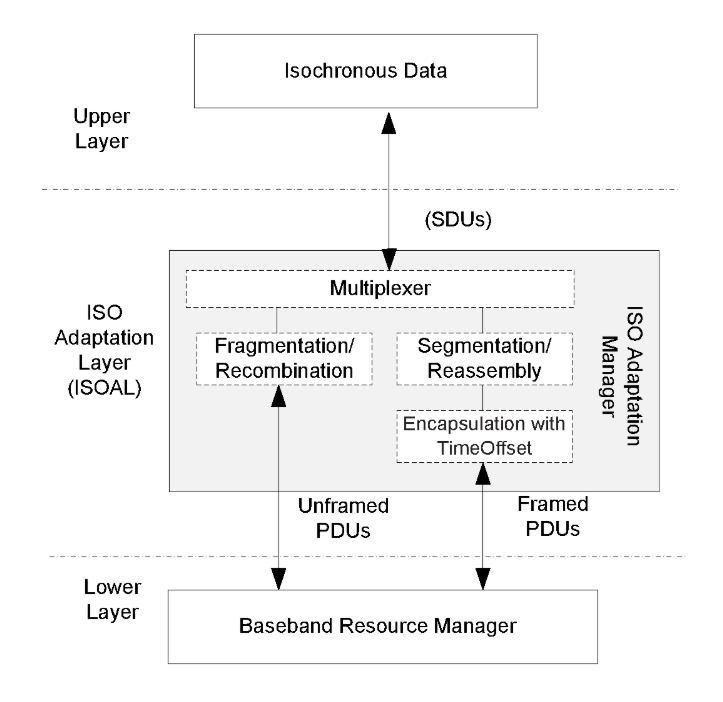
To bridge this data alignment gap, the updated Bluetooth controller architecture introduces a specialized processing layer called the Isochronous Adaptation Layer (ISOAL). As visualized in the transport stack, ISOAL sits directly between the high-level application framework and the low-level physical radio layer.
The system operates by accepting high-level Service Data Units (SDUs), which are the raw, encoded audio blocks coming straight from the hardware’s compression engine. ISOAL takes these variable-length SDUs and translates them into uniform Link Layer Protocol Data Units (PDUs). It uses two discrete packaging mechanisms:
- Unframed Mode: Fragments the audio payload into clean blocks to minimize latency.
- Framed Mode: Segments and packages data with precise time-offset variables.
This uniform data output flows straight down into Isochronous Channels, which schedule radio events to guarantee that left and right audio channels land in a user’s ears at the same microsecond.
2. Unicast Audio: True Wireless Stereo Stream Architecture
The primary day-to-day benefit of this new low-energy framework is the introduction of native multi-stream audio capabilities. In the legacy Bluetooth Classic ecosystem, the audio profile was restricted to a strict point-to-point link. A smartphone could only maintain one active A2DP connection to a single wireless earbud.
To simulate stereo sound, headphone manufacturers were forced to design complex, hacky relay systems. The primary earbud accepted the full stereo track from the phone, decoded it, split the channels, and then re-transmitted a mono signal onward to the secondary earbud. This old relay design caused asymmetric battery drain, audio synchronization errors, and high latency. Under the new unicast topology, the host device uses Connected Isochronous Streams (CIS) to eliminate the relay bottleneck entirely. The source device functions as a Unicast Client, creating a group of separate, tightly synchronized point-to-point paths wrapped into a single Connected Isochronous Group (CIG).
The phone transmits separate left and right audio channels directly to each earbud simultaneously. This multi-stream approach balances the processing load evenly across both earbud batteries, provides true stereo alignment, and improves overall signal reliability.
3. The Low Complexity Communication Codec (LC3)
At the heart of the energy savings found in this technology is an entirely new mathematical compression engine: the Low Complexity Communication Codec (LC3). Developed jointly by Fraunhofer IIS and Ericsson, LC3 replaces the aging SBC standard that has compressed wireless audio since 2003.
The Bitrate vs. Quality Performance Paradigm
A codec’s efficiency is determined by a simple rule: how much data can it strip away from a raw audio file without creating distracting, audible artifacts for the human listener? The old SBC standard requires high bitrates (up to 345 kbps) to deliver acceptable acoustic clarity. As soon as network congestion drops the available bitrate down, SBC audio quality degrades rapidly, introducing noticeable distortion and crackle. LC3 uses advanced Modified Discrete Cosine Transform (MDCT) compression algorithms to change this equation. In extensive double-blind listening tests conducted by the Bluetooth SIG, LC3 achieved audio parity with, or outperformed, SBC while running at roughly half the data rate.
Specifically, LC3 running at a compact 160 kbps delivers identical perceptual fidelity to an SBC stream running at 345 kbps. By cutting the required data rate in half, the smartphone’s radio can spend significantly less time transmitting over the air, cutting battery consumption and freeing up bandwidth for other wireless features.
Technical Architecture Comparison
| Technical Profile Metric | Legacy Classic Audio (SBC) | Modern LE Audio (LC3 Base) |
| Mandatory Core Codec | Sub-Band Codec (SBC) | Low Complexity Communication Codec (LC3) |
| Operating Bitrate Range | 240 kbps to 345 kbps | 16 kbps to 320 kbps (per channel) |
| Supported Audio Sample Rates | Up to 48 kHz max | 8, 16, 24, 32, 44.1, and 48 kHz native |
| Acoustic Packet Latency | 100 ms to 200 ms average | 20 ms to 30 ms ultra-low latency |
| Signal Loss Mitigation | Dropouts, audible audio clicks | Integrated Packet Loss Concealment (PLC) |
4. Public Broadcasting Supremacy: Auracast Infrastructure
Beyond improving simple point-to-point connections, the most disruptive feature of this new wireless standard is its mass broadcast capability, branded publicly as Auracast.
Broadcast Isochronous Streams (BIS)
Traditional Bluetooth connections require a rigorous, secure two-way cryptographic handshake to link a source and receiver together. This design restricts transmissions to a strict one-to-one relationship.
Auracast circumvents this restriction by utilizing Broadcast Isochronous Streams (BIS). Under this broadcast model, a transmitter wraps multiple audio streams into a single Broadcast Isochronous Group (BIG) and pushes them out into open air.
Nearby receiving devices (like headphones or hearing aids) don’t engage in a complex, active pairing handshake. Instead, they act as passive listening nodes, scanning the local radio band for the broadcast’s metadata. Once discovered, the receiver synchronizes its internal clock to the incoming BIS packet train and begins decoding the audio instantly. This allows a single transmitter to stream high-quality audio to an unlimited number of receivers simultaneously.
Real-World Deployment Scenarios
This architectural shift enables three major real-world use cases:
- Public Space Accessibility: Silent television monitors mounted in airport lounges, sports bars, and fitness centers can broadcast their audio over open air. Passersby can browse the available channels on their phones, tap the screen, and listen directly through their earbuds.
- Assistive Listening Infrastructure: Auracast serves as a massive upgrade for the hard of hearing. Public auditoriums, theaters, and lecture halls can beam audio directly to compatible hearing aids, bypassing background room echo and significantly boosting accessibility.
- Personal Audio Sharing: A group of friends traveling together can sync multiple pairs of headphones to a single tablet or laptop, allowing them to enjoy a movie or song together without sharing earbuds.
5. The Layered Profile Stack: Mapping Functional Profiles
To organize these advanced capabilities, the Bluetooth SIG created a highly structured, modular software architecture known as the Generic Audio Framework (GAF). This framework splits tasks into distinct specialized profiles, ensuring interoperability across different device brands. At the base of the framework sits the Basic Audio Profile (BAP), which manages core codec setup and establishes both unicast and broadcast stream parameters. Positioned right next to it is the Common Audio Profile (CAP), which coordinates synchronization across multiple independent hardware units.
For example, when a user wears separate left and right earbuds, the Coordinated Set Identification Profile (CSIP) groups them together as a single, matched system. This prevents the phone from treating them as random, unconnected devices.
At the top of the stack sit specific application endpoints, including the Telephony and Media Audio Profile (TMAP) for media routing and the Hearing Access Profile (HAP) for assistive listening hardware. This modular structure allows a device to load only the specific software layers it needs for a given task, keeping the operational footprint light and saving system memory.
The Horizon of Universal Acoustic Connectivity
The structural transition detailed in this overview marks a major milestone in the history of consumer wireless tech. By replacing the old, point-to-point channels of Bluetooth Classic with an efficient architecture built on low-energy foundations, this new ecosystem resolves long-standing battery and latency challenges.
As hardware developers implement the LC3 codec, and public venues deploy Auracast transmitters, the way we experience sound in public and private spaces is shifting. By turning audio streams into shared, accessible resources, this technology builds a more connected, accessible world proving that the ultimate power of a wireless standard lies in how smoothly it links us to the world around us.