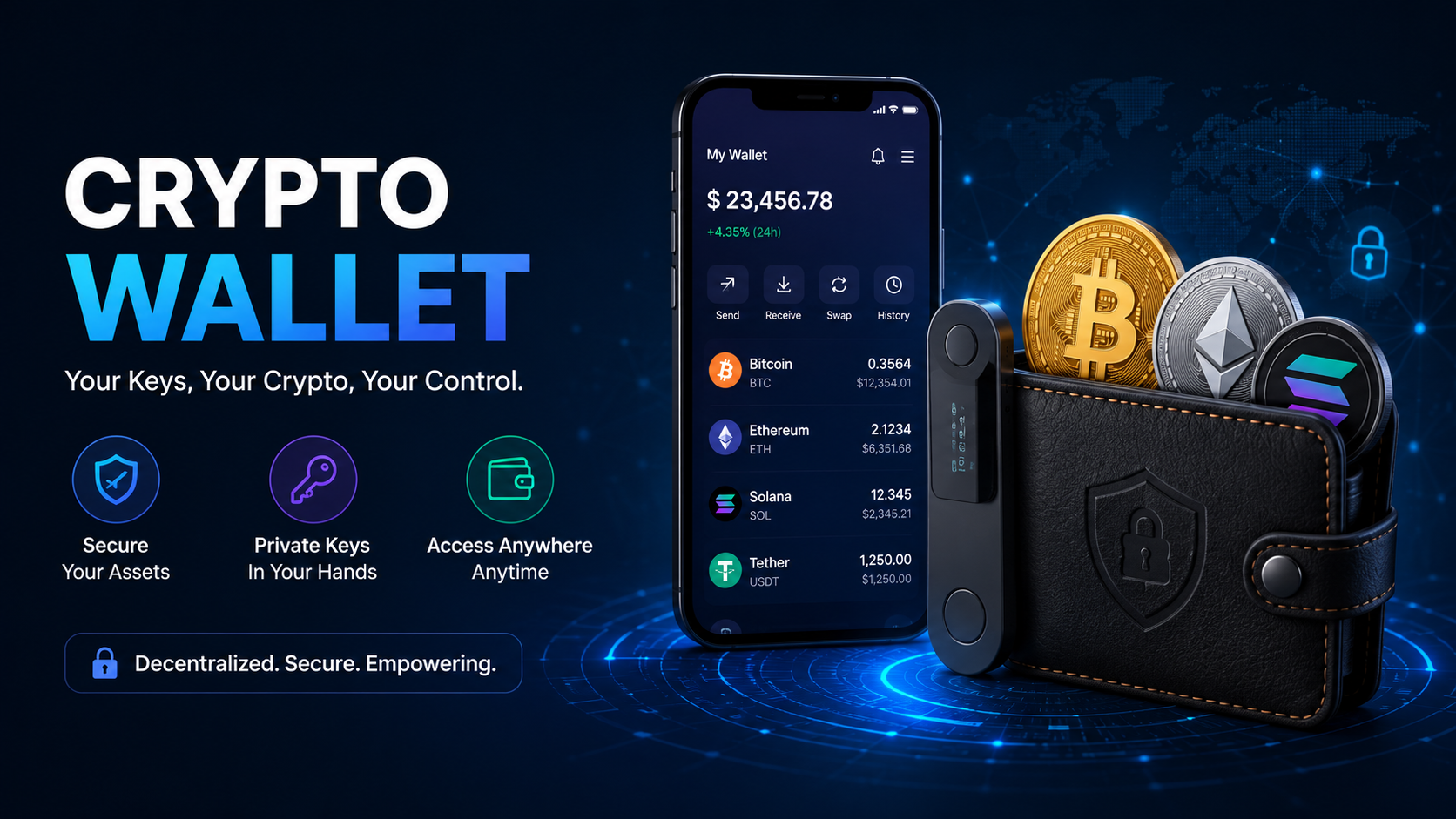
For millions of people entering the cryptocurrency market, downloading a digital wallet feels similar to opening a bank account. The assumption is simple: transfer Bitcoin, Ethereum, or another cryptocurrency into the wallet, and it sits there until you decide to spend or sell it.
But that’s not how cryptocurrency works.
In reality, your crypto wallet doesn’t store your Bitcoin, Ethereum, Solana, or any other digital asset. It never has. Instead, it stores something far more valuable: the cryptographic keys that prove you own assets recorded on a blockchain.
This misunderstanding is one of the biggest reasons people lose access to their crypto, fall victim to scams, or panic when changing devices. As digital assets become more mainstream and governments around the world continue to develop crypto regulations, understanding how wallets actually work has become essential for anyone investing in the space.
The Biggest Misconception About Crypto Wallets
The word “wallet” creates a misleading image.
A physical wallet holds cash, credit cards, identification documents, and receipts. If you lose it, the items inside are gone.
A cryptocurrency wallet works differently.
Your Bitcoin or Ethereum never leaves the blockchain. Every coin, token, or NFT continues to exist on a decentralized ledger maintained by thousands of computers worldwide. The wallet simply provides the credentials needed to prove ownership and authorize transactions.
Think of it this way.
Imagine your cryptocurrency is stored inside a highly secure digital vault that everyone can see but nobody can open without permission. Your wallet isn’t the vault itself. It’s the key that unlocks your specific section of that vault.
Without the key, the assets remain exactly where they are, but nobody can move them.
Your Crypto Lives on the Blockchain
The blockchain acts as a permanent public ledger.
Every transaction ever made is recorded across thousands of computers operating on the network. Instead of holding digital coins inside a wallet application, the blockchain continuously tracks which blockchain addresses control which assets.
When someone sends cryptocurrency to you, they aren’t placing coins into your phone or computer.
Instead, the blockchain updates its records to show that your blockchain address now controls those assets.
Your wallet merely allows you to interact with those records.
This is why you can restore your wallet on a completely different device without transferring any cryptocurrency.
As long as you recover your wallet using the correct recovery phrase, the blockchain recognizes that you still control the same address and displays your balances accordingly.
Private Keys Are What Really Matter
Behind every crypto wallet lies a private key.
A private key is a long, randomly generated string of numbers and letters that mathematically proves ownership of a blockchain address.
Whoever controls the private key controls the cryptocurrency associated with that address.
Nothing else matters.
Not your email address.
Not your username.
Not the device you use.
Not even the wallet application itself.
This is why experienced crypto users often repeat the phrase:
“If you don’t control the private keys, you don’t truly own the crypto.”
The private key is the ultimate proof of ownership.
The Role of the Recovery Phrase
Most wallets don’t ask users to memorize private keys directly.
Instead, they generate a recovery phrase, commonly consisting of 12 or 24 random words.
These words act as a master backup.
Using internationally accepted cryptographic standards, the recovery phrase can recreate every private key associated with that wallet.
That’s why wallet providers repeatedly warn users never to share this phrase.
Anyone who gains access to those words gains complete control over every cryptocurrency associated with that wallet.
Unlike online banking, there is usually no customer support team capable of reversing unauthorized transactions.
Why Losing a Phone Doesn’t Mean Losing Your Crypto
Many newcomers panic after damaging or replacing their smartphone.
Fortunately, the cryptocurrency isn’t stored on the device itself.
The phone simply holds encrypted copies of your private keys.
If the phone disappears but you’ve safely stored your recovery phrase, installing the same wallet—or even a different compatible wallet—on another device allows you to restore access almost instantly.
The blockchain continues to recognize your ownership because the cryptographic credentials remain the same.
The device changes.
Ownership does not.
Why Losing Your Recovery Phrase Can Be Permanent
The opposite scenario is far more serious.
If you lose both your device and your recovery phrase, recovering the wallet becomes practically impossible.
Unlike traditional banks, decentralized blockchains have no password reset button.
No customer service representative can verify your identity and restore access.
There is no administrator with the authority to unlock the wallet.
This level of decentralization is one of cryptocurrency’s defining features, but it also places complete responsibility on the owner.
Over the years, billions of dollars worth of cryptocurrency have become permanently inaccessible because people misplaced recovery phrases, discarded old hard drives, or forgot passwords protecting their wallets.
Those assets still exist on the blockchain.
Nobody can move them.
Hot Wallets vs Cold Wallets
Although all crypto wallets serve the same basic purpose, they differ in how private keys are stored.
Hot wallets remain connected to the internet.
These include mobile apps, desktop software, and browser extensions. They offer convenience for daily transactions but also face greater exposure to malware, phishing attacks, and hacking attempts.
Cold wallets, on the other hand, store private keys offline.
Hardware wallets are the most common example. They sign transactions without exposing private keys to internet-connected devices, making them significantly more secure for long-term holdings.
Importantly, neither wallet type actually stores cryptocurrency.
Both simply protect access credentials in different ways.
What Happens When You Send Crypto?
Sending cryptocurrency can seem mysterious, but the underlying process is straightforward.
When you initiate a transaction, your wallet creates a digital signature using your private key.
This signature proves to the blockchain network that you’re authorized to transfer assets from your address.
The blockchain verifies the signature.
Once confirmed, the ledger updates ownership records, assigning the cryptocurrency to the recipient’s address.
The actual coins never travel through your wallet application.
Only ownership records change on the blockchain.
Why Exchanges Are Different
Many investors buy cryptocurrency through centralized exchanges and assume those accounts function like personal wallets.
In reality, they’re very different.
When crypto remains on an exchange, the company generally controls the private keys on your behalf.
Users access balances through usernames and passwords, much like online banking.
This arrangement offers convenience but requires trust.
If the exchange experiences technical failures, regulatory issues, security breaches, or insolvency, customers may temporarily or permanently lose access to their assets.
This has fueled the popular saying within the crypto community:
“Not your keys, not your coins.”
Self-custody wallets shift responsibility to the user while eliminating reliance on third-party custodians.
Why Wallet Apps Can Show Zero Balance
Some users become alarmed when opening their wallet to find an empty balance.
In many cases, the cryptocurrency hasn’t disappeared.
Wallet applications rely on blockchain nodes to retrieve account information.
Internet connectivity issues, temporary synchronization problems, incorrect blockchain network selection, or software bugs may prevent balances from displaying correctly.
Since the assets remain on the blockchain, restoring the wallet using the same recovery phrase often resolves the issue.
Checking the wallet address on a blockchain explorer can also confirm whether the assets are still associated with that address.
Common Mistakes That Lead to Losses
Most cryptocurrency losses don’t occur because blockchains are hacked.
Instead, human error remains the biggest threat.
Common mistakes include:
- Sharing recovery phrases with fake customer support representatives.
- Entering seed phrases into fraudulent websites.
- Falling for phishing emails pretending to be wallet providers.
- Storing recovery phrases digitally without encryption.
- Sending cryptocurrency to incompatible blockchain networks.
- Forgetting passwords protecting encrypted wallet backups.
Security experts consistently emphasize that attackers usually target users rather than blockchain technology itself.
Why This Knowledge Is Becoming More Important
Cryptocurrency adoption has accelerated across retail investing, institutional finance, cross-border payments, decentralized finance, and tokenized assets.
At the same time, wallet technology has become increasingly user-friendly.
Ironically, that convenience can create false confidence.
People often assume wallet apps operate like traditional banking software without understanding the cryptographic systems working behind the scenes.
As regulators encourage greater transparency and financial institutions explore digital asset services, investor education is becoming just as important as technological innovation.
Understanding what a wallet actually does helps users make informed decisions about security, custody, and long-term asset protection.
The Future of Crypto Wallets
Wallet technology continues to evolve rapidly.
Developers are introducing features such as biometric authentication, social recovery mechanisms, multi-party computation, account abstraction, and improved user interfaces designed to reduce mistakes.
These innovations aim to simplify self-custody without compromising decentralization.
Despite these advances, one principle is unlikely to change.
Cryptocurrency will continue to exist on blockchains rather than inside wallet applications.
Whether users access their assets through smartphones, hardware devices, smart cards, or future digital identity systems, wallets will remain tools for managing cryptographic credentials rather than containers holding digital money.
The Bottom Line
The name “crypto wallet” has confused users ever since Bitcoin introduced decentralized digital money.
Unlike a leather wallet that stores cash, a cryptocurrency wallet stores access, not assets.
Your Bitcoin, Ethereum, and other digital holdings remain permanently recorded on the blockchain, while your wallet safeguards the private keys needed to prove ownership and authorize transactions.
This distinction may sound technical, but it has real-world consequences. It explains why a lost phone doesn’t necessarily mean lost crypto, why recovery phrases are so valuable, and why protecting private keys is the single most important responsibility for anyone managing digital assets.
As cryptocurrency continues moving toward mainstream adoption, understanding this simple concept could make the difference between confidently managing your investments and losing access to them forever.