
Most organizations already have identity and access management. What they often do not have is tight control over the accounts that can change configurations, dump databases, or move across servers. Those privileged accounts—human admins, service accounts, SSH keys, and application secrets—are still a common path in serious incidents.
A Privileged Access Management platform is the set of controls that discovers those accounts, stores and rotates their credentials, grants access for a limited time instead of leaving standing admin rights in place, records what happened during the session, and proves all of that to auditors. It is a subset of identity security, not a replacement for IAM. IAM answers “who is this user?” PAM answers “who is allowed to become admin, for how long, and what did they do?”
Questions that come up in almost every evaluation
- Do we need a full vault plus session broker, or mainly endpoint least privilege?
- Can we get to useful coverage in weeks, or are we planning a long program?
- How much hybrid and legacy infrastructure do we still run?
- Do vendors and contractors need access without a broad VPN?
Gartner’s Privileged Access Management Magic Quadrant has repeatedly placed CyberArk, BeyondTrust, and Delinea among the Leaders. That is a useful starting map, not a buying order. The platforms below are listed by a practical mix of coverage, deployment style, and how often they appear in real shortlists—not by market share alone.
The 7 platforms
1. Securden Unified PAM
Securden is a fit when a team wants vaulting, session control, just-in-time elevation, endpoint privilege management, and remote/vendor access in one product rather than several overlapping tools. Its Privileged Access Management platform covers account discovery across Windows, Linux, databases, and network devices, password and SSH-key rotation, approval workflows, session recording, and application control on endpoints.
Customer write-ups and independent reviews tend to emphasize a shorter path from install to daily use compared with the heaviest enterprise suites. That does not make it the deepest option for every mainframe or OT scenario. It does make it a credible first platform for mid-market IT teams, MSPs, and organizations that have delayed PAM because previous quotes looked like a year-long project. More background on the vendor is on the Securden homepage.
2. CyberArk Privileged Access Manager
CyberArk is the reference platform for large, regulated environments. Its vault model, connector coverage, session brokering, and secrets capabilities for applications and DevOps are the reason it shows up in so many enterprise RFPs. If you have a complex mix of on-prem systems, cloud workloads, and strict audit requirements, CyberArk is usually on the shortlist for a reason.
The consistent trade-off is operational weight. Implementations are often longer, and the platform is designed for teams that can staff it. Choose it when completeness and a long enterprise track record matter more than a lightweight rollout.
3. Delinea Platform
Delinea, built from Thycotic and Centrify, is frequently the mid-to-large alternative when buyers want vaulting and session management without the longest enterprise timeline. Secret Server remains the well-known core; the broader Delinea Platform adds more identity and privilege controls around it.
Teams often pick it for a more approachable admin experience, SaaS or hybrid deployment, and faster time to a working vault-plus-sessions program. It is less often the first choice solely for the most specialized legacy or OT connectors, where CyberArk still has an edge.
4. BeyondTrust
BeyondTrust is strongest when privileged passwords, remote access, and endpoint least privilege need to live under one policy model. Its remote-access heritage and Endpoint Privilege Management product are the usual reasons it wins bake-offs against vault-only tools.
If the main risk is local admin rights on workstations, or if contractors need tightly brokered access to specific systems, BeyondTrust is worth a serious look. Organizations that only need a credential vault may find parts of the suite more than they will use.
5. ManageEngine PAM360
PAM360 is the practical option for IT teams already in the ManageEngine ecosystem, or for mid-sized shops that need discovery, vaulting, session recording, and SSH-key management without a dedicated PAM program office. It covers the core privileged-account workflow and is generally easier to operate than the largest suites.
It will not match CyberArk’s breadth on every target system or BeyondTrust’s endpoint story. For many companies, that is acceptable if the goal is to stop shared spreadsheets and unrecorded admin sessions this quarter.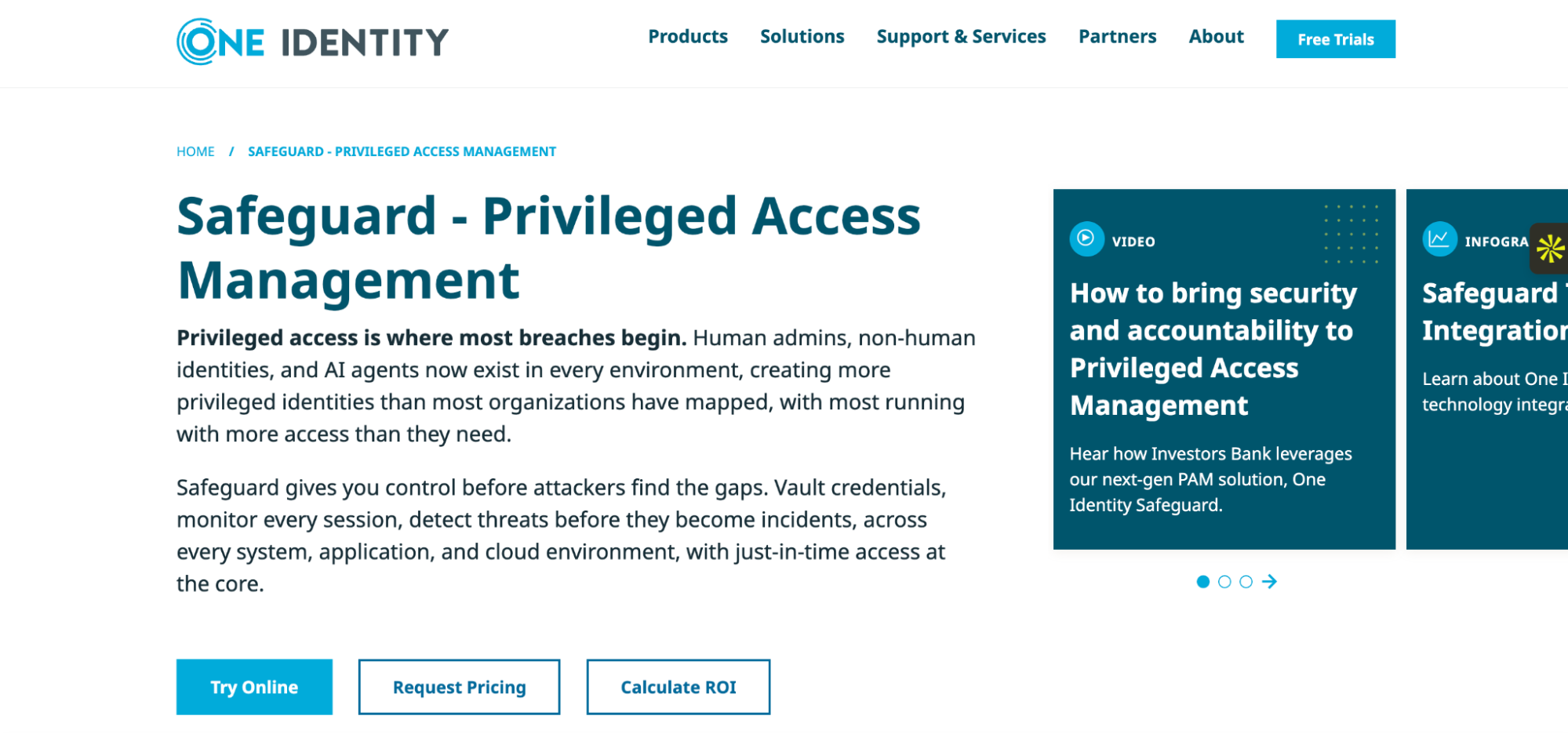
6. One Identity Safeguard
Safeguard is often evaluated by organizations that already run One Identity for broader IAM, or that care a lot about session inspection, approval workflows, and privileged-account lifecycle. Protocol-aware session control and indexed playback are typical strengths in reviews.
It sits in the enterprise-alternative category: capable and structured, not the simplest product on this list. It is a better conversation when identity governance and privileged access are being planned together.
7. Teleport
Teleport represents the cloud-native end of the market. Instead of leading with a classic password vault, it issues short-lived, identity-aware access to servers, Kubernetes, and databases. That model matches how many platform and engineering teams already want to work.
It is not a full replacement for Windows endpoint privilege management or a traditional PASM suite in a mixed legacy estate. It is a strong answer when the privileged-access problem is mostly infrastructure access for engineers, not shared domain-admin passwords on a thousand laptops.
What a good PAM program actually has to do
Regardless of vendor, the controls that show up in incidents and audits are consistent:
- Discover privileged and service accounts, including the ones nobody documented.
- Remove standing admin where you can; use just-in-time and just-enough access instead.
- Inject credentials into sessions so users never see the password.
- Record and review sessions, with a way to terminate a bad one.
- Rotate secrets on a schedule and after use.
- Produce evidence for NIST, PCI-DSS, HIPAA, ISO 27001, and, where relevant, NIS2 or DORA.
Those requirements are why PAM shows up next to zero trust. Zero trust says never assume trust and verify continuously. PAM is one of the concrete ways to do that for the most powerful accounts. Certificate-based trust and passwordless methods, including PKI and passkeys, sit beside PAM rather than replacing the need to govern admin access.
How to run a fair evaluation
Start with your environment, not a feature matrix. Count privileged users, service accounts, and the systems they touch. Decide whether endpoint local-admin removal is year-one work. Ask each vendor to discover accounts in a non-production slice of your network and to show a recorded session against a system you actually run.
Watch for two failure modes that are more common than a missing checkbox. The first is buying a platform so large that only a fraction of it ever goes live. The second is treating PAM as a vault only, while local admin rights and vendor VPNs stay untouched.
IT teams, especially in smaller companies and MSPs, also keep running ordinary operations while they tighten security. A focused utility such as a mobile bill format generator does not replace access control, but it is the kind of day-to-day tool those same teams still need for billing and shop documentation.
There is no single best Privileged Access Management platform for every company. There is a best fit for your mix of scale, infrastructure, staff, and how quickly you need the first privileged sessions under control. Use a proof of concept to find that fit, then measure success by standing privileges removed and sessions you can actually replay—not by how many modules were licensed.