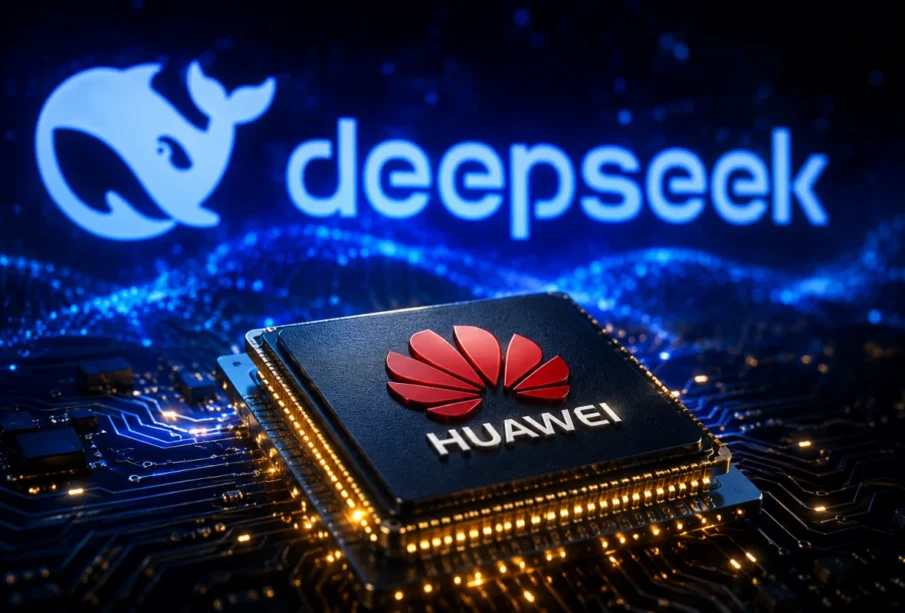
China’s artificial intelligence ambitions are moving into a new phase, with DeepSeek reportedly planning to deploy at least 160,000 of Huawei’s next-generation AI accelerators at a massive data center in Inner Mongolia. If completed, the project could become one of the world’s largest known clusters of Huawei AI chips and mark a significant step in China’s effort to reduce its dependence on Nvidia.
The Hangzhou-based AI startup plans to use Huawei’s upcoming Ascend 950DT processors primarily to run its AI models, according to people familiar with the matter. However, DeepSeek does not currently intend to use the chips for training its models, despite Huawei positioning the 950DT as a processor capable of handling demanding AI workloads.

Credits: Outlook Business
Huawei Faces Production Constraints
DeepSeek is reportedly seeking even more Huawei chips, but supply remains a major obstacle. Huawei currently lacks the manufacturing capacity needed to quickly satisfy such a large order.
Production of the Ascend 950DT is expected to be constrained by shortages of critical components, including high-end memory. Huawei’s total output could remain in the low hundreds of thousands of chips during 2026, meaning DeepSeek’s order alone could take more than a year to fulfill.
Huawei must also divide its limited supply among other customers while attempting to ship some processors overseas.
The situation highlights a major challenge for China’s semiconductor industry: demand for domestic AI chips is growing rapidly, but manufacturers are still struggling to match the scale of Nvidia’s global supply chain.
DeepSeek’s Massive AI Infrastructure Bet
The planned Inner Mongolia facility is part of DeepSeek’s broader push to build enormous computing infrastructure. The company is reportedly in discussions to raise billions of dollars to expand its AI capabilities.
Its infrastructure plans in the region are expected to reach gigawatt scale. At full utilization, the facility could consume enough electricity to power roughly 750,000 homes.
The 160,000 Huawei accelerators would represent only one portion of the planned computing capacity, leaving open the question of which chips DeepSeek will use for the rest of the facility.
US officials have alleged that DeepSeek has also obtained Nvidia’s powerful Blackwell processors and installed them in Inner Mongolia, although the claim has not been independently verified.
China’s Race to Replace Nvidia
The proposed cluster comes as Beijing intensifies its push for Chinese AI companies to adopt domestic processors. Huawei has emerged as the country’s leading alternative to Nvidia, while DeepSeek has become one of the most prominent AI companies demonstrating that Chinese models can be optimized for locally produced hardware.
Nvidia remains the global standard for AI training and inference, but US export restrictions have sharply limited access to its most advanced processors in China.
Those restrictions, introduced amid concerns over China’s military and technological development, have also encouraged Chinese companies to accelerate domestic alternatives.
Huawei’s Ascend processors are central to that effort. The upcoming 950DT is viewed as a substantially more capable chip and is widely regarded as being in the performance range of Nvidia’s previous-generation Hopper architecture.

Credits: The Economic Times
A Giant Leap for Chinese AI Chips
The scale of DeepSeek’s planned deployment is particularly striking when compared with China’s recent AI infrastructure projects.
Just six months ago, a Shenzhen technology newspaper reported the launch of China’s first 10,000-chip intelligent computing cluster based on Huawei’s Ascend processors. DeepSeek’s proposed 160,000-chip installation would be 16 times larger.
Other Chinese companies are also pushing toward large-scale domestic AI infrastructure. Meituan recently said it had trained an AI model using 50,000 Chinese-made chips, while Z.AI has completed a 1-gigawatt data center designed to eventually rely on domestically produced processors.
DeepSeek’s project therefore represents more than just a huge chip order. It could become a test of whether China can build AI infrastructure at a scale approaching the enormous data centers being developed by American technology companies—despite having less powerful hardware and facing significant supply constraints.
If Huawei can deliver the chips, the Inner Mongolia cluster could become a powerful symbol of China’s accelerating push toward AI self-sufficiency.