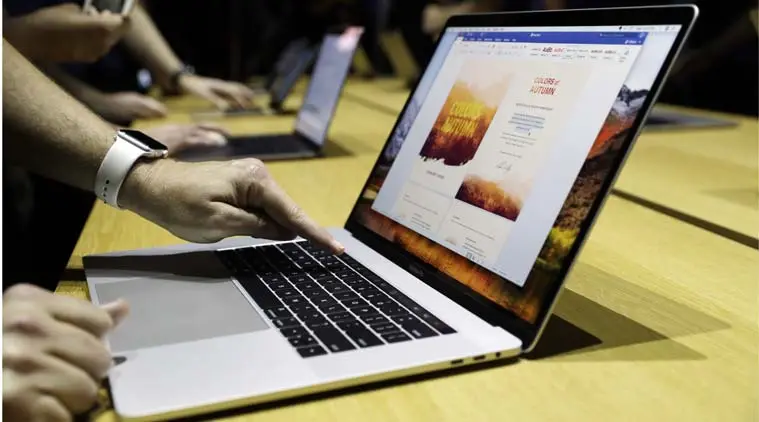
Apple’s first touchscreen MacBook Pro has arrived with a premium price tag, and buyers will pay considerably different amounts depending on where they purchase it. The new MacBook Pro with PROLED XDR Display, unveiled on October 28, introduces touchscreen functionality to the Mac lineup alongside a tandem OLED display and Apple’s M5 Pro and M5 Max processors.
While prices start at $2,899 in the US, the entry-level model costs ₹3,49,900 in India and £2,899 in the UK. The new laptop will be available in 14-inch and 16-inch variants, with the more powerful M5 Max configurations pushing prices substantially higher.
Credits: Hypebeast
Apple Touchscreen MacBook Pro Prices in the US, India and UK
The US has the lowest starting prices among these three markets, with the base 14-inch MacBook Pro featuring the M5 Pro chip priced at $2,899. The larger 16-inch version starts at $3,399.
Customers opting for the M5 Max processor will pay $4,499 for the 14-inch model and $4,799 for the 16-inch variant. These prices reflect Apple’s standard US starting prices before applicable sales taxes.
In India, the 14-inch M5 Pro model starts at ₹3,49,900, while the 16-inch version costs ₹4,09,900. The M5 Max variants are priced at ₹5,49,900 and ₹5,89,900, respectively.
UK buyers face a similar premium in local currency. The 14-inch M5 Pro model starts at £2,899, rising to £3,399 for the 16-inch version. The M5 Max configurations cost £4,499 and £4,799, respectively.
Canada and Dubai Also Get Premium Pricing
Apple’s Canadian pricing starts at C$3,999 for the 14-inch M5 Pro model and C$4,799 for the 16-inch version. The corresponding M5 Max configurations cost C$6,299 and C$6,599.
In Dubai, reported starting prices are AED 11,999 for the 14-inch M5 Pro model and AED 14,499 for the 16-inch version. The M5 Max variants are priced at AED 19,299 and AED 20,999, respectively.
These regional differences reflect more than currency conversion alone. Local taxes, import costs, pricing strategies and market conditions can influence the final retail price. Consequently, comparing the figures in their original currencies does not necessarily reveal which market offers the best deal.
How Much More Are Indian Buyers Paying?
The difference becomes clearer when US prices are converted into Indian rupees. Using an indicative exchange rate of ₹95.20 per dollar, the $2,899 entry-level model translates to approximately ₹2.76 lakh before US sales taxes.
That is around ₹73,900 below the official Indian starting price of ₹3,49,900. The gap widens for higher-end configurations: the 16-inch M5 Max model costs approximately ₹4.57 lakh at the same exchange rate, compared with its Indian price of ₹5,89,900.
However, the difference should not be treated as a guaranteed saving. US sales taxes vary by location, while overseas purchases may involve additional costs, warranty considerations and import requirements. Buyers should compare the final checkout price rather than relying solely on currency conversions.

Credits: Apple
When Will the Touchscreen MacBook Pro Go on Sale?
Apple opened pre-orders on October 28, with availability scheduled to begin on November 6 in the US, UK and Canada. Indian customers are scheduled to receive the laptops from November 9.
The launch marks a major change for Apple, which resisted touchscreen MacBooks for years. The new models combine touch interaction with macOS, a tandem OLED display and M5 Pro or M5 Max processing power.
For professionals considering an upgrade, the choice will depend on whether these improvements justify the higher cost. For Apple, the challenge is to convince buyers that touchscreen functionality and premium display technology are worth paying substantially more for, particularly as rising component costs put pressure on computer prices worldwide.
Ultimately, Apple’s touchscreen MacBook Pro highlights the growing premium attached to its latest hardware innovations. While US buyers enjoy lower pre-tax prices, international customers face significantly higher costs. Whether the touchscreen experience justifies the premium will depend on professional needs, regional pricing, and how effectively Apple integrates touch into macOS.