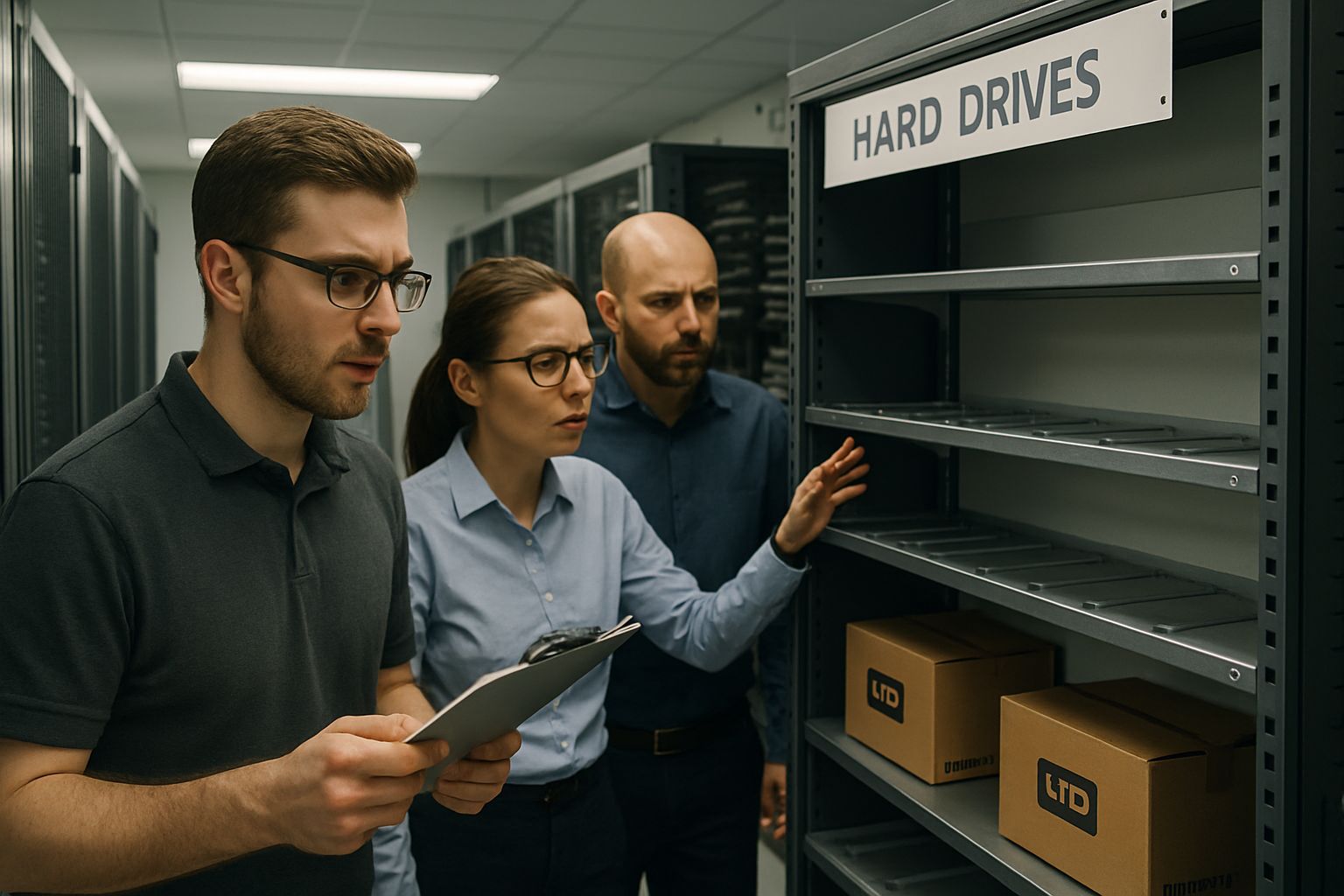
The global market or hard drives faces a squeeze, and the cause is clear: artificial intelligence. Demand from large cloud companies has absorbed nearly all available supply, leaving smaller buyers with few options.
Industry executives at Western Digital and Seagate report that their plants are already fully booked for the year. Current orders now extend well into the future as hyperscale cloud companies secure supply for their massive AI data centers.
Western Digital CEO Tiang Yew Tan told analysts that the company has firm purchase orders to cover all of its production in 2026. Some of its customers have signed up for long-term contracts that extend into 2027 and even 2028. Seagate CEO Dave Mosley gave a similar briefing, saying that the company’s nearline storage capacity is fully booked through 2026, with initial discussions already underway for 2028 demand.
The third-largest hard drive manufacturer, Toshiba, is also expected to be affected in the same way. The three companies control the hard disk drive market, leaving little room for additional production when demand is high.
Hard drives no longer power most laptops or home PCs. Solid-state drives have taken that role. However, hard drives are still essential in data centers because they hold massive amounts of data at a lower cost per terabyte. AI requires massive amounts of data for training and functioning, making high-capacity storage a necessity.
How AI Demand is Squeezing the Storage Market
Companies are working to increase storage capacity. Western Digital is set to release 44-terabyte storage drives this year and is working towards the release of 100-terabyte storage drives before the end of the decade. Larger storage drives are attractive to cloud service providers who have to store training data, backups, and archives.
Industry analysts say this surge creates clear winners and losers. According to Sid Nag, president and chief research officer at Tekonyx, most available production now serves hyperscalers with long-term contracts. That leaves little open capacity for mid-size enterprises or smaller cloud providers.
Research firm Omdia shares that concern. Senior research director Vlad Galabov expects a difficult year for general enterprise servers and storage systems. Many corporate IT teams rely on hard drives as a low-cost storage layer, and limited supply may delay upgrades or force companies to revise infrastructure plans.
The pressure does not stop with hard drives. AI demand has already strained supplies of DRAM and NAND flash memory, both key components in modern storage. IDC analyst Andrew Buss warns that shortages across memory, storage, and processors now influence one another. When flash storage prices rise, buyers shift back toward hard drives, which increases pressure on disk supply as well.
Scale, Scarcity, and the Return of Hard Drives
AI hardware also drives demand for faster storage. New GPU systems require large pools of high-speed SSD capacity to feed data into training workloads. As flash storage tightens, some organisations reconsider hybrid systems that combine SSD speed with HDD capacity. In certain workloads, traditional disk arrays may even regain popularity.
However, despite these challenges, the expenditure on data centers keeps rising. Omdia predicts that more than $1 trillion will be spent on data center capex in a year.
The leading cloud companies, such as Google, Amazon, Microsoft, Meta, Oracle, CoreWeave, ByteDance, xAI, Alibaba, and Tencent, are projected to represent over 70 percent of server investments. AI-optimized servers alone may represent 80 percent of the total server investments.
The result is a market shaped by scale. Hyperscalers gain supply certainty through long contracts and massive purchasing power. Smaller enterprises face higher prices, longer wait times, and delayed refresh cycles.
For now, the AI boom has turned a mature storage industry into a supply-constrained one. Hard drives, once seen as legacy technology, have become a critical resource again. The companies that build AI infrastructure will secure what they need. Everyone else may have to wait.