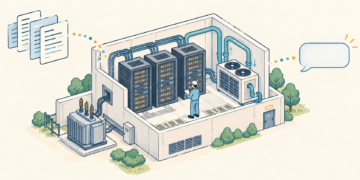
Amazon’s rapid expansion into artificial intelligence infrastructure is facing a major environmental controversy after the company confirmed plans for a massive new data center campus in Pecos County, Texas, that will be powered by its own natural gas generation facility.
The project could become one of the most significant examples yet of the environmental cost associated with the AI boom. The planned power plant has been authorised to emit up to 33 million tons of greenhouse gases annually, a figure that could make it the largest single source of climate pollution in the United States if the facility reaches its permitted maximum.
The scale of the proposed emissions is extraordinary. Thirty-three million tons of carbon dioxide in a year would be comparable to the annual emissions of entire countries, including Switzerland or Ireland. It would also exceed the emissions associated with many of the country’s largest individual industrial facilities.
At the center of the project is a planned 7.65-gigawatt natural gas power plant containing 35 turbines. The facility is being developed to provide electricity directly to Amazon’s planned data center campus, allowing the company to avoid waiting for additional grid capacity to become available.
The arrangement reflects a growing trend among technology companies as the artificial intelligence industry creates unprecedented demand for electricity.

Modern AI data centers require enormous amounts of electricity. Training large models, operating AI assistants and processing billions of user requests require powerful processors running continuously inside facilities that can occupy hundreds of acres.
Amazon’s Texas project is designed to meet those demands with dedicated generation.
The data center will initially operate largely independently of the Texas power grid, with the natural gas plant providing its electricity. The strategy gives Amazon greater control over its power supply and could allow the company to bring the facility online faster than if it had to wait for a major grid connection.
That speed is becoming increasingly important across the technology industry. Data center developers are competing for limited electricity capacity as AI workloads grow, while grid connections for massive facilities can take years.
Natural gas offers an attractive solution because it can provide electricity continuously and can be deployed more quickly than some large-scale low-carbon alternatives.
But the environmental trade-off is substantial.
A Potential Record-Breaking Polluter
The 33-million-ton figure represents the facility’s permitted emissions ceiling rather than a prediction that the plant will necessarily release that amount every year.
Even so, the potential scale has attracted significant attention.
If the plant were to operate at levels approaching its permitted emissions, it could rank among the largest sources of greenhouse gases in the country. Unlike traditional power stations, however, its primary purpose would not be supplying electricity to communities or businesses across Texas.
Instead, much of its output would be dedicated to powering Amazon’s computing infrastructure.
That distinction has intensified concerns about the environmental footprint of AI.
The technology is increasingly being presented as a tool for improving efficiency, scientific research and economic productivity. Yet behind every AI model is a physical infrastructure network consisting of data centers, servers, cooling systems, power generation facilities and transmission infrastructure.
As the demand for AI grows, so does the energy required to support it.
Amazon’s Climate Commitment Under Pressure
The Texas project also creates an uncomfortable contrast with Amazon’s environmental commitments.
Amazon has pledged to reach net-zero carbon emissions by 2040 and has invested heavily in renewable energy projects. The company has also promoted sustainability as a major part of its long-term corporate strategy.
However, the rapid growth of AI is making those commitments increasingly difficult to achieve.
Amazon’s carbon emissions have risen as its energy consumption has expanded, while the company and other technology giants continue investing in enormous computing facilities.
Amazon has defended the Texas project, arguing that the new on-site generation will pay for the energy required by its operations rather than shifting costs onto Texas households.
The company has also indicated that it is exploring solar power and battery storage at the site and plans to use water that is unsuitable for drinking or irrigation. Amazon says it intends to minimise water consumption through specialised cooling technology.
Those measures could reduce some of the project’s environmental impact, but they do not eliminate the central concern surrounding the natural gas plant: its potential carbon emissions.
Why Amazon Is Building Its Own Power Plant
The decision to build dedicated power infrastructure illustrates a fundamental problem facing the AI industry.
The electricity grid in many parts of the United States was not designed for the sudden arrival of enormous AI data centers. A single facility can require as much electricity as a small city.
Waiting for new transmission lines, substations and generation capacity can delay projects for years.
By developing behind-the-meter power generation, technology companies can bypass some of those limitations.
Amazon is not alone in pursuing this strategy. Other major technology companies are exploring natural gas, nuclear energy, renewable energy and other dedicated power sources to guarantee electricity for their growing AI operations.
The trend could fundamentally change the relationship between technology companies and the energy sector.
Instead of simply purchasing electricity from utilities, hyperscale technology companies could increasingly become major energy developers themselves.
The Bigger Environmental Debate
Amazon’s Texas facility is ultimately part of a much larger debate about how the AI revolution should be powered.
AI promises enormous economic and technological benefits, but those benefits come with physical costs. Data centers require electricity, water and land, while the manufacturing of chips and construction of computing infrastructure also require substantial resources.
The question is increasingly becoming not whether AI will consume more energy, but where that energy will come from.
If companies rely heavily on natural gas to meet rapidly growing demand, AI expansion could produce a significant increase in greenhouse-gas emissions. If the industry can transition more aggressively toward renewable energy, nuclear power, storage and other low-carbon sources, the environmental impact could be substantially reduced.
For Amazon, the Pecos County project represents both a solution and a challenge. It provides the company with a powerful source of electricity for its AI ambitions, but it could also become a symbol of the environmental consequences of the industry’s extraordinary growth.
The potential 33 million tons of annual emissions has already turned the project into a warning sign for policymakers and environmental advocates.
As the race to build bigger and more powerful AI systems accelerates, the world is now confronting a difficult question: how much pollution will society accept to power the next generation of artificial intelligence?