Apple’s Mac mini and Mac Studio are finding a surprising new audience: AI labs. While these compact desktops were originally designed for developers, creators and everyday professionals, their combination of powerful chips and large unified memory is making them increasingly attractive for running and developing AI models locally.
The demand has reportedly reached major AI companies, with OpenAI said to have purchased tens of thousands of Macs, while Anthropic is renting similar machines through Amazon Web Services (AWS). The trend highlights how Apple’s desktop hardware is quietly becoming part of the infrastructure behind the AI boom.
 Credits: NewsBytes
Macs Are Helping Train AI Agents
One of the most interesting uses of Apple’s machines is in developing computer-use AI agents.
OpenAI is reportedly using Macs for reinforcement learning (RL), a technique in which an AI system learns through trial and error by receiving feedback based on its actions. The approach can help models improve their ability to complete complicated tasks rather than simply generate text or answer questions.
The company is also using Macs to train agents capable of interacting with computers. These systems can navigate software interfaces, click buttons, enter information and complete multi-step workflows much like a human user.
That makes local computing particularly useful. Developers can test agents directly within desktop environments and observe how they interact with real software.
Why Mac Mini and Mac Studio Work Well for AI
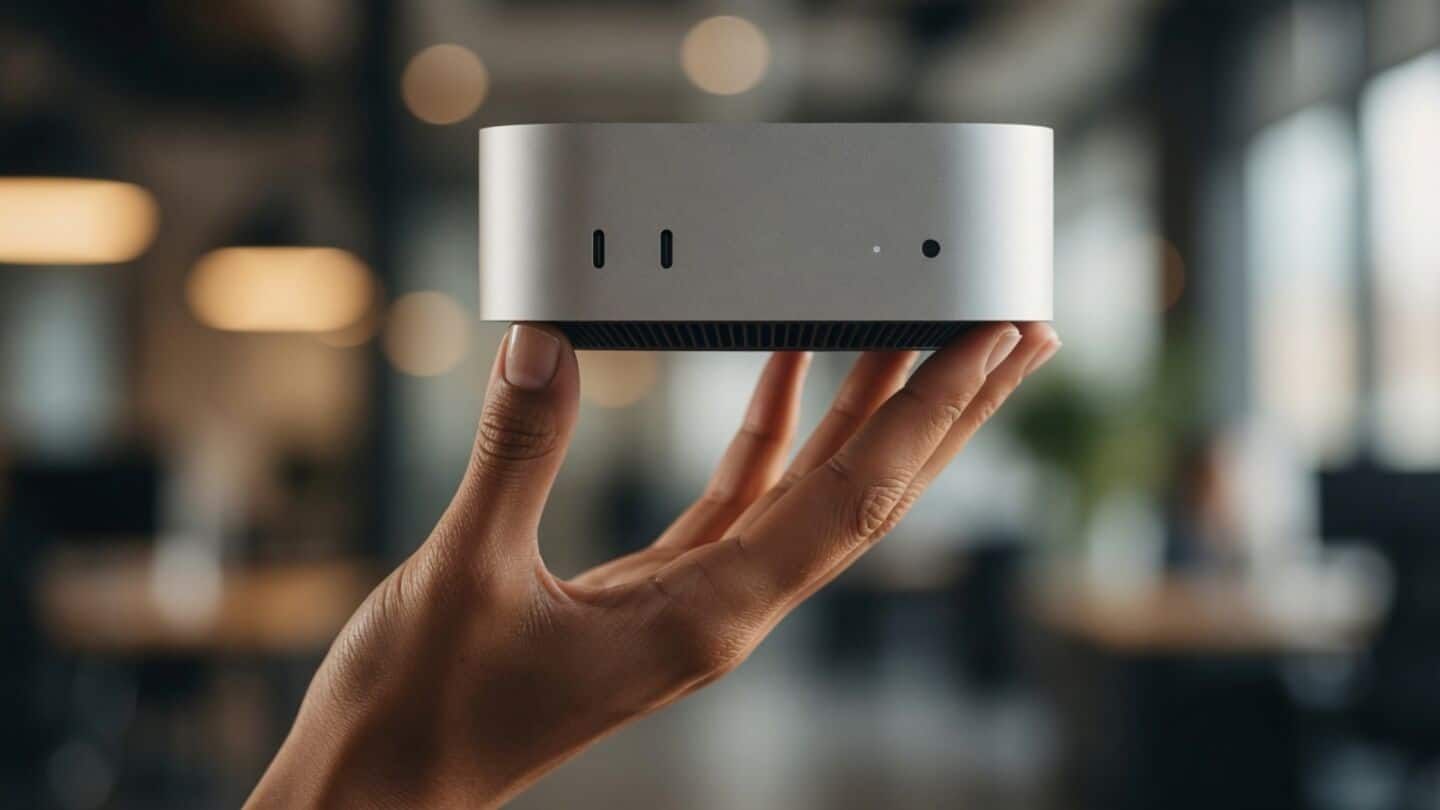
Apple’s latest Mac mini and Mac Studio models are particularly suited to workloads that require substantial memory.
The Mac mini now comes with Apple’s newer M6 chip, while the Mac Studio is powered by M5 Max or M5 Ultra processors. Their biggest advantage for AI workloads, however, isn’t simply raw processing power.
Apple’s Unified Memory Architecture allows the CPU and GPU to access the same pool of memory. For AI developers working with large models, this can be particularly useful because the system does not have to move data between separate CPU and GPU memory pools in the same way as traditional PC architectures.
The machines can therefore be used to run large AI models locally, alongside multiple development sessions and other desktop applications.
For researchers and developers, local inference can also reduce dependence on cloud APIs. There is no network latency for every request, and repeatedly running experiments locally can avoid some of the usage costs associated with cloud-based AI services.
OpenAI Buys, Anthropic Rents
The reported interest from OpenAI and Anthropic shows two different ways AI companies can use Apple’s hardware.
OpenAI is reportedly buying tens of thousands of Macs for its own operations. That suggests the company sees value in having dedicated machines available for research and experimentation.
Anthropic, meanwhile, is reportedly accessing Macs through AWS rather than purchasing the hardware outright. Cloud-based access gives researchers the ability to use Apple’s machines without having to manage the physical hardware themselves.
The fact that both approaches are emerging around the same hardware points to growing demand for flexible computing options beyond traditional AI servers.
Apple’s Mac Business Gets an AI Boost
The AI connection is also showing up in Apple’s financial performance.
Mac revenue increased nearly 29% year-over-year to $10.3 billion in the latest quarter, making it the company’s fastest-growing hardware category during the period.
While several factors can influence Mac sales, growing enterprise demand for machines capable of handling AI workloads could provide Apple with another important growth opportunity.
The company has reportedly responded to the stronger-than-expected demand by refreshing the Mac mini and Mac Studio earlier than usual. Instead of waiting for the traditional autumn launch window, the latest models were announced in late August.
Credits: Gadgets Now
Apple’s Unexpected Role in the AI Race
Apple has generally taken a different approach to AI infrastructure from companies that rely heavily on enormous GPU clusters. Yet the growing use of Macs by AI labs demonstrates that there is room for Apple’s hardware in the development process.
These machines aren’t replacing the massive data centers required to train frontier AI models from scratch. Instead, they can serve as useful tools for reinforcement learning, local model testing, agent development and experimentation.
That distinction is important. The AI revolution isn’t happening only inside giant data centers filled with specialised accelerators. Increasingly, powerful desktop machines are becoming part of the development ecosystem too.
For Apple, that could turn the humble Mac mini and Mac Studio into something far more significant: affordable, compact AI development machines that are finding their way into some of the world’s most ambitious AI labs.