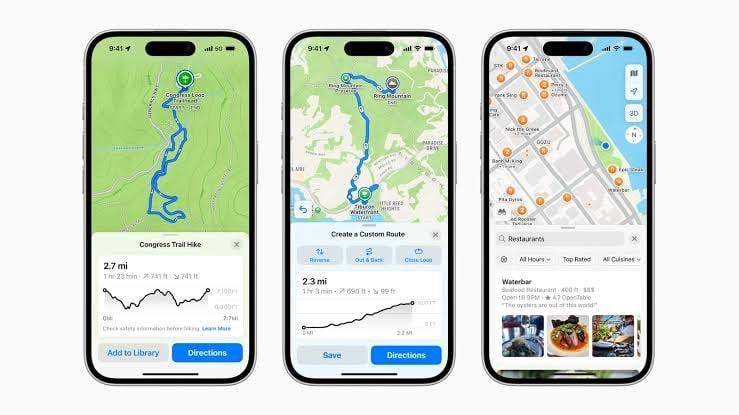
Apple Maps is preparing to introduce advertisements, ending one of the navigation service’s biggest advantages over Google Maps: an experience that has largely remained free from traditional advertising.
Apple plans to bring sponsored listings to Maps, allowing businesses to pay for greater visibility when users search for restaurants, shops, hotels and other local destinations. The change represents a significant expansion of Apple’s advertising business, but it could also change how people discover businesses through one of the company’s most frequently used services.
For years, Apple Maps has offered users a relatively straightforward experience. People could search for a location, compare nearby businesses, check opening hours, read information and get directions without constantly encountering paid placements.
That is about to change.
The introduction of sponsored listings means businesses will be able to compete for attention inside Maps. More importantly for users, there will reportedly be no setting that allows them to completely turn off these advertisements.
Apple Maps loses an important advantage
Apple and Google have taken noticeably different approaches to advertising within their mapping services.
Google Maps has incorporated sponsored businesses and promoted locations into its search and discovery experience for years. When users search for particular services, paid businesses can appear prominently among the results.
Apple Maps has generally avoided that model.

That difference has helped Apple Maps appeal to people who prefer a cleaner experience. While Apple has advertising across several of its services, Maps remained comparatively free from obvious commercial placements.
The introduction of advertisements removes that distinction.
Sponsored listings will likely be integrated into Maps rather than appearing as large traditional banner advertisements. This means the interface may continue to look relatively clean, but businesses will have the ability to pay for additional visibility.
For users, the important question will be how clearly Apple separates paid placements from normal search results.
Why Apple wants Maps advertising
The decision makes sense from a business perspective.
Apple has been steadily expanding its advertising operations, looking for new ways to generate revenue from its enormous ecosystem of devices and services.
Maps provides a particularly attractive opportunity because many searches have direct commercial intent.
When someone searches for a nearby restaurant, clothing store, hotel or coffee shop, they may be preparing to spend money immediately.
That makes Maps valuable advertising real estate.
A restaurant could pay to appear when users search for places to eat nearby. A retailer could promote its store to people looking for a particular product. A hotel could potentially reach travellers searching for accommodation in a specific area.
For businesses, this could become another important way to reach customers at precisely the moment they are looking for something.
For Apple, it creates another advertising market without requiring users to leave its ecosystem.
How sponsored listings could change search
The biggest concern is not necessarily the presence of advertisements themselves, but how they might influence search results.
When people search for a business on a map, they generally expect results to be based on factors such as location, relevance, popularity, ratings and availability.
Sponsored listings introduce another factor: money.
A business with a larger advertising budget could potentially gain more visibility than a smaller competitor, even if the smaller business has better reviews or is more relevant to the user’s search.
Apple will therefore need to make paid listings clearly identifiable.
If sponsored businesses are labelled prominently, users can make their own judgments about the results. If advertising is blended too closely with organic recommendations, however, people could feel that Maps is prioritising advertisers over users.
That could become particularly sensitive for local businesses, where rankings can have a direct effect on customer traffic.

Small businesses face a new challenge
Advertising could provide local businesses with a powerful new marketing tool, but it could also increase competition.
Large restaurant chains and retail companies often have dedicated marketing budgets. Independent businesses may not have the same resources.
If paying for prominent placement becomes an important part of appearing in Maps searches, smaller businesses could find themselves spending money simply to remain competitive.
At the same time, advertising could benefit businesses that struggle to gain visibility organically.
A new restaurant, for example, may have difficulty appearing near the top of search results because it has fewer reviews than established competitors. Sponsored placement could give it an opportunity to introduce itself to potential customers.
The impact will therefore depend heavily on how Apple’s advertising system is designed and priced.
Users cannot simply switch the ads off
For many Apple Maps users, the most frustrating part of the change could be the lack of an option to disable sponsored listings.
Unlike certain personalisation settings that users can control across Apple’s ecosystem, Maps advertisements are expected to become part of the standard search experience.
This means people who prefer entirely organic results may not have a way to remove paid placements.
That could be particularly irritating for users who rely on Maps primarily for navigation rather than business discovery.
Someone looking for directions does not necessarily want commercial recommendations competing for attention while they are trying to find a destination.
The issue also raises broader questions about Apple’s approach to its services. The company has built much of its brand around giving users a polished and controlled experience. Increasing advertising across more services could gradually change that perception.
Apple is building a bigger advertising business
Maps is only one part of Apple’s wider advertising ambitions.
The company already generates advertising revenue through areas such as the App Store and other services. Expanding into Maps would give advertisers access to users with highly specific location and purchasing intent.
That could make Maps one of Apple’s most valuable advertising opportunities.
The company does not necessarily need to cover the interface with banners to generate substantial revenue. Even relatively subtle sponsored listings could become valuable because of the commercial nature of local searches.
For advertisers, appearing at the exact moment a customer is searching for a product or service can be significantly more useful than reaching someone through a generic advertisement.
A new era for Apple Maps
The arrival of ads marks an important turning point for Apple Maps.
The service will still provide navigation, directions and location information, and advertisements may remain relatively limited and unobtrusive. But the fundamental experience will be different.
Users will increasingly have to distinguish between businesses recommended because they are relevant and businesses that have paid to be more visible.
For Apple, the change could create a significant new source of advertising revenue. For businesses, it could provide another way to reach customers. But for users, it means losing one of Apple Maps’ quiet advantages over Google Maps.
The biggest disappointment may be that there appears to be no simple switch to make the advertisements disappear.
Apple Maps once offered a relatively clean alternative in a world increasingly filled with sponsored content. With advertising now coming to the platform, even searching for the nearest coffee shop may become another place where businesses are competing for a user’s attention.