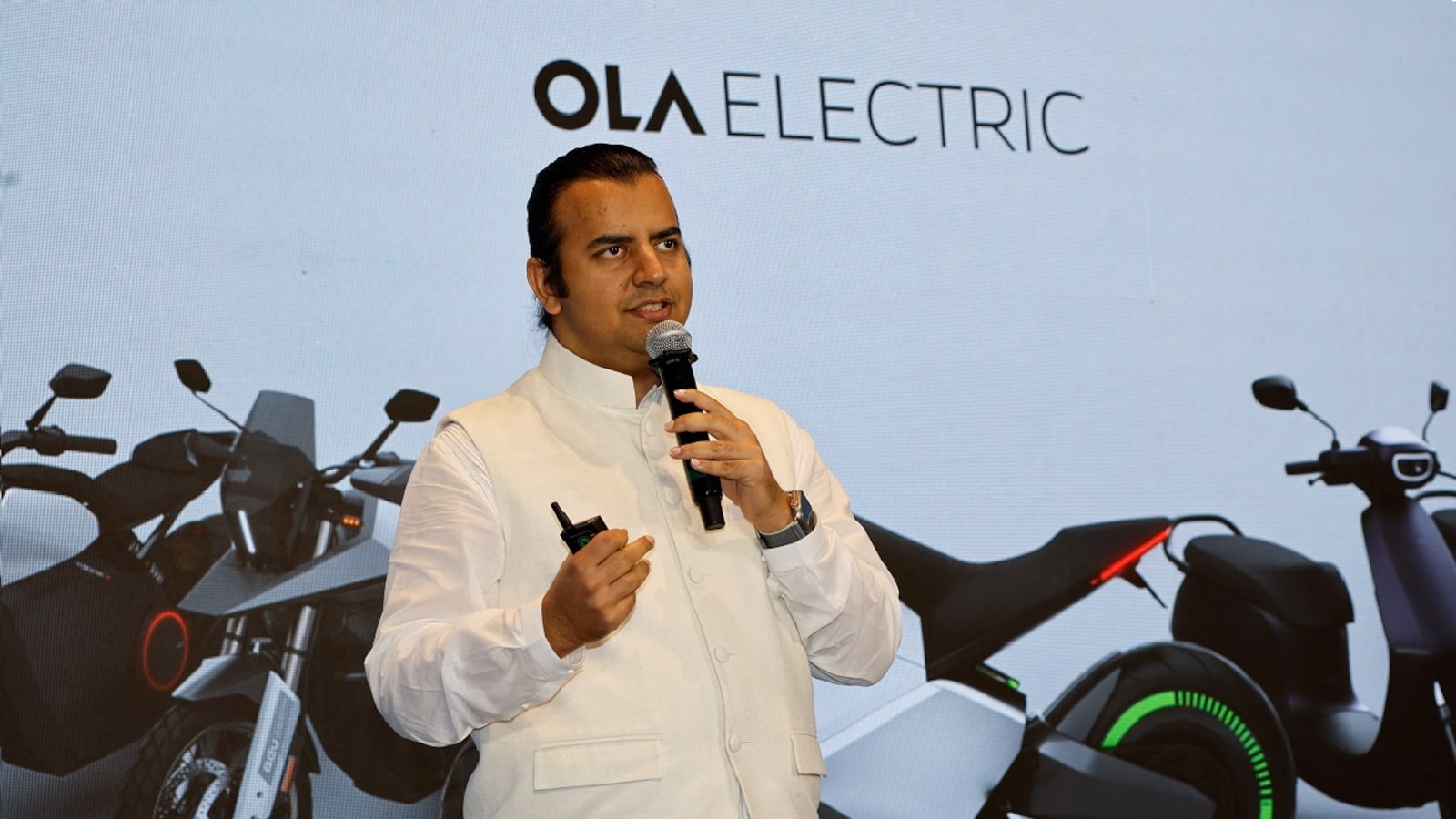
Ola Electric Mobility Ltd founder and promoter Bhavish Aggarwal has sold shares worth ₹92 crore through open market transactions, a move that has sparked fresh discussion around promoter confidence, stock performance, and governance at the electric two-wheeler maker. While the sale comes at a time when Ola Electric’s share price is under pressure, the company insists the transaction is a strategic clean-up exercise rather than a signal of reduced promoter conviction.

Credits: MSN
Details of the Share Sale
According to bulk deal data on the National Stock Exchange, Aggarwal sold 2.6 crore equity shares at an average price of ₹34.99 per share. The identities of the buyers were not disclosed. Prior to the transaction, Aggarwal held a 30.02% stake in the company as of September, making him the single largest shareholder.
Notably, a portion of this stake carried financial encumbrances. Around 10.11% of Aggarwal’s holding was pledged with lenders, while 66.63% was locked in, as per BSE shareholding disclosures. This structure had been a point of concern for some investors, given the risks associated with pledged shares in volatile markets.
Company Clarifies: “One-Time, Limited Monetisation”
Ola Electric was quick to clarify the rationale behind the transaction, calling it a “one-time, limited monetisation” of a small part of the founder’s personal stake. The proceeds, the company said, will be used to fully repay a promoter-level loan amounting to ₹260 crore.
With this repayment, all previously pledged shares—about 3.93% of the equity—will be released. The company described this as the removal of a “critical overhang,” which could otherwise contribute to stock volatility and investor unease.
Importantly, Ola Electric stressed that the transaction was executed entirely at the promoter’s personal level and has no bearing on the company’s operations, governance, or strategic direction.
Promoter Control Remains Intact
Despite the share sale, Ola Electric emphasised that there is no dilution of promoter control. Post-transaction, the promoter group is expected to hold approximately 34% of the company, which it claims is among the highest promoter holdings across newly listed, new-age technology companies.
The company added that Aggarwal’s decision reflects his conviction that Ola Electric should operate with zero promoter pledges. Eliminating leverage at the promoter level, it said, reduces avoidable risk and aligns with long-term value creation.
A History of Stake Monetisation
This is not the first time Aggarwal has sold Ola Electric shares. During the company’s IPO in August last year, he sold 3.8 crore shares at ₹76 per share. That transaction was part of the public offering process and helped bring the company to the stock market.
However, the contrast between the IPO price and the current trading levels has drawn attention, especially as the stock has struggled in recent months.
Stock Under Pressure Amid Broader Concerns
On the day of the transaction, Ola Electric Mobility’s shares ended 8.5% lower at ₹34.48, significantly underperforming the benchmark Nifty 50, which declined just 0.6%. The stock is down nearly 60% year-to-date and recently touched an all-time low of ₹33.2.
Trading activity remained heavy, with a total traded value of ₹254 crore and a delivery ratio of 51%, indicating meaningful investor participation despite the sell-off.
Credits: Moneycontrol
What Analysts Are Saying
Sentiment on the Street remains divided. Of the eight analysts tracking Ola Electric, three have a ‘buy’ rating, one suggests ‘hold,’ while four recommend ‘sell,’ according to Bloomberg data. The average 12-month consensus price target stands at ₹45.88, implying a potential upside of 33% from current levels.
For investors, the key takeaway may lie in separating short-term stock performance from long-term governance signals. While the sharp correction in Ola Electric’s shares reflects operational and market challenges, the removal of promoter pledges could be seen as a positive step toward improving transparency and reducing financial risk.
As Ola Electric navigates a tough phase in the public markets, how effectively it translates founder conviction into operational execution will likely determine whether confidence—and valuation—can be rebuilt.