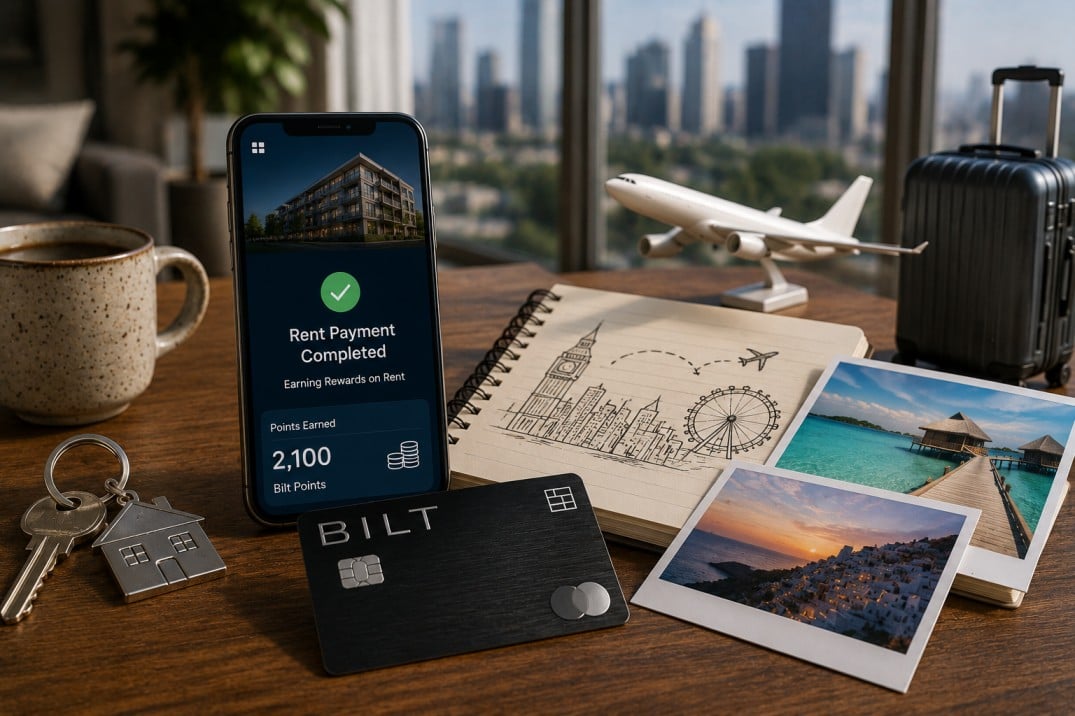
There was a time when paying rent felt like one of life’s least rewarding financial experiences. Every month, money disappeared from a bank account with all the excitement of watching paint dry. No airline miles arrived. No hotel points appeared. No luxury holiday quietly materialised in the background. Rent was simply a bill, and often a very large one.
That reality helps explain why Bilt Rewards has attracted so much attention among travellers, points enthusiasts and ordinary renters. The programme took one of the largest monthly expenses many people face and attached a rewards system to it. Suddenly, rent payments were no longer disappearing into the financial void. They were earning points.
The idea sounds almost suspiciously attractive at first. Pay rent. Earn points. Use points for travel.
Naturally, the next question follows quickly.
What are those points actually worth?
As with nearly every rewards currency, the answer depends on how they are used. Some redemptions produce modest value. Others can create the sort of travel stories that cause friends to ask suspicious questions about whether you secretly won the lottery.
What makes Bilt interesting is that it sits in a rather unusual position within the travel rewards world. Despite being a relatively young programme compared with some long-standing competitors, it has built a reputation for offering unusually strong value when points are redeemed carefully.
Travel analysts frequently place Bilt points among the most rewarding transferable currencies available today. Depending on how they are used, valuations often land somewhere around 1.8 to 2.2 cents per point. Under certain circumstances, values can climb much higher.
The important phrase here is “under certain circumstances”.
A person using points for a luxury hotel stay in a city where room rates resemble mortgage payments will receive a very different outcome from someone redeeming points for cash.
That gap explains why conversations about Bilt points often become surprisingly animated.
Why Transfers Are Where the Real Value Usually Lives
The easiest way to understand Bilt points is to think of them as a flexible travel currency rather than a fixed rebate programme.
Many rewards systems offer a straightforward proposition. Spend money, earn points, convert points into cash at a fixed rate and move on with life.
Bilt works differently.
Its strongest redemptions usually come from transferring points to airline and hotel partners.
This is where things begin to get interesting.
Imagine two travellers who each have 50,000 Bilt points. One uses those points for a low-value redemption. The other transfers them to an airline partner and books a premium cabin flight that would normally cost several thousand pounds.
Both spent exactly the same number of points.
Both technically received value.
Yet the financial outcome may be dramatically different.
This explains why transfer partners dominate nearly every serious discussion about Bilt points.
Among hotel programmes, World of Hyatt remains one of the most discussed partners. Hyatt’s award pricing often produces attractive redemption opportunities, particularly when hotel cash rates climb during busy travel periods.
A room costing hundreds of pounds per night may require a relatively modest number of points. As hotel prices rise, the value received from those points often rises as well.
This simple relationship explains why Hyatt has developed something of a cult following among points enthusiasts.
The airline side offers even more possibilities.
Programmes such as Alaska Airlines, United Airlines, Virgin Atlantic, Air Canada Aeroplan, British Airways Executive Club, Flying Blue and Qatar Airways Privilege Club all present opportunities where transferred points can unlock flights that would otherwise carry substantial cash prices.
Business class cabins are particularly popular targets.
There is a simple reason for this.
Many people would never voluntarily spend several thousand pounds on a premium airline seat. However, using points changes the psychology entirely. The same traveller who rejects a £4,000 airfare may happily redeem points for exactly the same seat.
The airline still provides the same service. The seat remains the same size. The food arrives on the same tray. The champagne remains equally cold.
The only difference is the payment method.
This is why premium cabin redemptions often generate some of the strongest values available within travel rewards programmes.
Of course, there is a catch.
Award availability behaves according to rules known only to airline revenue departments and possibly a handful of ancient wizards.
The perfect flight may appear one day and disappear the next. Seats available today may vanish tomorrow morning. Routes that seem impossible to book suddenly become available without warning.
This uncertainty is part of what keeps many points enthusiasts permanently glued to award search websites.
The Portal Option and the Appeal of Simplicity
Not everyone wants travel planning to resemble an academic research project.
Many people simply want a straightforward booking process and a holiday that begins without spreadsheets.
For those travellers, the Bilt Travel Portal offers a different route.
Points redeemed through the portal generally deliver a fixed value of around 1.25 cents per point. That figure may not create the dramatic stories associated with luxury airline cabins or five-star resorts, but it offers something equally important to many people.
Certainty.
The value calculation is clear. The booking process is familiar. There is no need to study airline alliances or hotel award charts.
That simplicity matters more than many travel enthusiasts sometimes acknowledge.
The points world has a tendency to reward people who enjoy spending their evenings comparing redemption options across multiple loyalty programmes. Not everyone finds this entertaining.
Some travellers would rather spend twenty minutes booking a flight than three weeks researching twelve different airline schemes.
The portal serves that audience well.
There is another reason the portal attracts attention. Award availability is not always available when people actually need to travel.
A family travelling during school holidays may discover that the flights they want simply do not exist in airline award inventories. At that point, a fixed-value redemption becomes a practical alternative.
The same logic applies to hotels.
Sometimes a luxury redemption creates excellent value. Sometimes a reasonably priced hotel booked through the portal makes more sense.
What matters is understanding the trade-off.
Transfer partners often provide higher value but require more effort and flexibility. Portal bookings generally provide lower value but much greater convenience.
Neither approach is automatically correct.
They simply serve different travellers with different priorities.
The Hidden Power of Rent Day and the Mistakes That Reduce Point Value
One reason Bilt continues to attract attention is its monthly Rent Day promotions.
These promotions have become something of a recurring event within the travel rewards community. Transfer bonuses occasionally increase the number of airline miles or hotel points received when points move from Bilt to selected partners.
When these bonuses align with attractive award opportunities, the mathematics can become surprisingly favourable.
A transfer bonus effectively stretches the purchasing power of existing points. Suddenly, a redemption that already looked appealing may become even more attractive.
This is why experienced travellers often pay close attention to these monthly announcements.
Yet even with transfer bonuses available, not every redemption represents good value.
One of the most common mistakes involves treating all redemptions as equal.
They are not.
Cash redemptions, rent credits and certain shopping options often generate much lower value than travel-focused alternatives.
This does not mean those choices are wrong.
Personal finance is personal. A traveller saving money on a holiday has different priorities from someone reducing everyday expenses.
Still, the gap can be surprisingly large.
The difference between a strong transfer redemption and a low-value cash redemption may effectively double the value received from the same points balance.
Another common misunderstanding involves assuming that high point values automatically represent savings.
A traveller who redeems points for a luxury experience they never intended to purchase in cash has not necessarily saved money. They have received a different experience.
This distinction often gets lost in conversations about travel rewards.
The value of points ultimately depends on personal circumstances, travel habits and redemption choices.
What makes Bilt unusual is that it gives renters access to a travel currency that competes with programmes traditionally associated with heavy credit card spending.
For years, rent represented a financial dead end for rewards collectors. Large monthly payments generated little in return. Bilt changed that equation by attaching a points programme to one of the largest household expenses many people face.
That shift has broader consequences.
It means travellers can accumulate meaningful balances through spending that would occur anyway. It creates another source of airline miles and hotel points without requiring dramatic changes in spending habits.
The programme’s popularity reflects a simple reality about modern travel rewards. Travellers increasingly value flexibility.
Rather than committing themselves to a single airline or hotel chain, many prefer currencies that can move between multiple programmes. Bilt’s partner network gives users that freedom.
The result is a rewards currency that often punches above its weight in discussions about travel value.
For some people, Bilt points may eventually become a discounted flight, a luxury hotel stay or even assistance with a home purchase. For others, they may simply provide a modest reduction in travel costs.
Either way, the programme has achieved something unusual.
It has transformed rent from a monthly financial obligation into something people actively discuss with excitement.