Stablecoins have quietly moved from being a niche cryptocurrency product to becoming one of the busiest areas in financial technology. What began as a way for crypto traders to move money between exchanges is now attracting banks, payment companies, asset managers and some of the world’s largest technology firms. Their interest is no longer limited to trading cryptocurrencies. Increasingly, it centres on something much broader: building faster and cheaper ways to move money across borders.
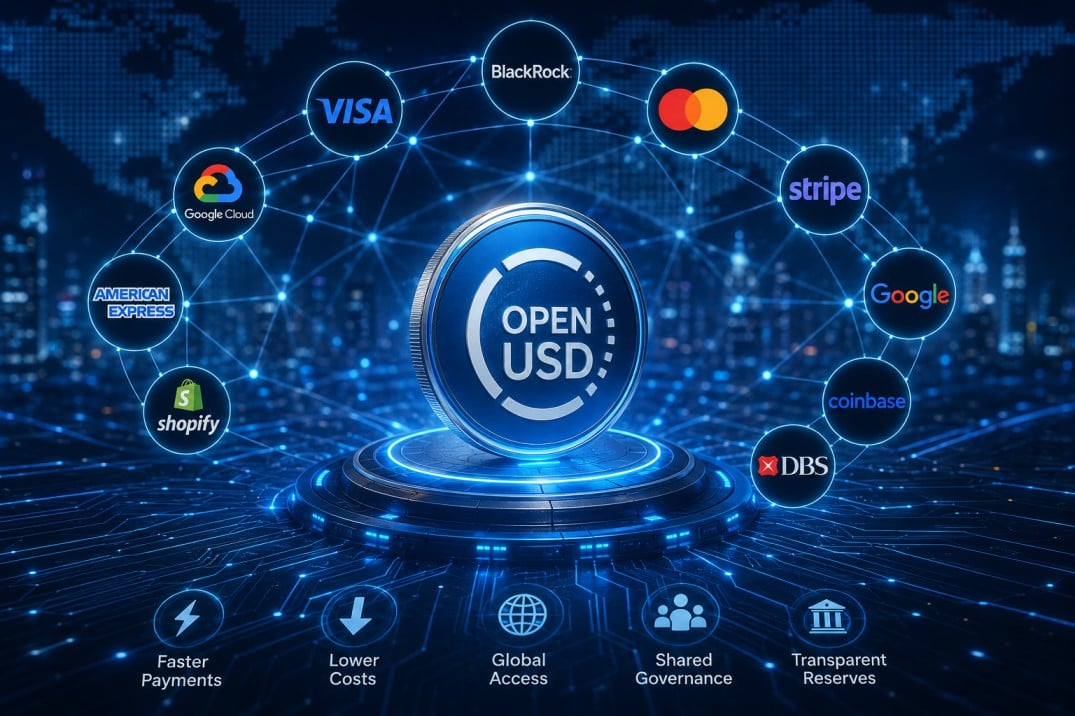
That changing picture has become even clearer with the launch of Open USD, a new stablecoin project supported by more than 140 companies. The list includes household names such as BlackRock, Visa, Mastercard, Stripe, Google, Coinbase, American Express, Shopify and DBS. Together they represent banking, payments, cloud computing, crypto and retail, making Open USD one of the widest industry-backed stablecoin efforts announced so far.
Rather than introducing another payment token competing only with existing cryptocurrencies, the project is attempting to rethink how stablecoins are issued, governed and shared among the companies that use them. Its supporters argue that current stablecoin models often concentrate control and financial rewards in the hands of a single issuer. Open USD aims to spread both decision making and economic benefits across the wider network.
The initiative is being led by Open Standard, an organisation headed by Zach Abrams, co-founder of Bridge, the stablecoin infrastructure company acquired by Stripe. The stablecoin is expected to launch later this year, although participating companies have already outlined how the system is intended to operate.
A different approach to stablecoins and shared ownership
The design of Open USD differs from many existing stablecoins in several important ways. Businesses using the stablecoin will be able to create and redeem tokens without paying minting or redemption fees. That removes one of the costs that institutions often consider when deciding whether to use stablecoins for payments or treasury management.
The project also plans to distribute most of the income generated from reserve assets back to participating members. Stablecoins normally hold cash and short-term government securities to support the value of each token. Those reserve assets generate income, particularly while interest rates remain relatively high. Traditionally, that revenue has flowed mainly to the issuing company. Open USD intends to return much of those earnings to businesses helping expand the network while retaining a smaller management fee to cover administration and compliance. Governance also takes a different direction.
Instead of placing authority with a single corporate issuer, Open USD will be managed through an independent company owned collectively by participating businesses. The stated aim is to give members greater influence over future decisions while reducing dependence on one organisation.
Supporters argue this structure more closely resembles how the internet itself developed, where shared technical standards allowed many companies to build products without relying entirely on one owner.
BlackRock, whose money market products already support parts of the growing tokenised asset market, described Open USD as giving businesses another route into tokenised financial assets. Coinbase also confirmed that Open USD is expected to become available on Base alongside other blockchain networks after launch. Stripe plans to make Open USD its default stablecoin for businesses using its payment services, showing how closely the project is tied to commercial payment activity rather than cryptocurrency trading alone.
Stablecoins are becoming a larger part of the payments business
The timing of the announcement reflects how rapidly stablecoins have moved into mainstream financial discussions. The stablecoin market is now valued at more than $300 billion, with Tether remaining the largest issuer by circulation. Yet competition has become much stronger during the past year as banks, financial technology companies and payment processors attempt to secure their own place in the market. Large acquisitions illustrate that growing interest.
Stripe purchased Bridge in a deal worth approximately $1.1 billion. Mastercard has expanded its own stablecoin settlement work through the acquisition of BVNK. Visa has widened blockchain settlement pilots across several networks while continuing to test how stablecoins can support commercial payments.
These investments suggest payment companies increasingly view stablecoins as part of future payment systems rather than simply another cryptocurrency product. Businesses see several reasons for that interest.
Traditional international payments often involve multiple financial institutions, currency conversions and settlement periods lasting several days. Stablecoins offer the possibility of moving funds almost immediately while operating continuously rather than following banking hours.
For companies handling international payroll, supplier payments or cross-border commerce, shorter settlement times may improve cash management while lowering transaction costs. That opportunity also explains why banks have joined the Open USD initiative.
Financial institutions including BNY, BBVA, Standard Chartered and DBS appear alongside payment companies and crypto businesses among launch partners. Their participation suggests stablecoins are gradually becoming relevant to mainstream financial services rather than remaining confined to cryptocurrency exchanges. Open USD also enters a market becoming more competitive every month.
Existing stablecoins already benefit from large user bases, deep liquidity and broad acceptance across cryptocurrency markets. Convincing businesses to adopt another stablecoin requires more than simply matching those capabilities. Open Standard believes its shared ownership structure, lower transaction costs and revenue-sharing model may provide sufficient incentives for businesses that actively distribute and process stablecoin payments. Even so, adoption will depend on more than technology.
Stablecoins continue attracting close attention from financial regulators as governments develop rules covering reserves, consumer protection, anti-money laundering requirements and operational resilience. Institutions considering large-scale stablecoin use generally require clear legal treatment before committing substantial payment volumes. That means Open USD enters a market where commercial demand is growing alongside regulatory scrutiny. The wider message from the project is perhaps more important than the stablecoin itself.