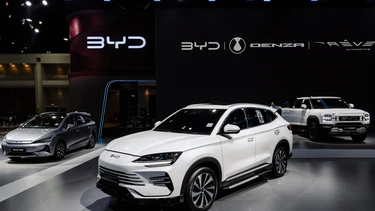
Electric car charging might soon feel a lot closer to filling up a petrol tank. Chinese automaker BYD has unveiled the second generation of its Blade Battery, and the headline figure is hard to ignore: charging from 10% to 97% in around nine minutes.
Alongside the new battery, the company also introduced a new high-power charging system called Flash Chargers, designed to unlock the battery’s full fast-charging potential.
The announcement signals another aggressive step by BYD as it pushes to dominate the global electric vehicle market.
A Major Upgrade to the Blade Battery
When BYD first launched the Blade Battery in 2020, it quickly became known for its safety and durability. Built using lithium iron phosphate (LFP) chemistry, it avoided many of the overheating risks associated with other battery types.
The new version keeps that foundation but adds several improvements.
Energy density at the cell level has increased by more than five percent, allowing vehicles to squeeze more range out of the same space. BYD also claims the battery maintains its capacity for longer and now offers a lifetime warranty on the cells, an unusually bold move in the EV industry.
The physical layout of the battery has also evolved. The long, blade-shaped cells are now mounted longitudinally rather than across the width of the vehicle, improving how the pack fits into the vehicle structure. BYD continues to use its cell-to-pack and cell-to-body architecture, which eliminates traditional battery modules and improves overall efficiency.
Fast Charging That Changes the Game
Fast charging is the real headline.
According to BYD, vehicles equipped with the new battery can charge from 10% to 70% in about five minutes. Charging from 10% to 97% takes roughly nine minutes, depending on the model.
During demonstrations, the charging times varied only slightly. The Yangwang U7 reportedly completed the 10–70% charge in 4 minutes 54 seconds, while the Yangwang U8L took 5 minutes 11 seconds.
The 97% limit isn’t random. BYD says the remaining three percent is intentionally left free so regenerative braking can continue capturing energy while driving.
The battery is expected to debut in ten upcoming electric vehicles, including the Denza Z9 GT, which BYD claims will offer a CLTC range of more than 1,000 kilometres.
Designed to Handle Extreme Cold
LFP batteries have traditionally struggled in freezing temperatures, but BYD says it has tackled that issue.
During testing, cells stored for 24 hours at –30°C were still able to charge from 20% to 97% in around 12 minutes. That improvement could make EVs far more practical in colder parts of China and other northern markets.
Safety Still at the Core
Despite the emphasis on charging speed, BYD insists safety remains unchanged.
In tests conducted during charging, the battery reportedly passed the notorious nail penetration test without producing smoke or flames even after more than 500 fast-charging cycles. The pack also survived a four-cell simultaneous short circuit and impact testing far beyond the latest Chinese regulatory requirements.
These results were presented during the launch event and have yet to be independently verified.
The Flash Charger Network
To achieve such rapid charging speeds, BYD also revealed its Flash Charger, capable of delivering up to 1,500 kW of power.
The charging stations feature two overhead cables that can connect to the same vehicle. Because delivering that level of power directly from the grid would be difficult, each station includes on-site energy storage that acts as a buffer.
These storage systems charge slowly when no vehicle is connected and then release a burst of energy during ultra-fast charging sessions.
BYD says it has already completed 4,239 Flash Charger stations in early 2026 and plans to install 20,000 units by the end of the year.
If the technology works as promised, it could remove one of the biggest barriers to EV adoption: the time it takes to recharge.