In January 2026, Emergent announced a $70 million Series B funding round led by Khosla Ventures and SoftBank Vision Fund 2, marking a defining moment for the fast-growing AI startup. The round also saw participation from Prosus, Lightspeed Venture Partners, Together Fund, and Y Combinator, pushing Emergent’s valuation to around $300 million—nearly three times higher than just months earlier.
The funding instantly positioned Emergent among the most well-capitalized early-stage companies in the AI-driven software creation space. More importantly, it confirmed growing investor belief that the future of software may not be written in code, but described in natural language.
Credits: The Economic Times B2B
The Founding Vision: From Code to Intent
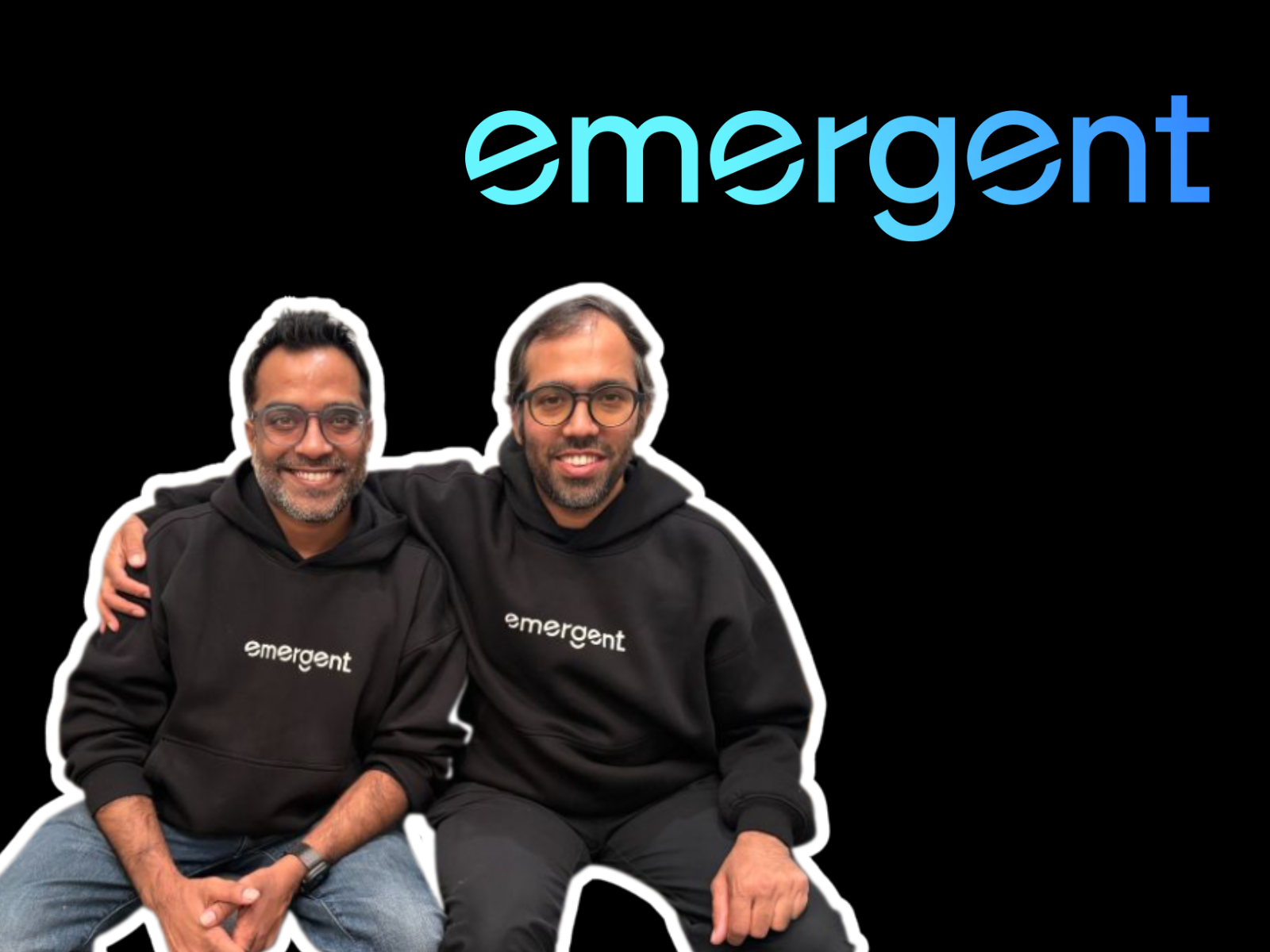
Emergent was founded in 2025 by twin brothers Mukund Jha and Madhav Jha with a bold idea: what if building software didn’t require writing code at all? Instead, users could simply explain what they want, and AI would do the rest.
Mukund Jha, the company’s CEO, previously co-founded Dunzo, where he experienced firsthand how slow and expensive software development could be. His brother, CTO Madhav Jha, brought deep expertise in artificial intelligence and machine learning. Together, they set out to build a system where intent matters more than technical skill—opening software creation to anyone with an idea.
The company operated in stealth for several months before opening to early users in 2025, quietly refining its core technology before stepping into the spotlight.
How Vibe Coding Changes Software Creation
At the heart of Emergent’s platform is a concept it calls “vibe coding.” Instead of dragging templates or writing scripts, users describe their desired application in plain language. Emergent’s AI agents then design the interface, write backend logic, set up databases, configure cloud infrastructure, integrate authentication and payments, and deploy the product live.
Unlike traditional no-code tools, Emergent doesn’t stop at prototypes. Its system continuously improves applications—fixing bugs, updating features, and adapting as user needs change. The result is a production-ready app, not just a demo.
This approach makes the platform especially attractive to non-technical founders, small businesses, creators, and internal enterprise teams that need to move fast without building large engineering teams.
A Business Model Built for Scale
Emergent follows a tiered subscription model combined with usage-based pricing. Individual users can start with free or low-cost plans to experiment and launch small applications. As usage increases, pricing scales based on compute needs, complexity, and deployment requirements.
For startups and enterprises, Emergent offers premium plans with private deployments, enhanced security, compliance features, and priority support. Large organizations can also opt for dedicated infrastructure, making the platform suitable for mission-critical workloads.
This hybrid model allows Emergent to grow revenue from both individual creators and large companies—an important factor behind its rapid financial momentum.
Explosive Growth and Global Adoption
After launching publicly in mid-2025, Emergent saw rapid global adoption. By the end of the year, millions of users from more than 190 countries had signed up. Notably, most of them had little or no programming experience, validating the company’s core thesis.
Within months, Emergent reached tens of millions of dollars in annual recurring revenue, driven by subscriptions and enterprise contracts. Such growth is rare even among top-tier AI startups and has made Emergent one of the most closely watched companies in the space.

Credits: Entrackr
Why Top Investors Are Doubling Down
Khosla Ventures is known for backing companies that redefine how work gets done, while SoftBank Vision Fund 2 seeks platforms that can reshape entire industries. Their decision to lead Emergent’s Series B reflects a shared belief that AI-driven software development could become the default over the next decade.
Investors see Emergent not just as a productivity tool for developers, but as a platform that removes the need for coding altogether in many scenarios—dramatically expanding who can build software.
The Road Ahead: Building Trust at Scale
Emergent plans to use the fresh capital to expand its engineering and research teams, make its AI agents more autonomous and reliable, and strengthen enterprise-grade security and compliance. The company is also accelerating its expansion across North America, Europe, and Asia.
By early 2026, Emergent stands at a pivotal moment. With strong investor backing, rapid adoption, and a clear business model, the startup is now racing to prove that vibe coding is not a passing trend—but the foundation of how software will be built in the AI era.