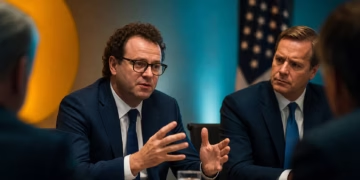
In one of the most surprising political turns in recent American history, Zohran Kwame Mamdani, a 34-year-old New York State Assembly member, rapper, and activist, became the mayor of New York City in November 2025. His victory was more than a political upset; it marked a cultural and ideological shift in one of the world’s most influential cities.
A member of both the Democratic Party and the Democratic Socialists of America (DSA), Mamdani’s rise from grassroots activism in Queens to leading the nation’s largest city represents a rare blend of idealism, immigrant experience, and left-wing politics. His election has been celebrated by progressives who view him as the face of a new generation of leadership. At the same time, critics warn that his socialist ideas could challenge the city’s economic base.
Zohran Mamdani’s life story crosses continents and cultures. Born on October 18, 1991, in Kampala, Uganda, he comes from a distinguished family known for intellectual and artistic influence. His father, Mahmood Mamdani, is a respected academic and professor at Columbia University, known for his critiques of colonialism and global power structures.
His mother, Mira Nair, is an award-winning filmmaker behind acclaimed works such as Monsoon Wedding and Salaam Bombay! With roots in both Hindu and Muslim traditions, the family represents a blend of identities and faiths. Mamdani spent his early childhood in Uganda and South Africa before the family settled in New York City when he was seven.
He attended New York’s prestigious Bronx High School of Science, where his leadership qualities began to emerge. He later graduated from Bowdoin College in 2013 with a degree in Africana Studies. During his time at Bowdoin, Mamdani became politically active, founding a chapter of Students for Justice in Palestine (SJP) and supporting the Boycott, Divestment, and Sanctions (BDS) movement.
These early experiences shaped his worldview, particularly his views on colonialism, identity, and global justice. His activism was not limited to campus; it reflected a deep concern with oppression and inequality that would later define his political life.
Before entering politics, Mamdani worked as a housing counsellor in Queens, helping low-income and immigrant homeowners facing foreclosure. This period was pivotal in developing his focus on housing rights and economic fairness. He witnessed firsthand how working-class families struggled to survive in one of the most expensive cities in the world.
At the same time, he pursued his artistic side as a rapper under the stage name “Mr. Cardamom,” using music to address themes such as immigration, race, and identity. His 2016 mixtape Sidereal showcased his blend of hip-hop with South Asian influences and his commitment to storytelling grounded in social issues.
Mamdani entered the political arena in 2020 when he challenged and defeated long-time Democratic Assemblywoman Aravella Simotas in the 36th Assembly District primary. His victory, powered by young voters and grassroots organising, made him part of a growing wave of democratic socialists in New York politics.
As an Assembly member, he became known for his advocacy on housing reform, public transit access, and climate justice. He helped draft and promote the “Good Cause Eviction” law, which aimed to protect tenants from unfair rent hikes and arbitrary evictions. He also championed fare-free bus programs and supported measures to shift the city away from fossil fuel dependence.
His years in the Assembly were marked by both praise and controversy. Supporters saw him as a principled reformer, while opponents accused him of being too radical. His open support for Palestinian rights and criticism of U.S. policies toward Israel drew strong reactions. He refused to condemn slogans like “Globalise the Intifada,” which he viewed as expressions of solidarity rather than incitement.
Organisations such as the Anti-Defamation League (ADL) labelled his positions as antisemitic, while others, including progressive Jewish groups like J Street, defended him, arguing that his critics misrepresented his views to discredit his political agenda.
In October 2024, Mamdani announced his candidacy for mayor of New York City. His campaign message was clear and focused: he wanted to tackle the city’s affordability crisis and give working people a fair chance to live with dignity.
His slogan, “A City for All of Us,” resonated across younger and immigrant communities. Despite being seen as a long-shot candidate against political heavyweights like former Governor Andrew Cuomo, Mamdani’s campaign gained momentum through grassroots organising, social media, and small-dollar fundraising. Cuomo’s campaign, backed by major donors and corporate interests, raised more than $25 million, while Mamdani’s relied on volunteers, unions, and activists.
In the June 2025 Democratic primary, Mamdani achieved a historic upset, defeating Cuomo by nine points. His success was driven by overwhelming support from voters under 35, renters, and working-class neighbourhoods. In the general election against Republican Curtis Sliwa, Mamdani secured 52 per cent of the vote.
He became New York City’s first Muslim mayor and one of the most prominent democratic socialists in U.S. political history. His victory speech, delivered in Astoria, paid tribute to his immigrant background and promised “a city that works for the people who build it.”
Mamdani’s policy agenda as mayor reflects his socialist principles. He has pledged to freeze rent increases on stabilised units, construct 100,000 new affordable homes, and create city-owned housing cooperatives. His transportation plan calls for fare-free buses and expanded subway service. On labour rights, he supports raising the minimum wage to $30 an hour by 2030 and establishing universal public childcare.
He also advocates for city-run grocery stores to fight food insecurity and taxes on large corporations and wealthy individuals to fund social programs. His climate policies include a city-level Green New Deal, banning new fossil fuel projects, and investing in green jobs.
Critics argue that his proposals could burden businesses and drive investment away. Some label his ideas as unrealistic or overly ideological. Former President Donald Trump dismissed him as a “communist lunatic,” while conservative media outlets portrayed his victory as a warning sign for Democrats. Yet supporters insist that his policies address real struggles, soaring rents, corporate greed, and stagnant wages, which have deepened inequality in urban life.
Mamdani’s personal life also draws public interest. He is married to Ramadan (Rammy) Abuibaid, a Syrian-American artist and community organiser. The couple lives in Astoria, Queens, where Mamdani’s political journey began. He openly practices his faith and often incorporates his cultural identity into his public image. His victory rally featured Bollywood music and community performances, reflecting his commitment to multiculturalism and inclusivity.
Despite his success, Mamdani faces daunting challenges as he prepares to take office in January 2026. New York City’s budget exceeds $100 billion, and the economic recovery from the post-pandemic era remains uneven. He must manage public expectations while negotiating with powerful unions, real estate interests, and state legislators. His administration’s success will depend on how effectively he can translate his socialist vision into practical governance.
On the national stage, Mamdani’s win has positioned him as a rising figure in progressive politics. Though constitutionally barred from running for president due to his Ugandan birth, he could play a major role in shaping the Democratic Party’s future direction. His success could embolden other left-wing candidates, while his missteps might strengthen critics who argue that socialism cannot govern effectively.