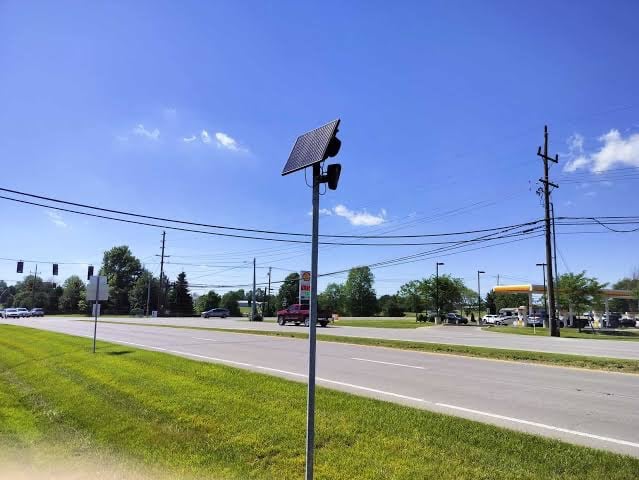
The backlash against automated license plate readers is growing across the United States, but opposition to one of the industry’s most recognizable companies has not necessarily meant an end to the technology itself. As communities question their relationships with Flock Safety, competitors in the surveillance technology market are finding an opportunity to expand.
Flock Safety has become one of the most prominent names in automated license plate recognition, providing cameras and software that allow law enforcement agencies and other organizations to identify and track vehicles. The company’s technology has been promoted as a modern tool for fighting crime, recovering stolen vehicles and helping investigators locate vehicles connected to criminal investigations.
But the same technology has increasingly become a source of controversy.
Automated license plate readers, commonly known as ALPRs, can capture license plates as vehicles pass cameras installed along roads, in parking lots and around neighborhoods. The systems can record the time and location of a vehicle and store the information in databases that can later be searched by authorized users.
For law enforcement agencies, the appeal is obvious. Instead of relying entirely on officers to spot suspicious vehicles, technology can automatically scan thousands of vehicles every day. A vehicle reported stolen, for example, can potentially be identified within seconds of passing a camera.

Privacy advocates see a different side of the equation.
The overwhelming majority of drivers captured by these cameras are not suspected of committing crimes. Yet their vehicles can still become part of massive databases documenting where cars were seen and when. Critics argue that this creates a form of location surveillance that can operate quietly in the background of everyday life.
That concern has increasingly placed Flock Safety under public scrutiny.
Communities that once viewed license plate readers primarily as crime-fighting tools are now questioning how much surveillance is appropriate in public spaces. Residents have raised concerns about data retention, information sharing, access by outside agencies and the possibility that technology introduced for one purpose could eventually be used for another.
The controversy has created a complicated situation for local governments.
When a community decides to cancel a contract with Flock, it may appear to be rejecting automated license plate surveillance. But that is not necessarily what happens next. Another company can step in and offer similar technology, sometimes with different policies and contractual terms.
This has allowed competitors to benefit from the backlash without necessarily abandoning the underlying surveillance model.
Companies in the ALPR industry can differentiate themselves by emphasizing privacy protections, shorter data-retention periods, stronger access controls or greater transparency. These differences may matter to communities attempting to balance law enforcement needs with civil liberties.
But critics argue that changing the company behind the camera does not automatically solve the larger problem.
At the center of the debate is the question of whether people should be routinely tracked simply because they drive through a particular area.
Traditional surveillance cameras can record a road or parking lot, but ALPR systems add another layer by transforming images into searchable information. A vehicle’s license plate can become a data point that can be connected to time and location information.
Over time, those individual records can create a detailed picture of vehicle movements.
That capability is particularly controversial because people generally have little control over whether their vehicles are photographed. Unlike voluntarily sharing a location through a smartphone application, driving past a roadside camera does not require explicit consent.
Supporters of the technology argue that these concerns should be balanced against the public-safety benefits. Police departments have used license plate readers to investigate vehicle thefts, identify suspects and develop leads in serious criminal cases. For agencies dealing with limited personnel, automated systems can provide investigative capabilities that would otherwise require significant manpower.
The challenge is determining how far those capabilities should extend.
Questions about data retention have become particularly important. If information about an innocent person’s vehicle is captured today, should that information remain searchable weeks, months or years later? Should another law enforcement agency be able to access it? Under what circumstances should historical vehicle-location data be used in an investigation?
There is no single answer across the country.
Different jurisdictions have adopted different policies, creating an uneven regulatory environment. Some communities have established strict limits, while others have granted law enforcement agencies broad access to the technology.
This inconsistency has also created an opportunity for technology providers.
As public scrutiny increases, vendors can compete by presenting themselves as more responsible alternatives. A company facing backlash can lose a contract, while another provider can gain it by promising stronger privacy controls or greater transparency.
For competitors, the controversy surrounding Flock is therefore not simply a political development. It is a business opportunity.
Yet the broader debate is unlikely to disappear simply because communities change vendors.
The technology itself is becoming increasingly sophisticated. Modern systems can process enormous amounts of visual information, identify vehicles based on characteristics beyond license plates and connect records across multiple locations. As these capabilities develop, the potential benefits and risks will grow simultaneously.

That makes public oversight increasingly important.
Communities considering ALPR systems may need to look beyond the name of the company providing the cameras. They may need to examine exactly what information is collected, how long it is stored, who can access it, whether it can be shared outside the jurisdiction and what safeguards exist against misuse.
The Flock controversy has ultimately exposed a larger issue: surveillance does not necessarily disappear when one surveillance company is cancelled.
It can simply change hands.
For communities, the question is therefore bigger than whether Flock Safety should remain in business. It is about what role automated surveillance should play in public life and what limits should govern it.
For competitors, meanwhile, the answer may already be clear. If customers are walking away from Flock, there is money to be made by offering them another option.
The real test will be whether those alternatives represent a meaningful change in how surveillance operates—or simply a new brand attached to the same expanding system.