General Motors seems to be dusting off an old idea and giving it a high-tech makeover. A recently published patent hints that the company is exploring a fresh take on two-stroke engines, a format many assumed was long gone from mainstream automotive engineering. What’s interesting is the angle: solving emissions, improving efficiency, and potentially plugging these compact engines into hybrid powertrains.
Let’s break it down.
Why Two-Strokes Ever Mattered
Two-stroke engines built a reputation on simplicity, lightness, and absurd power density. Fewer moving parts. Higher specific output. Lower manufacturing cost. They were the workhorses of motorcycles, small engines, and performance-obsessed engineers everywhere.
Then, emissions regulations tightened. Two-strokes relied on ports rather than valves, which meant a slice of the intake charge slipped straight out of the exhaust. No amount of nostalgia could save them from their unburnt hydrocarbon habit.
They faded out. Four-stroke took over. Case closed… or so it seemed.
What GM Thinks It Can Fix
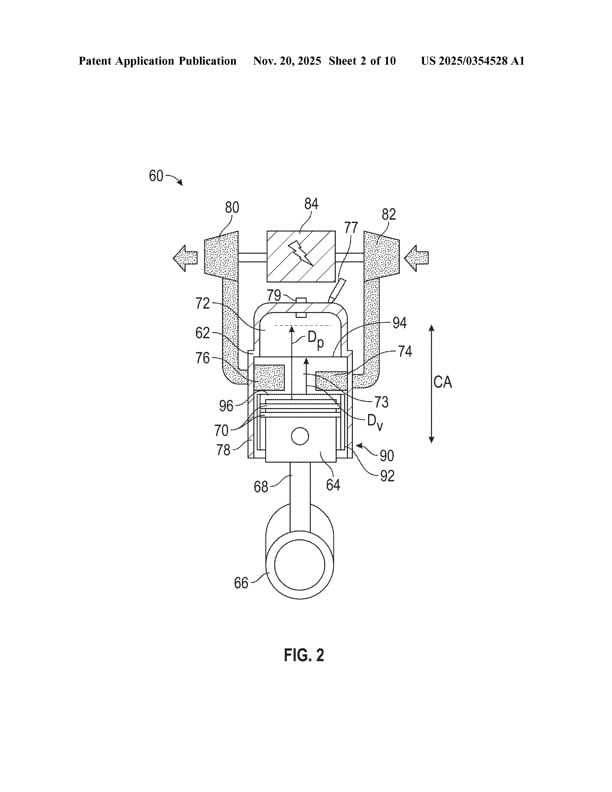
GM’s patent introduces something that two-stroke engines historically lacked: precise gas-exchange control. The design adds an electronically actuated sliding sleeve between the piston and the cylinder wall. This sleeve can open and close intake and exhaust ports independently of piston position.
What this really means is GM wants to eliminate the old overlap problem. Instead of relying on piston timing alone, the sleeve acts as a controllable gatekeeper. Intake stays in when it should. Exhaust leaves when it should. Hydrocarbons don’t slip away unused.
If the system works, it could finally solve the core flaw that doomed two-stroke engines in the modern emissions era.
Why Now? Look at Hybrids
Here’s the thing. Hybrid vehicles don’t need huge engines. They need compact, efficient generators that can run at a steady load for maximum efficiency. A modern two-stroke that’s cleaner, lighter, and easier to package could hit that sweet spot.
Imagine a plug-in hybrid with:
-
a smaller engine
-
more usable space
-
less weight
-
lower cost
-
higher power density
-
and far fewer emissions than old-school two-strokes
That lines up neatly with GM’s electrification strategy. Not everything needs to be battery-only. Some cars need clever middle-ground solutions.
The Bigger Picture
A patent doesn’t guarantee production. Sometimes companies file them simply to stake out future possibilities. But it does signal something interesting: automakers are re-examining old technologies with new tools, especially as hybrids become a long-term bridge in the transition toward electrification.
GM’s modern two-stroke idea is one of those “why didn’t anyone do this sooner?” moments. It blends classic simplicity with digital control, the exact kind of mashup that could reshape how small engines evolve in an emissions-restricted world.
The comeback story isn’t written yet. But GM has clearly opened the first chapter.