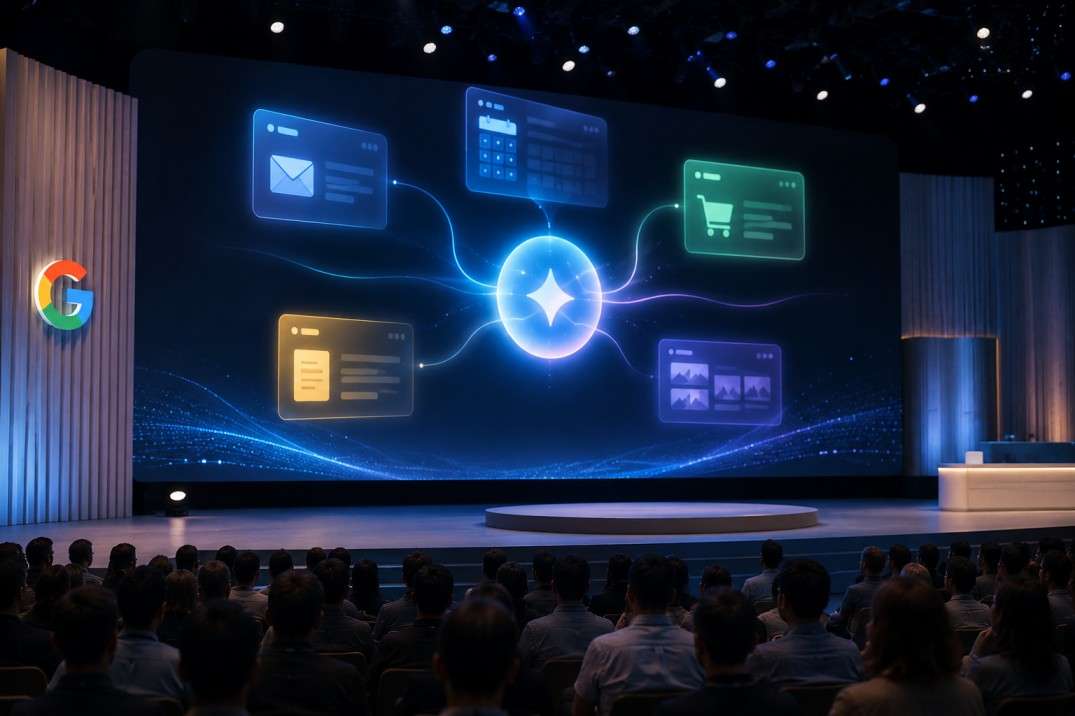
Google arrived at its annual I/O developer conference with a clear message for developers, investors and consumers alike: the company wants artificial intelligence to move from a chatbot that answers questions into a system that quietly handles work on a user’s behalf. Over two days in Mountain View, California, executives packed the keynote with announcements tied to Gemini, Google Search, Android, Workspace and a growing set of AI agents that now sit closer to the centre of the company’s plans than almost anything else.
The tone of the event felt different from earlier Google conferences where Android phones, smart home gadgets or cloud services often dominated the conversation. This year, almost every product announcement flowed back to Gemini. Chief executive Sundar Pichai repeatedly described a future where users no longer jump between apps to complete tasks. Instead, Google wants AI systems to monitor inboxes, organise schedules, handle purchases, draft documents and manage online activity in the background.
The company’s biggest reveal came in the form of Gemini Spark, a personal AI agent that stays active around the clock through Google Cloud. During demonstrations, Spark sorted through emails, tracked deadlines from school messages, prepared meeting summaries, organised event planning and drafted responses without requiring constant prompts from users. Google said the assistant can continue working even when devices are idle or locked.
At launch, Spark connects directly with Gmail, Google Docs and Workspace services. Support for outside apps through MCP, a standard intended to link AI systems with third-party software, is expected later this year. Spark will first roll out in the United States for subscribers paying $100 a month under Google’s new AI Ultra plan.
That pricing structure drew attention across the conference because it revealed how aggressively Google is reorganising its subscription business around artificial intelligence. The company introduced a new $100 monthly tier positioned between its existing Pro and Ultra plans while cutting the price of its highest subscription package from $250 to $200. Those plans now bundle together AI access, YouTube subscriptions, cloud services and developer credits.
Alongside Spark, Google introduced Gemini 3.5 Flash as the company’s default AI model across Gemini apps and AI-powered Search. Executives described it as faster and cheaper than previous versions, particularly for coding and agent-based tasks. A more powerful Gemini 3.5 Pro model is expected later this year.
Google also introduced Gemini Omni, a multimodal system capable of handling text, images, audio and video together. During demonstrations, Omni altered videos, inserted new characters into scenes and generated moving footage from still photographs. The company said the system will appear inside YouTube Shorts, Google Flow and Gemini services for paid subscribers.
For developers, Google placed heavy attention on Antigravity, the company’s AI coding and agent development environment. Antigravity 2.0 gained a standalone desktop application, command-line interface and new programming controls intended to help developers create AI systems capable of handling longer and more complicated tasks. During one stage presentation, Google used Antigravity to help build a stripped-down operating system capable of running the game Doom in less than a day.
The company also announced managed agents through the Gemini API. Developers can now launch AI agents with a single API call while Google handles hosting, remote environments and computing support. The move reflects growing competition between major technology companies to become the default supplier for AI agent development.
Search, Android and smart glasses take centre stage
Although artificial intelligence dominated the conference, Google also used I/O to show how Gemini is moving into products already used by billions of people every day. Search received one of its biggest updates in years, with Google redesigning the search box itself to accept images, videos, files and browser tabs alongside ordinary text.
Executives described the redesign as part of a wider move away from static search results. Google now wants Search to handle long-running tasks in the background through information agents that continue tracking topics after a user closes the page. In demonstrations, Search monitored apartment listings, stock prices and online discussions, then sent updates when new information appeared.
The company also previewed a new style of search results that replaces traditional links with interactive layouts and simulations. For some requests, Search will now generate dashboards, planners and visual interfaces rather than lists of websites.
That move may deepen concerns among publishers already worried about falling web traffic from AI-generated answers. Google did not spend much time discussing how news organisations, bloggers or smaller websites could be affected if users stop clicking through to original sources.
The company also expanded Gemini’s presence inside Workspace products. Docs Live now allows users to speak naturally while Gemini turns those conversations into organised documents in real time. Gmail Live lets users ask spoken questions about inbox content, while Google Keep can split rambling voice notes into separate organised entries.
One of the more eye-catching product announcements came through Google Pics, a new image editing service that treats each object inside a photo separately. During demonstrations, presenters altered clothing colours, moved people around images and swapped objects without rebuilding the entire scene. The product will initially launch for high-paying AI subscribers in the United States.
Google also spent considerable time discussing Android XR glasses, an area where the company has stumbled before. Executives unveiled audio glasses and display-equipped eyewear developed alongside Samsung, Qualcomm, Warby Parker and Gentle Monster. The glasses connect with Gemini for navigation, translation, messaging and voice interaction.
Stage demonstrations showed Gemini helping users order coffee, navigate streets and respond to messages while keeping phones in pockets. Some observers praised the hardware designs for looking closer to ordinary glasses than earlier smart eyewear attempts. Others questioned whether the products solved meaningful problems or simply extended smartphone functions into another device.
Android itself continues moving deeper into Gemini integration. Google previewed Android 17 features that place AI functions closer to the operating system level rather than treating Gemini as a standalone app. Those additions include AI-generated widgets, smarter voice dictation, scam call detection and theft protection systems.
A newly announced category of laptops called Googlebooks also attracted attention. The devices, expected later this year from companies including Acer, Asus, Dell, HP and Lenovo, combine parts of Android and ChromeOS into a single operating system built heavily around Gemini. Pricing has not yet been announced.
For developers building Android apps, Google introduced migration agents capable of turning web, iOS or React Native code into native Kotlin Android applications. The company claimed the process could reduce work that previously took weeks into a matter of hours, though the real-world accuracy of those migrations remains to be tested.
Throughout the conference, Google repeatedly returned to one idea: AI systems should not merely answer requests but carry out actions independently. Whether through Search agents, Spark assistants, shopping carts or coding systems, the company is betting heavily that users will grow comfortable handing more responsibility to software working quietly in the background.
That ambition comes with unresolved questions. Privacy concerns surfaced repeatedly during discussions around Gmail access, shopping behaviour, voice recordings and personal health data. Google also confirmed that AI watermark detection through SynthID will expand across Chrome and Search in response to rising concerns about manipulated media.