
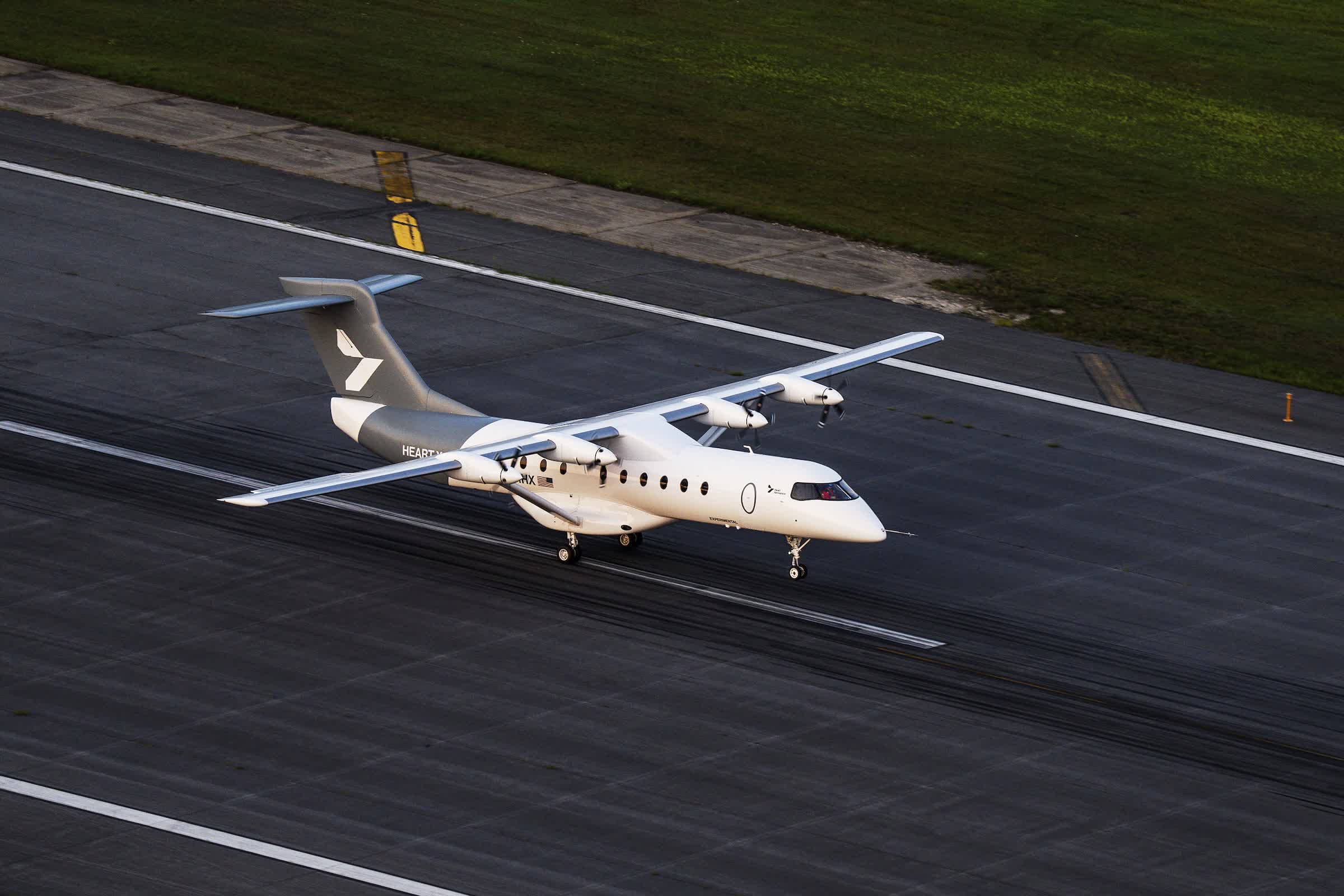
Electric aviation has taken another major step forward after Heart Aerospace successfully flew its X1 demonstrator, a battery-powered aircraft roughly the size of a regional airliner. The milestone offers a glimpse of what passenger aviation could look like in the future, while also highlighting the biggest obstacle facing electric aircraft: limited battery energy density.
The X1 completed its first flight from a regional airport in upstate New York, remaining entirely powered by batteries throughout the 27-minute test. With one pilot aboard and no passengers, the aircraft climbed to around 1,100 feet.
For Heart Aerospace, the flight represents an important proof of concept. The company says the X1 is the largest fully battery-powered aircraft ever flown and describes the test as evidence that electric propulsion can be scaled to the size of a commercial airliner.
Credits: Techspot
A Big Aircraft Running Entirely on Batteries
The X1 is no small experimental aircraft. It is approximately 76 feet long, has a wingspan of 106 feet and weighs more than 25,000 pounds. Although it has space for 30 passengers in its planned configuration, the test flight carried only a pilot.
The aircraft is primarily a technology demonstrator rather than a commercial product. Heart Aerospace intends to use data gathered from the X1 to develop its planned ES-30, a 30-seat hybrid-electric aircraft that the company hopes to put into commercial service by 2031.
Several airlines and operators, including United Airlines, Air Canada and JSX, have expressed interest in the ES-30, giving Heart a potential customer base if the aircraft successfully completes development and certification.
Why Batteries Are Still Holding Electric Planes Back
The X1’s flight demonstrates that battery-electric propulsion can power a relatively large aircraft, but it does not eliminate the fundamental physics problem facing the industry.
Jet fuel contains significantly more usable energy per unit of weight than today’s batteries. That difference becomes increasingly important as aircraft get larger.
A conventional aircraft also becomes lighter during a flight because it burns fuel. An electric aircraft does not have that advantage. Its battery pack weighs essentially the same when the plane lands as it did when it took off.
This creates a difficult trade-off. Adding more batteries increases range, but also increases weight, which requires more energy to fly and reduces the amount of space available for passengers, luggage and cargo.
The ES-30 Takes a Hybrid Approach
Heart Aerospace is therefore not planning to make its first commercial aircraft fully electric.
The ES-30 is designed to travel roughly 125 miles using battery power alone. That range could be sufficient for some short regional routes, but it would be too limited for many commercial operations once airlines account for required reserves and operational conditions.
To solve the problem, Heart plans to equip the aircraft with a combustion-engine range extender. With the hybrid system, the ES-30 could reportedly achieve a maximum range of around 500 miles.
The strategy represents a compromise: use electric propulsion where batteries make the most sense, while relying on conventional fuel-powered generation when additional range is required.
Could Electric Aircraft Be Cheaper to Operate?
Heart believes the hybrid approach could also offer airlines significant financial benefits.
The company estimates that the ES-30 could cost more than 40% less to operate than a comparable conventional regional aircraft. Lower energy consumption and reduced maintenance are expected to contribute to those savings.
Electric motors generally contain fewer moving parts than conventional aircraft engines, potentially reducing mechanical complexity and maintenance requirements.
Heart also highlighted the extremely low electricity cost of the X1’s test flight, saying it consumed roughly $5 worth of electricity. However, that figure only represents the energy used during the demonstration. It does not include expenses such as labor, insurance, airport fees, maintenance or battery degradation.
Credits: Techspot
Electric Aviation Is Expanding
Heart is part of a growing group of companies attempting to electrify aviation, particularly for shorter flights where battery technology is more practical.
Rolls-Royce has tested an electric aircraft that reached 387 mph, while Harbour Air has worked on an electric seaplane. Companies such as Joby Aviation and Archer Aviation are developing electric vertical-takeoff-and-landing aircraft designed for short-distance transportation and airport connections.
Rather than attempting to replace long-haul jets immediately, much of the industry’s focus is therefore shifting toward smaller aircraft and shorter routes.