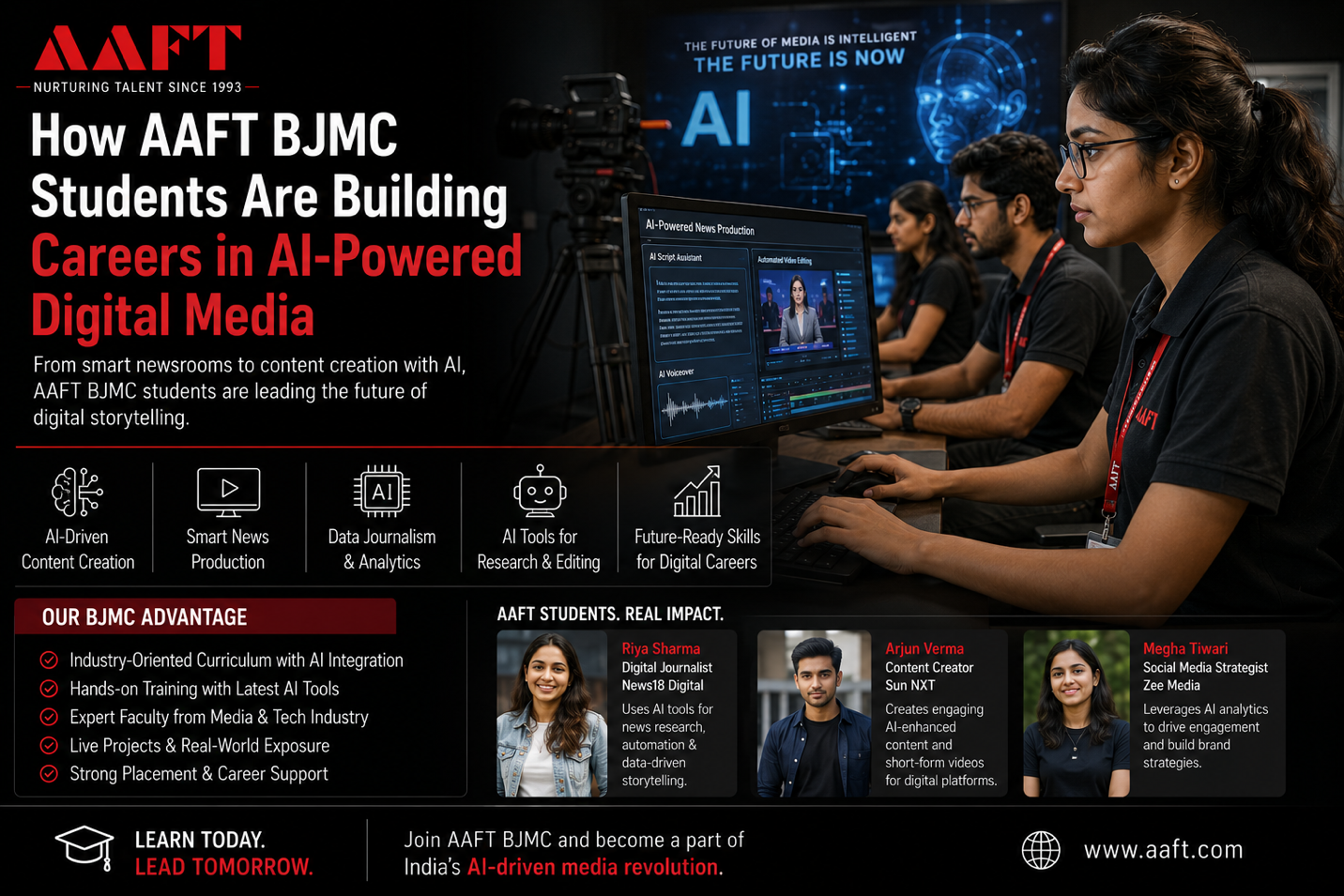
Noida, India — As artificial intelligence reshapes how news is researched, written, produced and distributed, The AAFT Noida has opened its 2026 admissions for the BA in Journalism and Mass Communication and MA in Journalism and Mass Communication both updated to prepare students for careers in AI-powered digital media. AAFT BJMC students today are building careers in a media industry where AI tools are no longer optional add-ons but central to daily editorial workflow.
From AI-assisted research and transcription to automated content tagging, voice synthesis and personalised news delivery, the modern newsroom looks dramatically different from even five years ago. AAFT’s journalism curriculum has evolved to ensure graduates can lead, not just survive, this shift.
How AI Is Changing the Media Industry
AI is being deployed across the news production pipeline in 2026:
- Research and fact-checking are accelerated by AI-powered tools that scan archives, verify quotes and surface related coverage
- Transcription tools convert interviews and press conferences to text in real time
- AI editing assistants help editors trim long videos, generate captions and create platform-specific cuts
- Personalisation engines decide which stories appear in which reader’s feed
- Voice synthesis powers audio versions of articles and AI-narrated explainers
- Trend detection tools help newsrooms spot emerging stories from social media data
These tools are now standard at most major newsrooms and a working knowledge of them has become a hiring criterion.
AAFT’s Approach to AI in Journalism Education
Rather than treating AI as a separate elective, AAFT has woven AI literacy into the broader BJMC curriculum progressively, across almost every semester. From the first year through to postgraduate study, students encounter AI tools in context: not as standalone modules, but embedded within the subjects where they are most relevant: research, production, verification, storytelling, and distribution. Students learn:
- How to use AI research tools responsibly for news gathering
- Verification techniques for AI-generated content and deepfakes
- Ethical frameworks for AI-assisted reporting
- AI-assisted video editing and post-production
- Working with AI transcription and translation
- Audience analytics and recommendation systems
- Data journalism using AI-powered analysis
This integrated approach ensures students see AI as a journalistic tool — not as a replacement for journalistic judgment.
Career Roles in AI-Powered Digital Media
AAFT BJMC and MA JMC graduates today are entering newer roles that did not exist a few years ago:
- AI-augmented content producer for digital news platforms
- Data journalist working with AI analysis tools
- Newsroom AI workflow specialist
- Audience analytics and personalisation editor
- Misinformation researcher and deepfake verification specialist
- AI-assisted video producer and editor
- Voice and podcast producer with AI-enhanced workflows
- Social media intelligence analyst
Why Human Journalists Still Matter
AI tools accelerate research, automate routine tasks and personalise distribution. But editorial judgment, ethical reasoning, source relationships, on-the-ground reporting, on-camera presence and the ability to ask the right question in a live interview are skills no AI can replicate. AAFT’s curriculum places equal weight on these uniquely human skills, ensuring graduates can use AI as a force multiplier without losing the integrity that defines journalism. Industry Dean Faye D’Souza, herself a pioneer of independent digital journalism, anchors this perspective in the program’s overall direction.
Practical Exposure to AI Tools
AAFT’s 70% practical exposure model means students don’t just hear about AI tools — they use them. Live newsroom simulations include AI-assisted research, transcription tools for interviews, AI-driven video editing and audience analytics dashboards. By graduation, AAFT BJMC students are comfortable with the AI workflow that most modern newsrooms now rely on.
AAFT Programs for Digital Media Careers
- BA in Journalism and Mass Communication — three-year UG degree with AI-integrated curriculum
- MA in Journalism and Mass Communication — two-year PG degree with advanced digital and AI modules
- PG Diploma in TV Journalism and Communication — one-year intensive program
- Diploma in TV Journalism and Communication — one-year UG diploma
- Certificate courses in News Anchoring and Radio Production
Industry Partnerships
AAFT maintains active partnerships with leading Indian news networks and digital media houses, ensuring students benefit from real industry exposure to AI workflows. Top recruiters include NDTV, Aaj Tak, India TV, News Nation, Republic Bharat, Times Network, TV9 Bharatvarsh, Red FM and Economic Times — many of whom now hire graduates specifically for their fluency with modern digital and AI-assisted tools. The school’s industry interface includes regular masterclasses and live projects with these recruiters, giving students direct exposure to how AI is being deployed in real newsrooms today.
Faculty and Industry Dean Faye D’Souza
AAFT’s Industry Dean Faye D’Souza, a trailblazer in Indian journalism celebrated for fearless reporting and the leadership of her independent digital platform, brings unique relevance to a program training students for AI-powered digital media. As one of the most respected figures shaping India’s new digital news economy, her involvement ensures the curriculum stays aligned with where the industry is actually heading — not where it was five years ago. Faculty Dean Dr. Syed Nawaz Ahmad, Head of Department Prof. Harinder Kumar and the broader faculty team add academic depth and current industry practice to this strategic direction.
Studios and Infrastructure for Digital Production
AAFT students working on AI-powered digital content have access to a chroma studio, podcast studio, radio studio, news anchoring setup, post-production lab with Adobe Premiere Pro, Final Cut Pro, Nuendo audio editing and a full photography studio. This infrastructure supports the multi-format content production that modern digital newsrooms now demand — from short-form video to long-form podcasts to interactive data stories. Students leave AAFT having actually produced this kind of content, not just studied it.
The Future of BJMC Careers
AI is not eliminating journalism careers — it is reshaping them. The journalists who thrive in 2026 and beyond will be those who can combine classical reporting skills with fluent use of modern tools, strong ethical judgment, and the ability to add unique human perspective that audiences trust. AAFT’s BJMC and MA JMC programs are designed to produce exactly this kind of well-rounded media professional, ready for the next decade of digital media.
Admissions 2026 Now Open
Applications are open for the 2026 academic session at AAFT Noida. Class 12 graduates can apply for the BA in Journalism and Mass Communication, while graduates can apply for the MA in Journalism and Mass Communication or PG Diploma in TV Journalism. Admissions are based on academic credentials and creative aptitude evaluation.
About AAFT Noida
The AAFT Noida, established in 1993, is one of India’s most reputed creative education institutions. With more than 30 years of academic excellence and a global alumni network of over 35,000 professionals working across films, OTT platforms, television, journalism, advertising, design and digital media, AAFT continues to offer industry-focused programs that prepare students for careers in the global creative and media economy. The institution operates from Marwah Studios, Noida Film City, with full broadcast infrastructure including chroma studios, radio studios, podcast studios, post-production labs and news anchoring setups. The AAFT School of Journalism and Mass Communication offers an 85% practical exposure model and counts leading media houses among its top recruiters, including NDTV, Aaj Tak, India TV, News Nation, Republic Bharat, Times Network, TV9 Bharatvarsh, Red FM, Economic Times and many more.