• Send Us A Tip
  • Calling all Tech Writers
  • Advertise
Sunday, June 21, 2026
  • Login
TechStory
  • News
  • Crypto
  • Gadgets
  • Memes
  • Gaming
  • Cars
  • AI
  • Startups
  • Markets
  • How to
No Result
View All Result
  • News
  • Crypto
  • Gadgets
  • Memes
  • Gaming
  • Cars
  • AI
  • Startups
  • Markets
  • How to
No Result
View All Result
TechStory
No Result
View All Result
Home How to

How to pay advance tax

by Khushi Sethi
March 15, 2022
in How to, Tech
Reading Time: 5 mins read
0
How to pay advance tax
TwitterWhatsappLinkedin

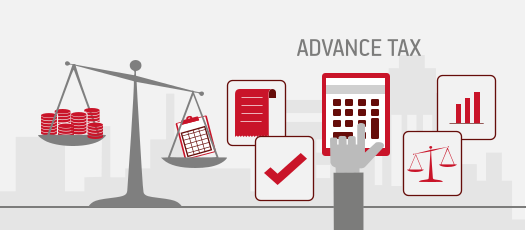
Advance tax is to be paid based on assessed pay during the year. An individual needs to pay advance taxes just when the all-out charge obligation surpasses Rs 10,000 in a monetary year. As a rule, it is normal that you will procure the pay first and afterwards pay the charges on it. In any case, if there should be an occurrence of advance duty, an assessee needs to appraise his pay for the year and pay the charges somewhat or completely ahead of time.
You might also like

How to Increase Gas Mileage: Small Driving Changes That Save Big at the Pump

Paradigms of Luminance and Chemistry The Definitive OLED vs Mini LED Display Audit

Next-Generation Wireless The Architectural Breakthrough of Wi-Fi 7 Explained

Know Who Should Pay Advance Tax - ABC of Money
Source: Aditya birla capital

Who needs to settle Advance Tax?

The advance tax applies basically to independently employed individuals like money managers, experts, specialists, and so on NRIs who have pay of more than Rs 10,000 in India are likewise obligated to settle advance duty. Senior residents who have no pay from business and calling are absolved from settling advance expenses. Salaried people don’t need to pay advance charges since their duties are as of now deducted at the source when the compensation is delivered. Truth be told, any sort of assessee whose expense is deducted at source won’t need to cover advance duty. For instance, a consultant works for two clients of which one sends him the sum after TDS allowance while the other doesn’t. In such cases, the advance expense should be paid for the second client just as the first has as of now deducted charge at the source.

Beginning with the Financial Year 2016-17, the people who choose the possible plan under the Income Tax Act are expected to pay the whole measure of their development charge prior to the fifteenth of March. An elegance time of 15 days, or at least, till 31st March is additionally permitted. A hypothetical tax collection plot is proposed to independent companies wherein the business pay is assumed at 8% of the turnover or gross receipts of the given business year. In the event that the gross receipts/turnover is obtained via a record payee bank draft or record payee check or with the utilization of an electronic clearing framework, the business pay ought to be determined at 6% of the turnover. The sum determined from there on turns into the last available pay for the business and the development duty should be paid on this sum.

Advance Tax Due Dates


  1. Advance Tax Due Dates for Small Businesses who have selected hypothetical tax assessment to conspire

Such business citizens should pay the whole measure of their development charge prior to 31st March of consistently. The assessments ought to be determined at 6% or 8% of their business receipts for the given year, in view of the method of such receipt.

Advance Tax Calculation

Advance expense portions are to be paid based on assessed pay for a monetary year. You can consider allowances like Section 80C while assessing your expense obligation. It is typically done based on past pay patterns of the citizen. The assessee needs to appraise his future pay and pay the charges likewise. This determined pay will be decreased by TDS deducted, TCS gathered, MAT/AMT credit and any help under charge settlement. Subsequent to making the initial two portions, the assessee can likewise reexamine the assessed pay and pay the following portions as needs be.

Dissimilar to different situations where the public authority requests charge instalment, here the onus is on the citizen to compute his pay for an evaluation year and make the instalments ahead of time in the current monetary year. The motivation behind why this is done is on the grounds that the individual who acquires the pay will understand the future patterns better compared to the duty specialists.

For instance, finance manager Ravi Prasad assessed his available pay at Rs 10,00,000.

The charges to be paid on this pay (accepting no derivations are guaranteed) will be Rs 1,12,500.

Interest Charges on Short Payment of Advance Tax Installment

Under area 234B, in the event that the assessee has not covered any development charge or paid a sum during the year which is under 90% of his complete development charge obligation, the premium will be charged at the pace of 1% each month beginning from the first April of the monetary year. At the end of the day, assuming that you pay your development charge by 31st March of the significant monetary year, you won’t be responsible to pay interest.

For instance, Nisha determined her complete assessment responsibility at Rs 50,000 yet she made this instalment on the fifteenth of June, at the hour of recording her expense forms. Thus, she should pay interest @1% on the sum for a long time in April, May and June.

1% of 50,000= Rs 500

For quite a long time, the interest will be Rs 500 x 3 = Rs 1,500

Subsequently, Nisha should pay an interest of Rs 1,500 for not making the development charge instalment.

Nisha’s companion Rahul’s net available pay during the year was Rs 65,000. In any case, he made an instalment of Rs 55,000 when he was recording his ITR toward the finish of May. Since this sum is under 90% of his all-out charge risk, he was additionally expected to pay the interest at 1% on the equilibrium sum.

1% of 10,000 for a very long time April and May = Rs 200

How to Pay Advance Tax Online?

Various bank offices have been approved by the Income Tax Department for getting an Advance Tax instalment for the benefit of the public authority. You can visit any of the bank offices and make the expected instalment. On the other hand, you can make an online instalment by visiting the authority site of the annual expense division.

  • Visit the e-instalment office on the site of the Income Tax Department.
  • Pick the right structure for the instalment of Advance Tax. For people, it is ITNS 280.
  • Select the right code for Advance Tax. The code number appropriate is 100.
  • Finish up your PAN, name, address, email address, number and so on
  • When you click on continue, you will be diverted to the net financial page or check card instalment passage, whichever you have picked.
  • Make the instalment

Subsequent to making the instalment, you will get the receipt called Challan 280 on the following screen. Save a duplicate of it as you will require it at the hour of documenting ITR.

On the off chance that you have made an additional instalment towards the development charge, you can guarantee a discount by filling and submitting Form 30. This discount guarantee should normally be made in the annual government form documented before July 31st however in all cases, should be made in the span of 1 year of the finish of the pertinent appraisal year. For instance for the monetary year 2018-19, the evaluation year in 2019-20. Thus the discount guarantee should commonly be made by documenting your return before 31st July 2019. In all cases, it must be made before 31st March 2020.


 

Tags: Advance TaxAdvance Tax CalculationAdvance Tax Due DatesInterest Charges
Tweet54SendShare15
Previous Post

Instagram now completely blocked in Russia

Next Post

How to book tatkal ticket in irctc app

Khushi Sethi

Recommended For You

How to Increase Gas Mileage: Small Driving Changes That Save Big at the Pump

by Samir Gautam
June 21, 2026
0
Fuel prices may rise and fall, but one thing stays constant: drivers want to make every litre go further. The good news is that improving gas mileage does not always require buying a new hybrid or changing cars altogether. A few disciplined habits behind the wheel, along with basic maintenance, can make a noticeable difference over time. For most drivers, the biggest gains come from reducing waste. That means less aggressive acceleration, fewer unnecessary trips, correctly inflated tyres and a car that is mechanically healthy. Smooth Driving Uses Less Fuel The quickest way to burn more fuel is to drive as if every traffic light is a starting grid. Hard acceleration, sharp braking and sudden changes in speed force the engine to work harder and consume more petrol. A smoother approach works better. Accelerate gradually, maintain a steady speed where possible and look ahead to anticipate traffic. If a red light is visible in the distance, easing off the accelerator early is usually more efficient than rushing forward and braking hard at the last moment. Speed also matters. As speeds rise, aerodynamic drag increases and the engine needs more energy to keep the vehicle moving. On highways, staying within a sensible cruising range rather than constantly pushing at high speeds can help reduce fuel consumption. Check Tyre Pressure Regularly Tyres are easy to ignore until something goes wrong, but they play a major role in fuel economy. Under-inflated tyres create more rolling resistance, which means the engine has to use more fuel just to move the car forward. Drivers should check tyre pressure at least once a month, preferably when the tyres are cold. The correct pressure is usually listed on the driver-side door frame or in the owner’s manual. It is important not to use the maximum pressure printed on the tyre sidewall as a target. That figure is not necessarily the recommended setting for the vehicle. The US Environmental Protection Agency notes that under-inflation reduces fuel economy, increases tyre wear and adds to emissions. Stop Carrying Extra Weight A car is not a storage room. Heavy items in the boot may seem harmless, but extra weight makes the engine work harder, especially in city traffic where the vehicle is constantly stopping and starting. Clear out unnecessary tools, boxes, sports gear and other items that have been sitting in the car for weeks. Roof racks and cargo boxes can also hurt mileage by increasing aerodynamic drag. If they are not being used, remove them. This is especially relevant for drivers who spend most of their time on highways, where wind resistance becomes a bigger factor. Keep Up With Maintenance A well-maintained vehicle is usually a more fuel-efficient vehicle. Delayed oil changes, worn spark plugs, clogged air filters, dragging brakes and poor wheel alignment can all affect how efficiently a car runs. Following the manufacturer’s service schedule is the safest route. Use the recommended engine oil grade and get warning lights checked instead of ignoring them. A sudden drop in mileage can be an early sign that something needs attention. The EPA advises motorists to follow their vehicle maintenance schedule and use the recommended motor oil to support better fuel efficiency and safer operation. Combine Trips and Avoid Long Idling Short trips can be surprisingly fuel-hungry because the engine has not had enough time to reach its most efficient operating temperature. Combining errands into one planned route can reduce cold starts, unnecessary kilometres and fuel use. Idling is another quiet fuel drain. If you are waiting for an extended period, switching off the engine can be more sensible than leaving it running. Modern cars do not need long warm-up periods before driving. Start, settle for a few seconds and drive gently. The Bottom Line Better gas mileage is less about one miracle trick and more about consistent habits. Drive smoothly, maintain the right tyre pressure, remove excess weight and service the car on time. These small changes may not feel dramatic on a single trip, but over months of commuting, school runs and highway drives, they can add up to real savings.

Fuel prices may rise and fall, but one thing stays constant: drivers want to make every litre go further. The good news is that improving gas mileage does...

Read more

Paradigms of Luminance and Chemistry The Definitive OLED vs Mini LED Display Audit

by Anochie Esther
June 21, 2026
0
OLED vs Mini LED

The global display and consumer electronics sectors are locked in a historic technological civil war. For years, the gold standard of premium visual performance was dictated by a...

Read more

Next-Generation Wireless The Architectural Breakthrough of Wi-Fi 7 Explained

by Anochie Esther
June 21, 2026
0
Wi-Fi 7 Explained

The global networking landscape is entering a period of massive data scaling. For years, consumer and enterprise spaces managed their growing hardware ecosystems by relying on iterative upgrades...

Read more
Next Post
How to book tatkal ticket in irctc app

How to book tatkal ticket in irctc app

Please login to join discussion

Techstory

Tech and Business News from around the world. Follow along for latest in the world of Tech, AI, Crypto, EVs, Business Personalities and more.
reach us at info@techstory.in

Advertise With Us

Reach out at - info@techstory.in

Aviator Game India 2026

BROWSE BY TAG

#Crypto #howto 2024 acquisition AI amazon Apple Artificial Intelligence bitcoin Business China cryptocurrency e-commerce electric vehicles Elon Musk Ethereum facebook funding Gaming Google India Instagram Investment ios iPhone IPO Market Markets Meta Microsoft News OpenAI samsung Social Media SpaceX startup startups tech technology Tesla TikTok trend trending twitter US

© 2025 Techstory.in

No Result
View All Result
  • News
  • Crypto
  • Gadgets
  • Memes
  • Gaming
  • Cars
  • AI
  • Startups
  • Markets
  • How to

© 2025 Techstory.in

Welcome Back!

Login to your account below

Forgotten Password?

Retrieve your password

Please enter your username or email address to reset your password.

Log In
Are you sure want to unlock this post?
Unlock left : 0
Are you sure want to cancel subscription?