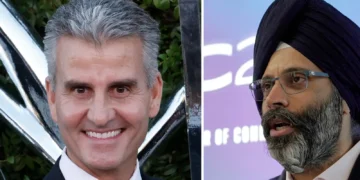
Japan’s chief trade negotiator, Ryosei Akazawa, abruptly canceled a scheduled visit to Washington on Thursday, citing unresolved issues over U.S. tariffs on Japanese automobiles and auto parts. The decision underscores the continued uncertainty clouding the U.S.-Japan trade relationship, despite a framework agreement announced earlier this summer.
According to Chief Cabinet Secretary Yoshimasa Hayashi, the trip was intended to further discussions on tariff reduction, but “certain points required further technical discussion.” Instead of face-to-face negotiations, talks will now continue at the administrative level until the sticking points are resolved.
The July Trade Agreement: Progress, But With Caveats
In July, the U.S. and Japan announced a landmark trade agreement aimed at lowering tariffs on Japanese goods. Under the deal, Washington agreed to reduce tariffs on a broad range of Japanese exports from 25% to 15%, in exchange for a $550 billion investment package from Tokyo.
This package, expected to be a mix of government-backed loans and guarantees, is designed to support infrastructure, technology, and defense initiatives in the United States. The agreement was widely celebrated as a symbol of economic cooperation between two of the world’s largest economies.
However, the agreement left ambiguity around automobile tariffs, an issue central to Japan’s economy and trade agenda. While tariffs on general goods were set to fall, there was no formal written confirmation that auto tariffs would also drop to 15%. For Japan, whose car industry is one of its biggest export sectors, this omission remains a major sticking point.
Japan’s Demand: A New Presidential Order
Tokyo is now urging the Trump administration to amend the existing executive order on reciprocal tariffs. Specifically, Japan wants Washington to issue a new presidential order that explicitly lowers tariffs on automobiles and auto parts to 15%.
Hayashi stressed that Japan expects a “sincere and prompt implementation” of the trade agreement and views clarity on auto tariffs as essential. Without this assurance, Japan fears that its auto industry could face continued uncertainty and potentially punitive costs in its most important foreign market.
One of the technical points at the heart of the dispute is the so-called “no-stacking” arrangement. Akazawa had stated in July that Washington promised tariffs would not accumulate beyond 15%, even in cases where additional reciprocal measures are applied.
This arrangement mirrors a deal the U.S. previously struck with the European Union, ensuring that tariffs remain capped. However, with no signed amendment to the U.S. presidential order, Japan remains skeptical. The absence of a written guarantee has made it difficult for Tokyo to reassure its powerful automobile sector and may explain Akazawa’s decision to delay his U.S. visit.
Uncertainty Around the $550 Billion Investment Package
The delay also raises questions about the $550 billion investment package, which was supposed to be a cornerstone of the U.S.-Japan agreement. Details of the package remain unclear, and its announcement has now been postponed due to Akazawa’s canceled visit.
Earlier this week, U.S. Commerce Secretary Howard Lutnick suggested that a “significant announcement” on the package was forthcoming. But with Akazawa remaining in Tokyo, the timeline for unveiling those details has become murky.
The lack of clarity risks undermining confidence in the trade deal, both in financial markets and within Japan’s corporate sector. For now, investors appear to be adopting a wait-and-see approach, with retail sentiment on the iShares MSCI Japan ETF (EWJ) sitting in neutral territory on trading platform Stocktwits.
The dispute highlights the ongoing tensions created by President Donald Trump’s protectionist trade policies. Since his first term, Trump has emphasized the need for reciprocal trade and has been willing to use tariffs as leverage against allies and rivals alike.
For Japan, securing lower tariffs on automobiles is not only an economic issue but also a political necessity. The auto industry is a critical part of Japan’s GDP and employment base, and prolonged uncertainty could create domestic political pressure on Prime Minister Fumio Kishida’s administration.
At the same time, Trump’s administration views tariffs as a strategic tool to encourage investment in U.S. manufacturing and secure better trade terms. This dynamic has made negotiations with close allies like Japan particularly complex.
Despit the cancellation, Japanese officials have not ruled out Akazawa traveling to Washington as early as next week, once the technical issues are resolved. Sources cited by Reuters suggested that progress is being made at the administrative level, and both sides remain committed to implementing the July agreement.
Still, the episode underscores how fragile the deal remains. Without clear written commitments on auto tariffs, Japan is unlikely to move forward with the investment package or send senior negotiators to Washington.
The cancellation of Akazawa’s U.S. trip is a reminder that even high-profile trade agreements can falter without detailed implementation. While the July U.S.-Japan deal was celebrated as a breakthrough, ambiguity around tariffs on automobiles and auto parts threatens to derail its momentum.
Until Washington issues a revised presidential order confirming tariff reductions and a no-stacking arrangement, Japan is unlikely to move ahead confidently. For now, the $550 billion investment package and the broader promise of closer U.S.-Japan economic cooperation remains in limbo.
With trade tensions lingering and both economies facing domestic challenges, the coming weeks will be crucial in determining whether the agreement solidifies into a landmark partnership or becomes yet another case of stalled diplomacy.