Amazon founder Jeff Bezos has weighed in on one of the tech world’s most pressing debates: whether artificial intelligence is experiencing a dangerous bubble. Speaking at Italian Tech Week in Turin on Friday, the billionaire entrepreneur acknowledged that AI is indeed in what he calls an “industrial bubble”—but he’s not necessarily worried about it.
Bezos offered a surprisingly optimistic take on the situation, arguing that while the signs of a bubble are clear, the underlying technology is legitimate and will ultimately deliver massive benefits to society, even if some companies crash and burn along the way.
Jeff Bezos on the Indiscriminate Investment Fueling the AI Boom
When Exor CEO John Elkann asked whether the current AI frenzy shows signs of a bubble, Bezos didn’t shy away from the question. He laid out the telltale characteristics that define speculative bubbles, and acknowledged that most of them are present today.
First, there’s the disconnect between stock prices and business fundamentals—a hallmark of any bubble. Second, there’s the overwhelming excitement that clouds rational judgment. “People get very excited like they are today about artificial intelligence,” Bezos noted.
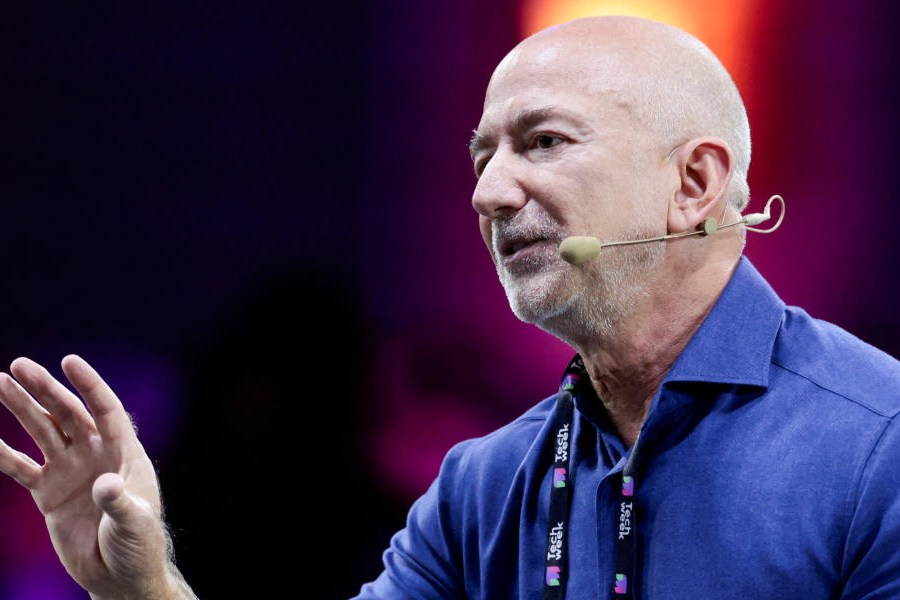
Perhaps most tellingly, Bezos pointed to the indiscriminate funding environment where investors struggle to separate promising ventures from doomed ones. “Every experiment or idea gets funded. The good ideas and the bad ideas,” he said. “And investors have a hard time in the middle of this excitement, distinguishing between the good ideas and the bad ideas. And that’s also probably happening today.”
Bezos even referenced a six-person company receiving billions in funding—calling it “very unusual behavior” that nonetheless reflects today’s reality, though he didn’t specify which company he meant.
Jeff Bezos Compares AI Boom to 1990s Biotech Bubble
Despite identifying these warning signs, Bezos maintained that the current situation isn’t cause for alarm. His key argument? The technology itself is real, not imaginary hype.
“That doesn’t mean anything that is happening isn’t real. AI is real, and it is going to change every industry,” Bezos emphasized.
He drew parallels to previous industrial bubbles, particularly the biotech and pharmaceutical boom of the 1990s. While many companies from that era eventually failed, the period also produced life-saving drugs that continue benefiting people today.
“The [bubbles] that are industrial are not nearly as bad, it can even be good, because when the dust settles and you see who the winners are, society benefits from those inventions,” Bezos explained. “That is what is going to happen here, too. This is real, the benefits to society from AI are going to be gigantic.”
Growing Chorus of Bubble Warnings
Bezos isn’t alone in raising concerns about AI valuations. The warnings have been mounting from various corners of the business world.
OpenAI CEO Sam Altman reportedly acknowledged in August that the AI market is in bubble territory. Meanwhile, Goldman Sachs CEO David Solomon struck a more cautious note at the same Italian Tech Week event, expressing concern about stock market levels driven by AI enthusiasm.
“When [investors are] excited, they tend to think about the good things that can go right, and they diminish the things you should be skeptical about that can go wrong,” Solomon warned. “There will be a reset, there will be a check at some point, there will be a drawdown.”
Karim Moussalem, chief investment officer of equities at Selwood Asset Management, went even further last week, suggesting that “the AI trade is beginning to resemble one of the great speculative manias of market history.”
Why Bezos Believes Today’s Tech Frenzy Will Leave Revolutionary Residue?
The bubble debate also evoked memories of the 2000 dotcom crash, where overvalued dotcom company valuations came tumbling down to earth. The bubble-era saw countless startups fail, wiping out billions of investor capital.
Bezos’s optimistic model, though, proposes that industrial bubbles have a remaining residue of useful infrastructure, knowledge, and innovations, as opposed to speculatively based bubbles. While the bubble of the internet killed off numerous enterprises, it also provided funding for the technologies and infrastructures that drive the current digital economy.
Whether that trajectory will be repeated by AI remains to be observed. For the moment, Bezos is wagering that after the dust settles and there’s the inevitable correction, society will have been left with revolutionary technologies that will have been worth the current frenzy even if companies and investors as individuals do not all survive the process.