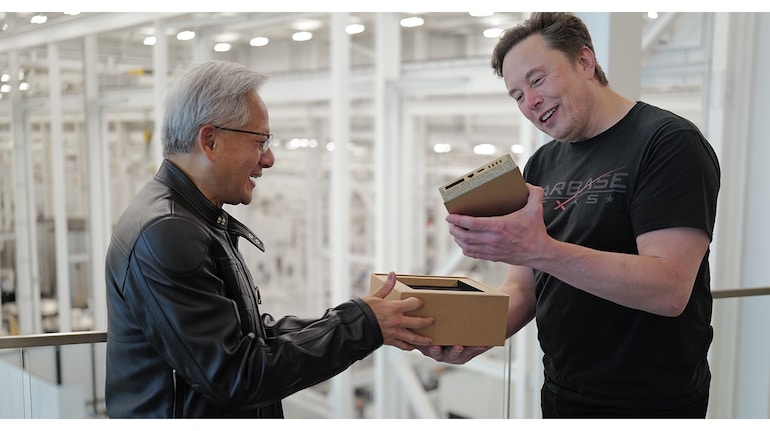
Jensen Huang doesn’t have typical product launches. Nvidia’s CEO went to SpaceX’s Texas base with something unexpected tucked under his arm the DGX Spark, a supercomputer that fits in a backpack but that’s powerful enough to run models of AI and has a parameter count of 200 billion.
The timing couldn’t have been more dramatic. Huang arrived as SpaceX prepared for the 11th test flight of Starship, the towering rocket that’s become synonymous with humanity’s interplanetary ambitions. Against this backdrop of engineering ambition, Huang personally handed over what Nvidia is calling the world’s smallest AI supercomputer to Elon Musk himself.
“Imagine delivering the smallest supercomputer next to the biggest rocket,” Huang joked, embracing the absurd incongruity of the occasion. The two tech giants munched pizza with SpaceX engineers while exchanging tales of the bleeding edge.
Huang’s “Full-Circle Moment”: Shipping the Power-Packed DGX Spark to Musk
The shipment also included a personal element for Huang. He could vividly remember shipping the initial DGX system a few years back when it sparked the current AI surge. Shipping the DGX Spark to Musk in Starbase felt like “a full-circle moment” for him, a recollection of where the technology has been and where it has yet to be.
The DGX Spark may appear modest-looking, but its specs speak otherwise. It tips the scales at a mere 1.2 kilograms or roughly the weight of a thick book — and it packs a whole petaflop of AI brawn. That’s processing power that would have needed a whole warehouse’s worth of machinery a decade back, but has been compacted to a roughly novel-sized package.
At its heart is Nvidia’s GB10 Grace Blackwell Superchip, the latest from the company in the processing of AI. The system is endowed with 128GB of unified memory, so it will take the big AI models in its stride without bottlenecks. NVLink-C2C connectivity and NVMe storage round out the package, gearing developers for serious work in AI.
The DGX Spark Makes AI Power Accessible
What’s so appealing about the DGX Spark isn’t the sheer power, it’s the accessibility. Nvidia has included the device in its entire AI software stack: Cosmos, Qwen3, and NIM microservices.
This way, the end-user doesn’t have to begin writing programs for making their own image generators or designing their own summarization software or chatbots. Everything comes pre-packaged and ready to roll. No cloud services need to be subscribed to, no time spent waiting for far-off servers to respond.
The DGX Spark isn’t being positioned by Nvidia as a new piece of merchandise but rather a statement about where AI is going. For years, the conversation around artificial intelligence has been about gargantuan cloud data centers and billion-dollar compute clusters. The DGX Spark is something different: the democratization of the forces of AI.
“A petaflop of AI performance in everybody’s arms’ reach,” Huang expounded when outlining Nvidia’s dream of making professional-level AI gear accessible to individual researchers, software developers, and independent makers. It’s the difference between renting time for a computer by the hour versus having your own AI research lab.
From Cloud to Core, The DGX Spark and the Decentralization of AI Power
That’s significant for a variety of reasons. Local AI processing is better for security because your sensitive data never leaves your device. It’s lower latency, because your workflow isn’t slowed by network delay. It’s independent no reliance on internet connections or subscription services to have access to world-class AI capabilities.
The DGX Spark arrives at a pivotal moment for AI development. As models become more sophisticated and applications more diverse, the industry faces a choice: concentrate power in massive cloud facilities or distribute it to individuals and small teams. Nvidia is clearly betting on both futures, but the DGX Spark shows where the company sees the most creative potential.
For SpaceX and Elon Musk, the uses are interesting. From designing the most efficient rocket configurations to processing telemetry streams, a mobile supercomputer could create new opportunities in aero engineering.
But the true tale may be when thousands of programmers take this technology and begin to stretch its limits in ways that no one imagined.